
Meta description: The best vitamin E foods at a glance with exact mg per serving, NIH-backed tips, and quick meal swaps to reach 15 mg a day without supplements.
Why Vitamin E Matters and How Much You Need
Skin that looks calm, cells shielded from oxidative stress, immune defenses ready to go. Vitamin E helps with all that, acting as a powerful antioxidant that protects cell membranes. That is the big picture, and it is practical.
The NIH Office of Dietary Supplements sets the recommended intake for adults at 15 mg a day of alpha-tocopherol. You can reach it with food. Oils, nuts, seeds, avocado and leafy greens do the heavy lifting.
Best Foods Rich in Vitamin E: Oils, Nuts, Seeds, Veggies
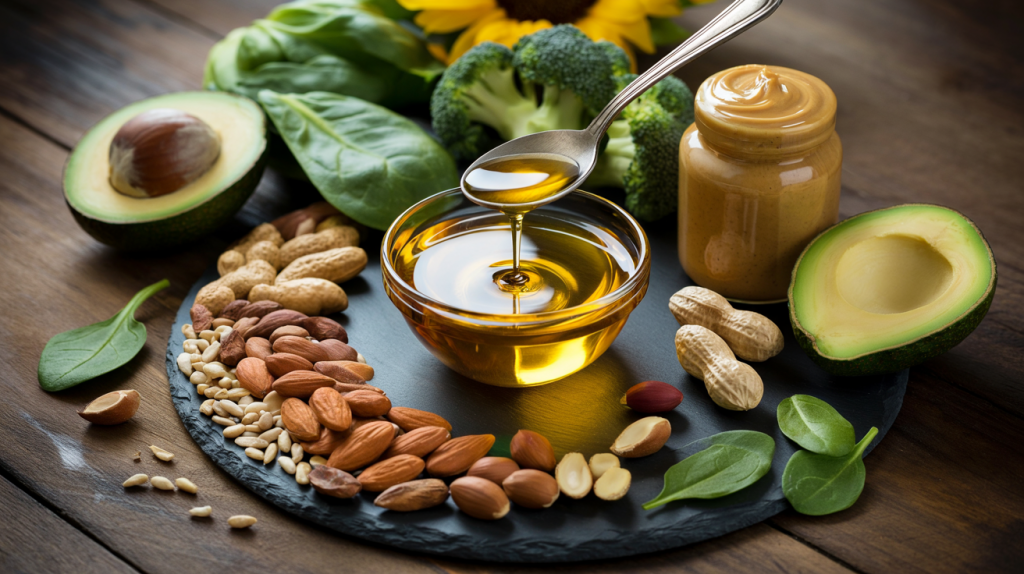
Here are top choices with precise amounts per common serving, drawn from the NIH Office of Dietary Supplements and USDA FoodData Central. Simple, reliable, and grocery-list ready.
- Wheat germ oil, 1 tablespoon : 20.3 mg
- Sunflower seeds, dry roasted, 1 ounce : 7.4 mg
- Almonds, dry roasted, 1 ounce : 6.8 mg
- Sunflower oil, 1 tablespoon : 5.6 mg
- Safflower oil, 1 tablespoon : 4.6 mg
- Hazelnuts, 1 ounce : 4.3 mg
- Peanut butter, 2 tablespoons : 2.9 mg
- Peanuts, dry roasted, 1 ounce : 2.2 mg
- Avocado, half fruit : 2.1 mg
- Spinach, boiled, 1/2 cup : 1.9 mg
- Broccoli, boiled, 1/2 cup : 1.2 mg
Sources : NIH Office of Dietary Supplements “Vitamin E Fact Sheet” and USDA FoodData Central listings for alpha-tocopherol per serving.
Smart Ways to Eat More Vitamin E Every Day
The main idea is straightforward. Most of the vitamin E in diets comes from plant oils and nuts, so small swaps move the needle quickly.
Common mistake seen in kitchens every day: cooking everything on high heat with delicate oils, then discarding the pan drippings. Use stable oils for high heat, and add a spoon of sunflower or wheat germ oil after cooking to preserve vitamin E in the dish.
One concrete plate example that people actually eat. A snack of 1 ounce almonds gives 6.8 mg. Add half an avocado at lunch for 2.1 mg. Drizzle 1 tablespoon sunflower oil on roasted vegetables at dinner for 5.6 mg. Total : 14.5 mg. That is essentially the day’s target, and it tastes good.
Vitamin E is fat soluble, which helps absorption when the meal contains fat. Nuts, seeds and oils already include it, so the body does the rest without extra effort.
Safety, Labels, and When Supplements Enter the Chat
Labels can look confusing. Vitamin E often appears as alpha-tocopherol on ingredient lists. Natural and synthetic forms exist, and doses differ on bottles.
The tolerable upper intake level for adults is 1,000 mg a day of supplemental alpha-tocopherol according to the NIH Office of Dietary Supplements. That number is far above what food alone provides, so routine meals stay well within safe limits.
Supplements may be useful in specific medical situations, guided by a clinician. For most healthy adults, food first remains the simplest route. A small bottle of wheat germ oil, a bag of almonds, a jar of peanut butter – these pantry basics definitly cover the gap.
If comparing products, look for alpha-tocopherol content per serving and keep the daily diet in view. Once the plate regularly includes nuts, seeds, and a vitamin E rich oil, the numbers line up without trying.