
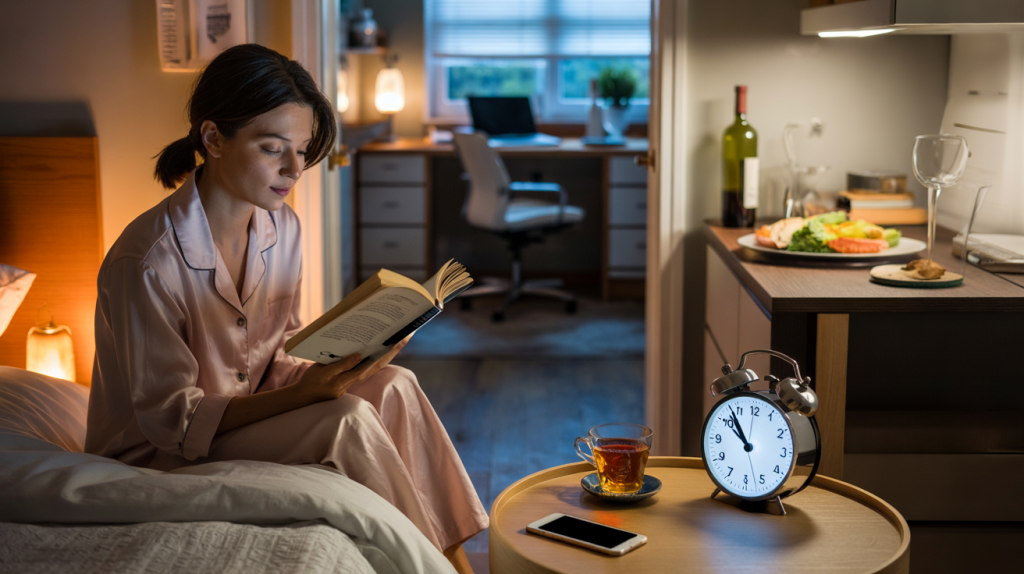
Staring at the ceiling again at midnight The 3-2-1 sleep method has taken off for one reason : it strips bedtime down to a clear countdown that nudges the brain to power down. Three hours, two hours, one hour – each step removes a proven sleep wrecker, so drifting off comes easier.
The context is stark. Short sleep affects about a third of adults in the United States, according to Centers for Disease Control and Prevention data from 2014 published in 2016 that pegged it at 35.2% (CDC). Big late meals keep body systems revving, blue light delays melatonin, and after-hours work keeps stress cycling. Cut to the chase : a timed evening routine tackles all three.
3-2-1 sleep method : what it is and why it works
The idea is simple. Use the clock as a cue to glide toward sleep, not crash into it. Rather than juggle ten hacks, this rule stacks three moves that remove frictions most people face on weeknights.
At its heart, the 3-2-1 sleep method means :
- 3 hours before bed : no heavy meals or alcohol.
- 2 hours before bed : stop work and mentally demanding tasks.
- 1 hour before bed : screens off and switch to a calming routine.
Why those levers Working digestion and alcohol both disturb normal sleep architecture. The Sleep Foundation advises avoiding large meals for at least 2 to 3 hours before bedtime, guidance updated in 2023 (Sleep Foundation, 2023). Blue light is potent too : a Harvard Medical School experiment reported in 2012 found blue light shifted circadian rhythms by about 3 hours compared with 1.5 hours for green light, and suppressed melatonin more strongly (Harvard Health, 2012).
Science check : screens, late meals and after-hours work
Most people bring glowing rectangles to bed. In the 2011 Sleep in America poll, 95% of respondents used an electronic device within an hour of bedtime at least a few nights per week (National Sleep Foundation, 2011). The American Academy of Sleep Medicine advises turning off electronics at least 30 minutes before bed, a baseline that the 3-2-1 method stretches to a full hour for more relief (AASM).
Food timing matters. Digesting a large, late dinner raises metabolic activity when the body should be winding down. Sleep specialists recommend finishing heavy meals 2 to 3 hours before lights out. Alcohol deserves a separate note. Reviews summarized by the Sleep Foundation describe initial sedation followed by more awakenings and reduced REM later in the night, a tradeoff that undercuts restorative sleep even when the first minutes feel drowsy (Sleep Foundation, 2023).
Then there is work spillover. The expectation of evening responsiveness keeps cortisol elevated and attention fragmented. Research published in 2018 connected after-hours email expectations with poorer sleep quality via increased anxiety, even when people did not actually work more that evening (Academy of Management Discoveries, 2018). Putting a 2 hour buffer creates a psychological boundary that lets the mind decelerate.
How to use the 3-2-1 rule tonight
Start with your target bedtime and count backward. If 11:00 pm is lights out, wrap dinner by 8:00 pm, close work by 9:00 pm, and begin screen-free wind down at 10:00 pm. A little planning goes a long way.
For the 1 hour window, choose low-stimulation cues : warm shower, paper book, gentle stretches, soft playlist, a short gratitude note. That hour is not a productivity slot. It is a glide path.
Handle stimulants earlier in the day. Caffeine has a half-life of about 5 to 6 hours in healthy adults, meaning an afternoon latte can still be active late at night (U.S. Food and Drug Administration guidance, 2018 – FDA). If sleep has been fragile, shift caffeine to mornings only for a week and reassess.
Troubleshooting : when sleep still will not come
Consistency beats perfection. A 3-2-1 routine on most nights trains the brain to expect rest. Miss a step once in a while It will be fine. Aim for the pattern, not a perfect streak – that mindset definetely helps adherence.
Light and temperature can stall progress. Dim overheads in the last hour and favor warm-tone lamps. Keep the bedroom cool, quiet and dark. If thoughts race, try a brief notebook dump or a 4-7-8 breathing set, then return to stillness without clock-checking.
Persistent insomnia needs a different toolkit. The American Academy of Sleep Medicine defines chronic insomnia as difficulty falling or staying asleep at least 3 nights per week for 3 months or more, with daytime impact (AASM, ICSD-3, 2014). In that case, ask a clinician about cognitive behavioral therapy for insomnia, which major guidelines list as first-line care.