
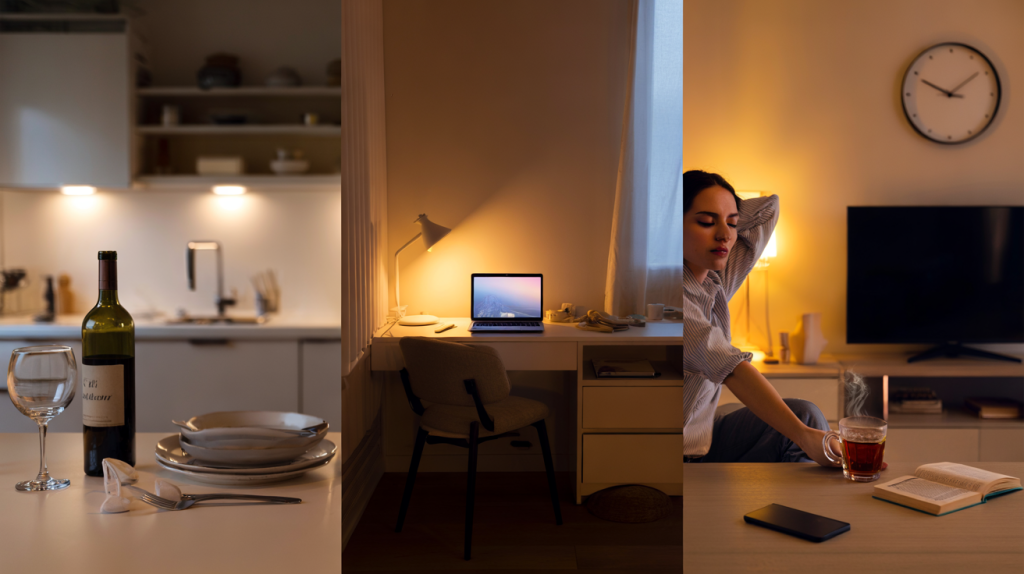
Sleep is fragile. Yet a clear routine can tilt the odds in your favor. The 3-2-1 sleep rule, known in French as the “règle 3-2-1 sommeil”, sets a calm countdown to lights out : three hours without heavy meals or alcohol, two hours without work, one hour without screens.
The timing matters. “About 1 in 3 adults in the United States do not get enough sleep” (CDC, 2016 : https://www.cdc.gov/media/releases/2016/p0215-enough-sleep.html). The American Academy of Sleep Medicine states : “Adults should sleep 7 or more hours per night on a regular basis to promote optimal health” (AASM, 2015 : https://aasm.org/review-of-healthy-sleep-duration-for-adults/). The rule gives a realistic path toward that benchmark, starting this evening.
3-2-1 Sleep Rule : what to do and when
The idea is simple. Tidy the evening so the body can ease into sleep rather than slam the brakes at midnight. Here is the plan, straight and practical.
- 3 hours before bed : stop large meals and alcohol. “Alcohol may help you fall asleep faster, but it reduces rapid eye movement (REM) sleep” (Sleep Foundation, 2024 : https://www.sleepfoundation.org/nutrition/alcohol-and-sleep).
- 2 hours before bed : end work and intense problem solving. This lowers mental arousal so the mind is not racing at lights out.
- 1 hour before bed : screens off. Harvard notes that “Blue light suppresses melatonin for about twice as long as green light and shifts circadian rhythms by twice as much” (Harvard Health Publishing, 2012 : https://www.health.harvard.edu/staying-healthy/blue-light-has-a-dark-side).
Why timing works : food, stress and blue light under the spotlight
Late dinners change metabolism right when the body should wind down. In a controlled study, researchers reported : “We found that eating 4 hours later makes a significant difference for our hunger levels, the way we burn calories after we eat, and the way we store fat” (Brigham and Women’s Hospital, 2022 : https://www.brighamandwomens.org/about-bwh/newsroom/press-releases-detail?id=4315). Pulling the last meal earlier cushions that metabolic bump.
Evening work keeps the brain in go mode. Sleep specialists promote a buffer. AASM’s healthy sleep habits say : “Keep a consistent sleep schedule and establish a relaxing bedtime routine” (AASM, 2023 : https://sleepeducation.org/healthy-sleep/healthy-sleep-habits/). Closing laptops two hours before bed is a clean way to create that routine, so thoughts can settle instead of spiral.
Screens add a second problem. Blue light tricks the clock. Harvard’s findings on melatonin suppression and rhythm shifting explain why a show or doomscroll at 11 pm can push sleep later and lighten it. Practical tip from clinicians : “Stop using electronic devices 30 minutes before bedtime” (Sleep Foundation, 2024 : https://www.sleepfoundation.org/sleep-hygiene/healthy-sleep-tips). With the 3-2-1 rule, that buffer grows to a full hour.
How to apply 3-2-1 on a real weeknight
Say target bedtime is 11 pm. At 8 pm, finish dinner, keep it lighter than lunch, and skip that last glass. The kitchen closes, which quietly removes late-night grazing.
By 9 pm, wrap emails and tomorrow’s to do list. Write it down, park it, and step away from work zones. A short walk or a shower tells the body the day is closing.
At 10 pm, screens go dark. Switch to an audiobook, a paper novel, or gentle stretches. Dim lamps. If caffeine tends to sneak in, remember : “The half-life of caffeine is about 5 hours” (FDA, 2018 : https://www.fda.gov/consumers/consumer-updates/spilling-beans-how-much-caffeine-too-much). That afternoon espresso could still be humming. A decaf or herbal tea earlier in the evening fits better.
Mistakes to avoid and easy adaptations that keep flow
Biggest stumble is rigidity. A late family dinner or a show premiere happens. Shift bedtime by 20 to 30 minutes rather than skipping the routine entirely. Consistency wins across the week, not perfection in a single night.
Second stumble is swapping screens for bright lights. Even without a phone, strong overhead LEDs signal daytime. Warm, low lighting reduces that alerting queue in the last hour, especially alongside quiet activities.
Travel days complicate the countdown. If dinner lands late, still protect two steps : end work two hours before sleep and keep the last hour screen free. The body reads those cues clearly, even when meal timing slips.
Some evenings are noisy in the head. A pen and a small pad by the bed helps. Offload thoughts fast, then return to the wind-down. It looks simple, yet it is definitly effective for people who tend to ruminate at night.
One missing piece many forget is the morning. Bright light soon after waking anchors the clock, which makes the 3-2-1 runway even smoother at night. Then the cycle supports itself. The rule is not a cure, it is scaffolding that makes healthy sleep more likely, day after day.