
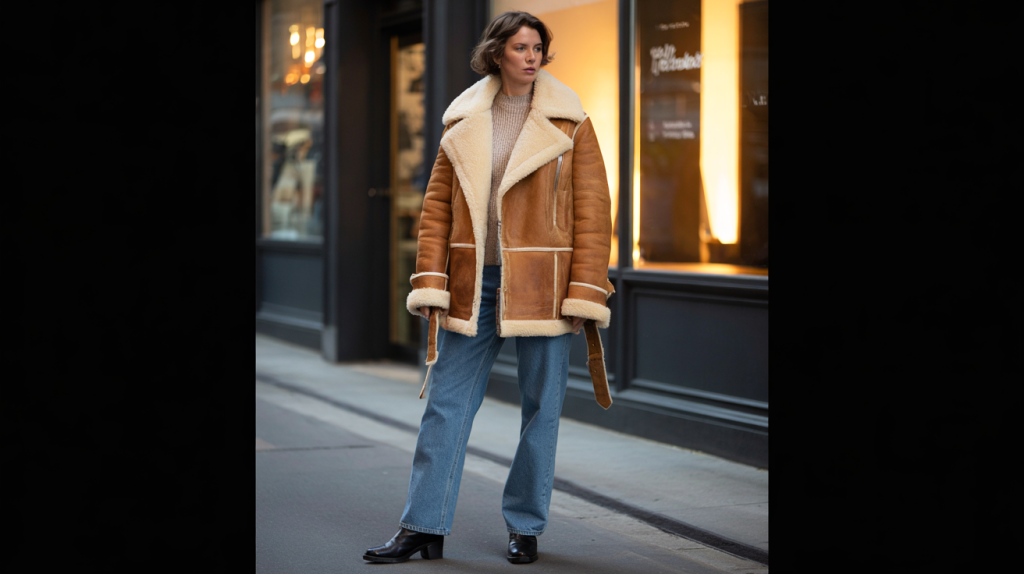
70s shearling jacket: the comeback with real warmth and character
Clicking for a 70s shearling sheepskin jacket makes sense right now. The coat looks luxe, keeps you warm, and anchors any outfit with that soft suede outside and plush wool inside. It is trending on runways and in resale at the same time, a rare sweet spot for style and longevity.
The shape is clear from the first glance. Boxy bodies, wide lapels, chunky seams, sometimes a belted waist. The origin story runs through the late 60s and early 70s. Levi Strauss and Co. introduced its sherpa lined Trucker in 1967, a mass market turning point that spread shearling to everyday wardrobes (Levi Strauss Archives, 2017). In the same decade, rock scenes in London and California popularized Afghan and Spanish style sheepskin coats now found in museum collections dated 1970 to 1975 (V&A Museum).
What makes an authentic 70s sheepskin coat different today
Real vintage uses full grain sheepskin with the fleece as the natural lining. No synthetic pile, no glued on faux fur. The panels are joined with visible bound seams and a weight you notice the moment you lift it. That heft is useful on cold days and signals durability that modern fast fashion copies do not match.
Function backs the romance. Wool fibers manage moisture and warmth in a way synthetics struggle to replicate. The Woolmark Company reports that wool can absorb up to 30 percent of its own weight in water before it feels wet, which helps regulate comfort in changeable weather (Woolmark). Simple, effective, and it has worked for decades.
Styling a 70s shearling jacket now without looking costume
Runway references keep the silhouette current. Fall Winter 2024 collections leaned into shearling collar trims and full coats, from minimalist lines to oversized pilots, which makes the vintage cut easy to plug into a modern wardrobe (Vogue Runway, FW24). The rule of thumb stays short and sharp on layers underneath. A ribbed knit, straight denim, leather ankle boots. Done.
Color cues help. Camel and tobacco shades read classic. Chocolate and black push it more urban. For a bolder 70s mood, a cream fleece with contrast seams pairs well with indigo jeans and a crisp white tee. Not a costume, just a grounded uniform with texture taking the lead.
Buying guide: how to spot the real deal and avoid heavy mistakes
The most common regrets come from weight, smell, and fit. Real sheepskin is substantial and has a clean, slightly lanolin scent. Mustiness signals poor storage and can be hard to clear. Fit runs snug in the shoulders for many 70s cuts, so outerwear measurements matter more than tagged sizes.
Sizing can trick the eye. Vintage European labels read smaller, and fleece volume eats into armhole space. Ask for shoulder width and underarm to underarm in centimeters. You want movement over a sweater, not a coat that looks amazing on a hanger and stays there. A quick test at home works too. Try it over your heaviest knit and reach forward. If the back pulls tight, size up.
Here is a quick checklist to make selection easy:
- Check the edge seams and turn them gently. Leather should not crack or flake at stress points.
- Look for uniform fleece density, especially at cuffs and collar where wear shows first.
- Press a damp cloth on an inside seam. Color should not bleed noticeably.
- Confirm panel symmetry by laying the coat flat. Uneven fronts suggest later alterations.
- Ask for natural light photos to judge patina rather than studio lighting that hides scuffs.
Care, repairs, and sustainability that actually add up
Care stays low tech. Use a soft suede brush on the exterior and let the coat air after wear. For stains, dab with a barely damp cloth and avoid soaps that strip oils. When in doubt, a specialist leather cleaner beats home experiments. Many small fixes are straightforward. Loose seam binding, replaced buttons, a re stitched pocket. These repairs return structure without changing the vibe.
Keeping a vintage coat in rotation has measurable impact. The UK charity WRAP found that extending the active life of clothing by nine months can reduce carbon, water, and waste footprints by 20 to 30 percent on average (WRAP, 2012). That stat meets the reality of a garment built to last. A 70s sheepskin jacket repaired once is often good for years, sometimes decades.
Authenticity signals and where to find them
Provenance helps, although labels vary. Some Spanish made coats display “Made in Spain” stamps on leather facing strips. Afghan pieces from the early 70s may have hand painted embroidery at hems. Levi’s sherpa lined jackets carry lot codes and care tags that changed after 1971 when the capital E on the red tab switched to lowercase, a useful dating detail referenced by Levi Strauss and Co. archives in 2017 (Levi Strauss Archives). These cues do not replace condition checks, they simply support them.
Final step before buying is comfort in real life. The coat should feel balanced at the shoulders and move when you move. If shopping online, request a 10 second video of the jacket on a hanger being lifted and turned. You see stiffness, seam strain, and shine from over conditioning immediately. Smart, quick, definitly worth asking.