
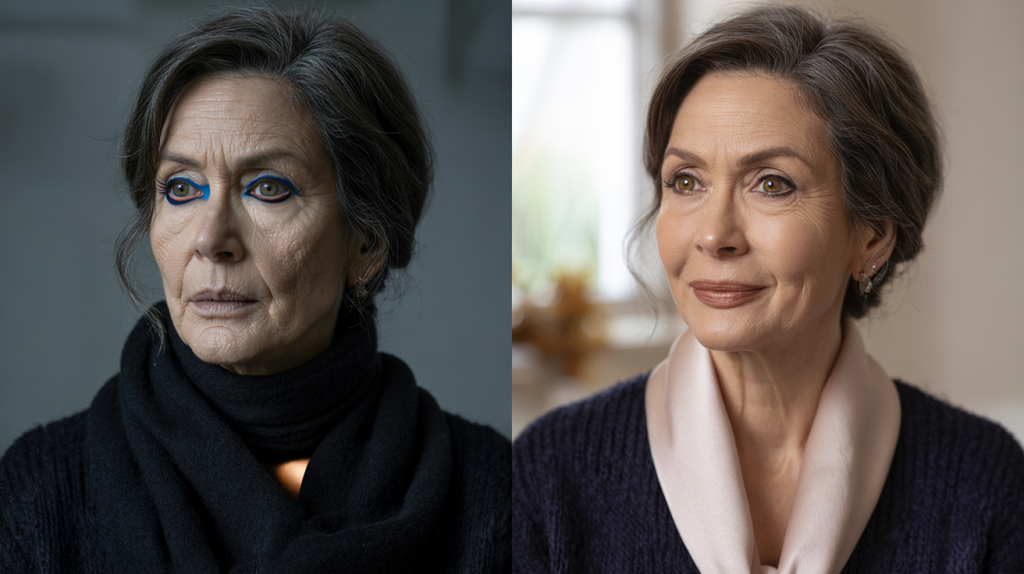
One glance. That is all it takes for a sweater or lipstick to sharpen lines, dull brightness, or make teeth look off. Color lives right under the face, so the wrong shade can add years in seconds while the right one lifts everything.
Past 50, skin looks thinner, hair often lightens, brows and lips lose pigment. The net effect : less built‑in contrast between features and skin. That shift makes some shades suddenly feel severe, even if they once felt perfect.
How color changes the face after 50
Researchers have mapped this. In 2013, a study in PLoS ONE led by Aurélie Porcheron showed that older faces display lower facial contrast, and that increasing that contrast makes faces look younger across samples in France and China (Porcheron, 2013). In plain terms : strong color next to the skin either amplifies the contrast that is missing or overpowers it, creating harsh edges and deeper-looking shadows.
So which color ages the face after 50? For most complexions, jet black worn close to the face is the number-one culprit. Pure, inky black creates a very high contrast wall. It throws every tiny shadow into relief, exaggerates under-eye circles, and can drain warmth from the skin. Great for drama on stage, less forgiving in daylight.
The culprit shade and its lookalikes
Think black turtlenecks, crewnecks, scarves, blue-black eyeliner, even blue-black hair dye. All sit near the face and bounce darkness upward. On camera and in mirrors, that reads as sharper nasolabial folds, sallow cheeks, and a tighter mouth line. Close seconds : stark optic white that glares against mature skin, ashy greige that leans gray, and neon brights that echo redness.
The aging of skin itself magnifies the effect. Ultraviolet exposure accelerates texture and tone changes through the years. The American Academy of Dermatology notes that SPF 30 filters about 97% of UVB rays and that only broad-spectrum sunscreen protects against UVA, the rays tied to photoaging (AAD, accessed 2025). When tone is uneven, very dark or very stark colors can spotlight that unevenness. Add harsh indoor lighting and the result looks older than it is.
Smart color swaps that lift skin tone after 50
Here are simple wardrobe and beauty shifts that soften features without losing style :
- Trade jet black tops for deep navy, charcoal, espresso or aubergine. Same sophistication, less shadow.
- Swap optic white for soft ivory, ecru or light stone. These reflect light without glare.
- Replace ashy greige near the face with camel, oatmeal or warm taupe to restore a touch of warmth.
- Switch neon fuchsia or orange for raspberry, rosewood or tomato red with a creamy finish.
- Choose medium-value lipstick rather than very dark or very pale. A subtile sheen adds dimension.
- Pick softly reflective metals : warm gold or rose gold when skin looks sallow, light silver when skin runs cool.
Makeup, hair and fabric : small tweaks, big difference
Makeup that boosts facial contrast looks fresher on mature faces. A 2011 PLoS ONE study by Nancy Etcoff found visible makeup increased perceived attractiveness in first impressions, which tracks with the contrast principle (Etcoff, 2011). Try a creamy rose or peach blush placed slightly higher than the cheek hollow, a defined brow that matches hair depth, brown or charcoal liner instead of black, and black-brown mascara. The goal : clear edges without hard lines.
Hair color plays into the same story. Blue-black or very ashy dark shades can harden features. Softer dark brown, a neutral chocolate, or dimensional highlights bring back the contrast between eyes, lips, and skin without the severe border of pure black. Texture matters too. A matte, heavy knit or a high neck traps shadow under the chin; a V-neck or open collar in a mid-tone lets light hit the face. Even a small scarf in the right ivory can act like a reflector.
Lighting and timing count. Outdoor midday sun is blunt. Early morning, late afternoon, or a window with diffused light treats skin kindly. Sunscreen habits do their quiet work daily : SPF 30 or higher, broad spectrum, and enough product to reach that 97% UVB filtration noted by dermatologists. Color choices then become the polish on top of skin that already looks looked-after.