
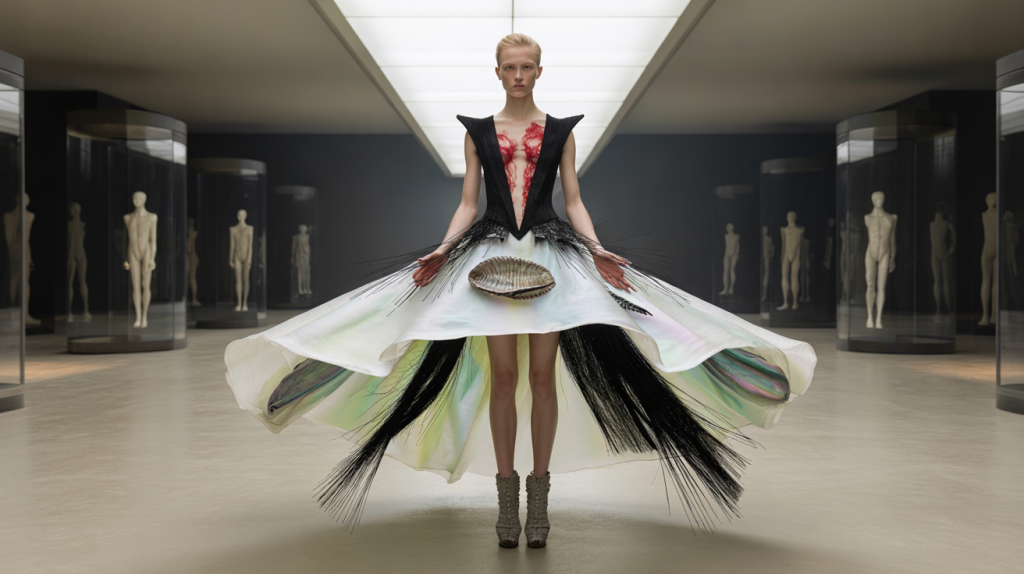
An Alexander McQueen archive dress still electrifies a room. The cut, the drama, the daring that rewired fashion in the 1990s and 2000s now powers one of the most fevered hunts in luxury collecting.
Here is the context that matters right now : Alexander McQueen launched his label in 1992, died in 2010 aged 40, and left a body of work museums and collectors guard closely. The Met’s 2011 exhibition “Alexander McQueen : Savage Beauty” drew 661,509 visitors, while the Victoria and Albert Museum’s 2015 edition welcomed 493,043. Those numbers tell the story. The archive dress moved from runway headline to cultural artifact, and demand never looked back.
Why an Alexander McQueen archive dress still stops time
McQueen’s dresses carry architecture and emotion in equal measure. Precision cutting sculpts the body, corsetry locks in a posture, then a burst of fantasy flips the narrative. That duality reads instantly in photographs and even stronger in person.
Scarcity also speaks. Many runway dresses were produced in tiny quantities, sometimes one sample and a handful for press or clients. When the designer’s own era closed in 2010, the timeline froze. Each piece became a finite chapter of that story.
The house continued under Sarah Burton from 2010 to 2023, adding celebrated gowns and red carpet moments. With Seán McGirr’s appointment in 2023, curiosity around earlier eras intensified again. Collectors keep circling back to the source.
Key runway moments to know : Highland Rape to Plato’s Atlantis
Understanding the landmark collections helps decode what qualifies as significant archive. It also clarifies why certain dresses anchor museum displays and auction catalogues.
Four pivotal dresses regularly cited by curators and collectors stand out :
- “Highland Rape” Autumn Winter 1995 : torn lace and tartan gowns that fused vulnerability with defiance.
- “Joan” Autumn Winter 1998 : severe tailoring against blood red lace, a study in beauty and fear.
- “No. 13” Spring Summer 1999 : the white strapless dress spray painted by robots on Shalom Harlow, an image now etched in fashion history.
- “Widows of Culloden” Autumn Winter 2006 : ethereal organza and the Kate Moss hologram that paused the world.
Then came “Voss” Spring Summer 2001 with shell and razor clam dresses that challenged the idea of couture materials. “Plato’s Atlantis” Spring Summer 2010 closed the chapter with future facing prints and the now famous Armadillo silhouette. The runway chronology creates a map. A real archive dress usually traces clearly to a look, a model, a moment.
What drives demand : collectors, museums, and record visibility
Museums set the floor for cultural value. The Met and V&A visitor totals above keep echoing in the market every season. When exhibitions travel, search interest spikes and private consignments follow.
Celebrity provenance occasionally amplifies a piece. A runway dress later worn by a major artist or on a significant red carpet attracts broader attention and a different bidder pool. That said, the most consistent demand still focuses on runway looks tied to the shows listed by date and title.
Established platforms validate the space. Kerry Taylor Auctions in London has long specialized in historical fashion including McQueen. Christie’s and Sotheby’s have included McQueen in dedicated fashion and design sales. Reputable dealers use museum catalog references such as “Savage Beauty” 2011 to anchor descriptions. Transparent paperwork lowers risk in a category that does not accomodate guesswork.
How to assess an Alexander McQueen archive dress today
Start with the runway match. Confirm season, look number if available, and construction details that align with images from trusted archives like the Met, V&A, or SHOWstudio. Small deviations can be normal, but the architecture should sing the same tune.
Provenance matters. A documented path from runway or press sample to collector, plus invoices or loan letters, helps. Museum catalog citations add another layer. If a piece appears in “Alexander McQueen : Savage Beauty” 2011 or in the V&A 2015 edition, that reference often appears in serious sales documentation.
Condition is the practical filter. Many dresses include delicate lace, plume, shell, or hand finishing. Request detailed condition reports and clear lighting photos. Restoration can be part of a dress’s life, yet any intervention needs to be disclosed plainly.
Then think storage and long term care. Acid free wrapping, breathable garment bags, and climate stability keep natural materials from tiring. For display, short durations under low light protect color and fabric memory.
New to the category and want a starting point that feels confident : focus on runway documented looks from 1995 to 2010, backed by paperwork and museum comparable examples. Work with specialists who can cite sources by title and date, not just adjectives. The right archive dress will read like a complete sentence the moment it walks into the room.