
Meta description : A clear, empathetic analysis of Annie Ernaux’s work : themes, style, dates, and the right reading order of the 2022 Nobel laureate.
Annie Ernaux, from Nobel spotlight to daily life dissected
In 2022, the Swedish Academy awarded Annie Ernaux the Nobel Prize in Literature “for the courage and clinical acuity with which she uncovers the roots, estrangements and collective restraints of personal memory”. That single sentence sets the frame. Her project turns private life into social evidence, tracking how class, gender, and history write themselves into the body. It resonates now because the questions at stake – who gets to speak, whose memory counts – are shared by millions.
Facts anchor her story. Born in 1940 in Normandy, published since the 1970s, Ernaux has built a compact, rigorous body of work where autobiographical episodes become collective mirrors. “La Place” (1983, Prix Renaudot 1984) revisits her father and class ascent. “Les Années” (2008) braids personal recollection with postwar France as a common memory. “L’Événement” (2000) recounts an illegal abortion in 1963 – later adapted as “Happening”, winner of the Golden Lion at Venice in 2021. The Nobel check in 2022 stood at 10 million Swedish kronor. The recognition placed her among the Academy’s count of 17 women laureates since 1901.
Autosociobiography, explained : how Ernaux fuses self and society
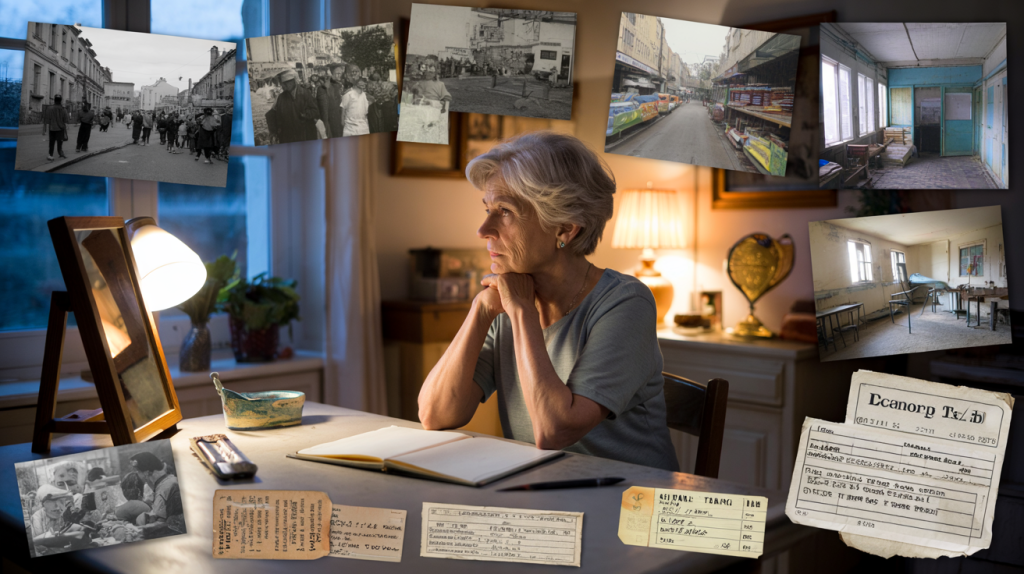
The main idea is straightforward. Ernaux’s books treat the self as a document of the times. She calls this approach a socio-literary inquiry where the “I” is less confession than lens. The observation is clear : details of grocery shops, train rides, school grades, the price of a dress, all become evidence of class codes and power.
Readers often face a problem that can be solved : where does memoir end and social science begin. Ernaux resolves that tension by stripping style to almost neutral phrasing. Dates, places, and observed gestures carry the argument. “Les Années” compiles photos, slogans, brand names, headlines across 1940s to 2000s France, turning a life into a timeline of shared signs.
Across the books the stakes repeat with variations. “La Place” maps class mobility and its cost in speech, manners, and shame. “La Honte” (1997) traces how a single family event reshaped perception. “Passion simple” (1991) observes desire with ledger-like honesty. “L’Événement” documents risk, stigma, and the law’s grip on a woman’s body in 1963 France – a country where abortion became legal in 1975 under the Veil Law. In 2021, Audrey Diwan’s film “Happening” brought that past into the present, the Golden Lion amplifying Ernaux’s testimony beyond the page.
Form and voice : the power of a so-called flat style
Advice often given to new readers is to expect precision, not lyricism. Ernaux avoids metaphor when facts suffice, lets short sentences accumulate until meaning clicks. The rhythm varies : notations, lists, temporal leaps, then a plainspoken line that reframes the whole scene. That choice isn’t an aesthetic whim. It is a method to keep attention on structures – school tracking, accent policing, price tags and their hierarchies.
One common mistake is to read her “flat” tone as coldness. It works like a microscope. Neutral vocabulary reduces the noise so that class shifts, gendered violence, and memory’s edits become visible. Diaries and notes enter the published text in “Journal du dehors” (1993) or “Mémoire de fille” (2016), where the archive of a young woman’s apprenticeship to adulthood is examined without excuse. The effect is cumulative rather than spectacular.
The numbers and dates help a lot. “Les Années” was published in 2008 and rapidly positioned as a signature work, a montage of decades where the “I” slides into “we”. The Nobel arrived in 2022, decades after “La Place” had already formalized her approach. The scale of recognition changed, the method did not. According to the Nobel Foundation, the prize that year amounted to 10 million SEK, and the Academy’s record confirmed Ernaux among a small cohort of women recipients since 1901.
Where to start : essential Annie Ernaux books, in a smart order
Readers often ask for a practical path into her oeuvre. A short list does the job, with a mix of themes and forms that sketch the whole project without redundancy. Definitly the easiest way to feel the scope and the craft.
- “La Place” (1983) : concise portrait of the father and class ascent, awarded the Prix Renaudot in 1984.
- “L’Événement” (2000) : the 1963 abortion account that later grounded the Golden Lion film “Happening” in 2021.
- “Les Années” (2008) : collective autobiography of postwar France, a keystone for understanding her method.
- “Passion simple” (1991) : intimate desire studied almost like a case file, revealing her documentary stance.
- “Mémoire de fille” (2016) : a return to youth, memory’s gaps, and the making of a writer’s gaze.
Why this sequence. It moves from origin to society-wide canvas, then back to intimacy and the workshop of memory. That arc mirrors Ernaux’s recurrent operations – locating self within class, measuring power on the body, using time as a comparative tool. The missing element, for many, is context, and the dates supply it : 1963 before legalization, 1975 after; a 1940 birth date anchoring a life lived alongside consumer growth, decolonization, student revolts, and feminist battles. This is how her pages turn private experience into public knowledge without stepping away from the facts.