
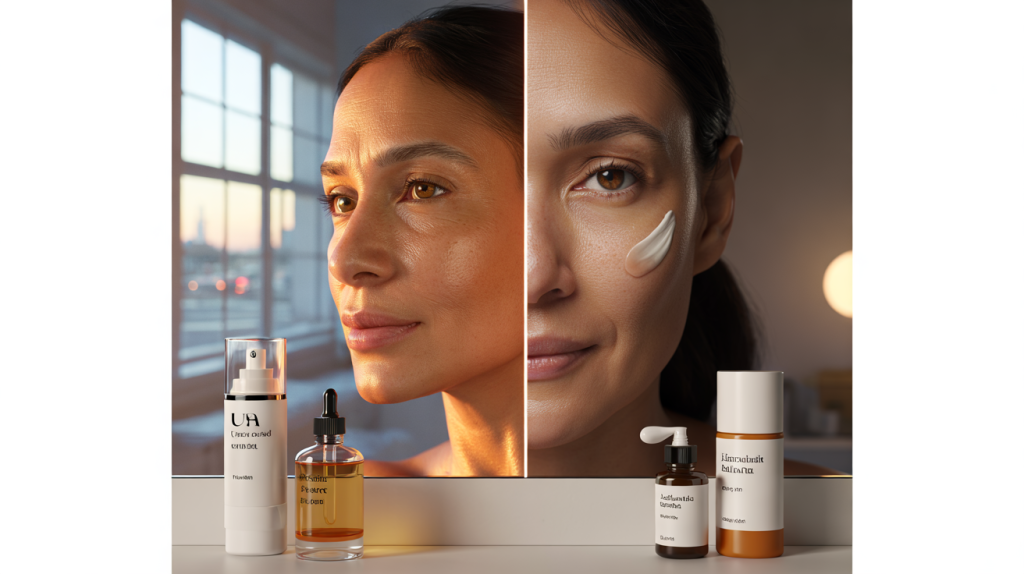
Dark spots and fine lines often land together. The fastest way to tackle both is a smart anti-dark spot and anti-aging routine built around daily sunscreen, a retinoid at night, and pigment-regulating actives that respect the skin barrier.
The numbers are clear. Research in 2013 linked up to 80% of visible facial aging to sun exposure, while a randomized Australian trial in the Annals of Internal Medicine showed daily SPF 15 reduced photoaging by 24% over 4.5 years. UVA accounts for about 95% of the UV that reaches us and passes through window glass, which explains why pigment and texture can worsen during commutes. This is why sunscreen plus targeted ingredients deliver the most reliable results for spots and age signs.
Anti-Dark Spot and Anti-Aging : Same Triggers, One Strategy
Here is the starting point : hyperpigmentation tends to follow inflammation, hormones or UV, and wrinkles deepen as collagen breaks down with time and light. The overlap is UV. So the routine that fades spots also slows lines when it prioritizes broad-spectrum protection, steady cell turnover, and calming of melanin overproduction.
Common obstacle seen everywhere : chasing five trendy serums at once. Skin reacts, redness flares, and the rebound pigment sets in. A simpler, paced plan works better, especially on reactive or melanin-rich skin where irritation can spark new marks.
American Academy of Dermatology guidance points to broad-spectrum SPF 30 or higher, reapplied every two hours outdoors. Pair that daytime shield with a nighttime retinoid to normalize cell turnover, then layer a brightening active that targets melanin transfer or tyrosinase. Less drama, more progress.
Morning to Night : A Calm, Effective Routine That Hits Both Goals
Short and practical beats complicated. The goal is steady protection by day and repair at night, with textures that people actually enjoy using, not endure.
Think in steps, not in products. Protection and pigment control in the morning. Renewal and recovery after dark. If skin is sensitive, alternate stronger actives on different nights to avoid aggresive overlap.
- AM : Cleanser, antioxidant serum such as vitamin C, hydrating layer with niacinamide, broad-spectrum SPF 30 or higher. Tinted sunscreen with iron oxides helps shield against visible light that can deepen discoloration.
- PM : Gentle cleanse, retinoid or retinal night, then azelaic acid or a targeted brightener on alternate nights. Finish with a barrier-supporting moisturizer rich in ceramides.
The Actives That Pull Their Weight : Retinoids, Vitamin C, Niacinamide, Azelaic Acid
Retinoids are the backbone at night. Decades of dermatology research show prescription tretinoin and over-the-counter retinol improve fine lines and uneven tone by promoting collagen and faster turnover. Start low, go slow, and buffer with moisturizer when needed.
Vitamin C by day helps on two fronts : it supports collagen and interferes with pigment formation. Stabilized L-ascorbic acid formulas are widely studied in dermatology literature, typically used between 10 and 20 percent. If stingy, swap to derivatives or use every other morning while the skin adapts.
Niacinamide is the calmer in the team. It reduces the transfer of pigment to surface cells and supports the barrier, which limits irritation-related darkening. Many derms recommend 4 to 5 percent for daily use. Azelaic acid, often at 15 to 20 percent, targets uneven tone and acne at once and suits sensitive or melanin-rich skin well.
For hormonally driven melasma, dermatologists may add hydroquinone in cycles or topical tranexamic acid. These are medical decisions. If discoloration worsens or plateaus after 8 to 12 weeks of careful home care, a professional review avoids months of wheel-spinning.
Timelines, Proof, and When to Go Pro
Results arrive in layers. Pigment often starts softening within 6 to 8 weeks of consistent sunscreen and brighteners, with retinoid-driven texture gains following over 12 weeks and beyond. This pacing is normal biology, not failure.
Why the sunscreen drumbeat keeps getting louder : the 2013 Annals of Internal Medicine trial tracked adults for 4.5 years and measured less photoaging with daily SPF 15. Pair that with the finding that UVA makes up about 95% of UV at ground level and passes through glass, and daily protection becomes the highest-yield step all year.
Clinic options can speed things up when home care stalls. Dermatologists use superficial chemical peels, microneedling in select cases, or lasers that target pigment. Settings matter a lot for darker skin tones because post-inflammatory hyperpigmentation risk is higher. A patch test and conservative parameters reduce that risk, and many clinics space treatments every 4 to 6 weeks to let pigment pathways cool down.
One last missing piece that often unlocks progress : reduce the triggers. Treat acne or eczema to stop new marks, manage heat and friction on the face, and use gentle, fragrance-free cleansers to keep the barrier steady. The routine stays simple, the science does the heavy lifting, and the mirror starts to cooperate.
Sources cited in text : International Journal of Cosmetic Science 2013 on photoaging drivers, Annals of Internal Medicine 2013 sunscreen-aging trial, American Academy of Dermatology sunscreen guidance, Skin Cancer Foundation on UVA proportion and window transmission.