
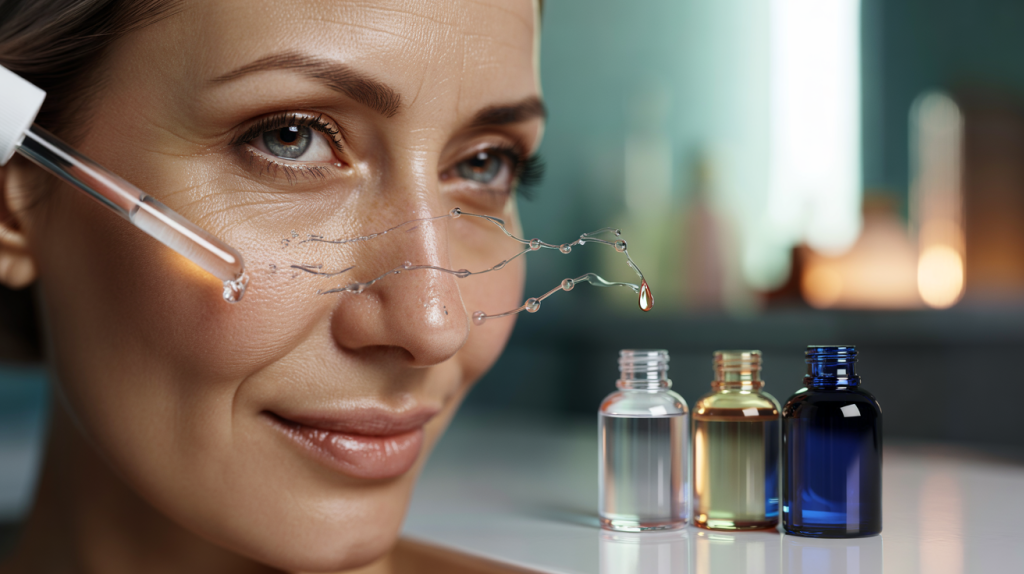
Lines staring back in the mirror often feel like a done deal. Enter anti-wrinkle peptides: short chains of amino acids designed to nudge skin into making more collagen or easing expression lines. They are not hype-only. Some have human data showing visible changes within weeks, with less sting than classic actives.
What to expect and when : certain formulas do more than moisturize. A 10 % acetyl hexapeptide-8 serum, known as Argireline, reduced wrinkle depth by up to 30 % after 30 days in a clinical study published in the International Journal of Cosmetic Science in 2002. Manufacturer data for palmitoyl pentapeptide-4, sold as Matrixyl, reported a 33 % reduction in wrinkle density after 8 weeks in 2005. Copper tripeptide GHK-Cu has also shown improvements in firmness and fine lines across 8 to 12 weeks in peer-reviewed work. Results vary with concentration, formula and patience.
Anti-wrinkle peptides : what they do and how fast they work
Peptides send signals that can encourage collagen, elastin and glycosaminoglycans. That signaling angle gives a gentler route for those who cannot tolerate nightly retinoids. Most users see subtle softening first, then texture looks smoother, then fine lines flatten.
Penetration still matters. The 500 Dalton rule published in Contact Dermatitis in 2000 notes that compounds above roughly 500 Da struggle to cross the stratum corneum. Many cosmetic peptides sit above that threshold, so delivery systems and carriers decide a lot of the outcome in the real world.
Timelines are slower than injectables. Argireline’s 30-day effect was measured on periocular wrinkles. Matrixyl’s 8-week change came from instrumental measurements on photoaged skin in supplier-run trials. Copper peptides typically need 8 to 12 weeks of steady use. And yes, sunscreen daily keeps those gains.
Argireline, Matrixyl and copper peptides : results you can verify
Argireline (acetyl hexapeptide-8) targets expression lines on the forehead and crow’s feet. In 2002, researchers reported up to a 30 % reduction in wrinkle depth after 30 days at 10 % concentration in the International Journal of Cosmetic Science. The study size was small, yet the numbers set the benchmark many shoppers look for.
Matrixyl (palmitoyl pentapeptide-4) and Matrixyl 3000 (palmitoyl tripeptide-1 plus palmitoyl tetrapeptide-7) act as signal peptides. Sederma’s 2005 dossier documented a 33 % reduction in wrinkle density after 8 weeks with consistent application. Vendor data is not the same as independent trials, so readers usually weigh it alongside user-visible outcomes.
GHK-Cu copper peptide supports extracellular matrix renewal. Multiple clinical and review papers between 2007 and 2015 describe improved skin elasticity and fine lines over 8 to 12 weeks, with good tolerance. The appeal : pairing firming benefits with a low risk of peeling or erythema compared with retinoids at equal usage.
Using peptide serums without mistakes : layering, dosing, patience
Many routines stall because of overcomplication. Peptides sit well after cleansing and before a mid-weight moisturizer. Thin-first rules still help : apply water serums, then emulsions, then creams.
Common pitfalls show up fast. Flooding skin with low pH acids right before a peptide can undercut comfort, and sometimes stability. Alternating nights with acids or vitamin C sidesteps that frustration. Another trap : expecting a Botox effect. Peptides soften, they do not paralyze.
A practical cadence keeps things moving. Argireline works best on the upper face, morning and night, especially along crow’s feet and the eleven lines. Matrixyl suits cheeks and smile folds where volume and collagen matter. Copper peptides fit night routines when the goal is bounce and density.
On regulation : in the United States, the Food and Drug Administration states that cosmetics do not require premarket approval as of 2022, so claims can vary by brand. Documented concentrations and transparent test data offer better predictability than vague marketing.
Smart shopping for peptides in 2025 : INCI names, concentrations, budget
Labels carry the clues. INCI lists tell you which peptide you are actually buying and how high it sits in the deck. Short tip : a peptide listed after fragrance usually means a very low dose.
Here is a quick checklist to pick well and use well.
- Look for clear names : acetyl hexapeptide-8, palmitoyl pentapeptide-4, palmitoyl tripeptide-1, palmitoyl tetrapeptide-7, copper tripeptide-1.
- Seek disclosed percentages : Argireline often at 5 to 10 %, Matrixyl around 2 to 3 %, GHK-Cu commonly 0.1 to 0.2 %.
- Prefer tested claims : cite to a journal and year, or a supplier dossier with method details and timepoints.
- Check vehicle design : serums with humectants and barrier lipids can help larger peptides do more.
- Pair with sunscreen : UV breaks collagen daily, so SPF preserves the smoother look you worked for.
Skin feel guides adherence. Peptides tend to play nice with sensitive or retinoid-intolerant faces, so daytime use is realistic. For faster visible change on etched lines, many dermatology clinics still point to retinoids, in-office energy devices, or neuromodulators. Peptides then steady the gains between visits.
One last piece ties the plan together. Consistency wins. Most studies measured change at 4, 8 and 12 weeks, not 4 days. A simple routine – cleanse, peptide, moisturizer, SPF – beats a crowded shelf every time. If redness or stinging shows up, pause and patch test before you recieve again.