
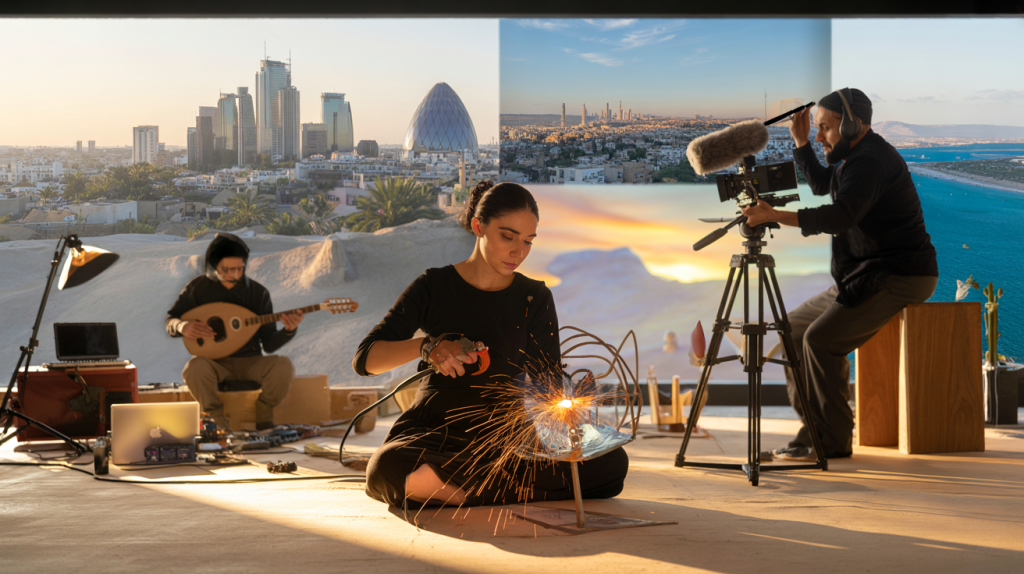
From London studios to Los Angeles writers’ rooms, Arab diaspora artists have slipped into the center of global culture. Sculptor Mona Hatoum challenges museum walls, comedian Ramy Youssef flips TV tropes, filmmaker Nadine Labaki brings Beirut streets to Cannes. Momentum shows in numbers too – the music business tracking the Middle East and North Africa as a growth engine, and biennials booking record international lineups.
The story is bigger than a trend. It’s a network of painters, filmmakers, designers and rappers who keep their roots while speaking to the world, and audiences respond. “Capernaum” by Nadine Labaki grossed over 68 million dollars worldwide in 2018, according to Box Office Mojo, after taking the Jury Prize at Cannes. Zineb Sedira carried the French pavilion at the Venice Biennale in 2022 – a headline that would have sounded unlikely a decade ago. This wave is remapping where taste is set and who gets the mic.
Arab diaspora artists rewriting the global stage
Here is the main picture: visibility is expanding, and gatekeeping thins when the work travels. Art Dubai’s 2023 edition hosted more than 130 galleries from over 40 countries, as the fair announced – proof that collectors and curators want cross-border dialogues and are paying for them.
On screen, the appetite is clear. Ramy Youssef won a Golden Globe in 2020 for Best Actor in a TV Series – Musical or Comedy. That win didn’t just crown a show. It signaled that nuanced Arab diaspora stories can lead prime-time conversations.
In publishing, awards have cracked open more shelves for Arabic voices. The International Booker Prize in 2019 went to “Celestial Bodies” by Jokha Alharthi, translated by Marilyn Booth – the first Arabic-language book to win that honor. Doors once half shut now stand ajar.
Names and milestones: from Mona Hatoum to Ramy Youssef
Mona Hatoum – London based, Beirut born – turned materials like glass and metal into tension and tenderness. Major institutions took notice. The Tate Modern presented a full-scale exhibition in 2016 that pulled wide audiences into her orbit.
Etel Adnan bridged painting and poetry with luminous color fields. “Etel Adnan: Light’s New Measure” ran at the Solomon R. Guggenheim Museum in 2021-2022, a late-career spotlight that cemented her global standing.
Nadine Labaki built a humanist cinema that travels. “Capernaum” landed an Academy Award nomination and moved beyond the arthouse bubble, with Box Office Mojo data marking that 68 million dollar-plus worldwide gross in 2018.
Zineb Sedira – French Algerian – staged a lyrical, politically sharp installation for France at the Venice Biennale 2022, confirmed by La Biennale di Venezia. Representation matters, but the craft is what keeps people in the room.
Tamino – Belgian Egyptian – carried a baritone that filled European halls while weaving Arab motifs into indie ballads. The result shows up in touring circuits and playlists that jump borders, ocasionaly overnight.
Data that matters: music, film, and galleries by the numbers
The music pipeline is accelerating. The IFPI Global Music Report 2023 names the Middle East and North Africa the fastest-growing region in 2022, up 23.8 percent year on year. Diaspora collaborations are part of that flywheel, helping tracks move between Arabic, French and English markets at speed.
Film keeps converting attention into receipts and awards. “Capernaum” crossed that 68 million dollar mark in 2018 per Box Office Mojo, rare for a Lebanese drama. Streaming then stretched the tail, making space for voices like Palestinian Algerian artist Saint Levant and Tunisian singer Emel Mathlouthi to reach unexpected geographies.
Exhibitions travel too. Sharjah Biennial 15 in 2023 gathered 150 artists from 70 countries, according to the Sharjah Art Foundation. That scale turns residency programs and cross-city collectives into real bridges for emerging diaspora artists.
Commercial platforms follow the art. Art Dubai’s 2023 tally – those 130-plus galleries – shows the market’s willingness to sustain risk, while institutions keep widening the lens.
Where to discover and support Arab diaspora artists today
Finding the work is easier when paths are clear. Start with platforms and festivals that consistently spotlight Arab diaspora voices, then branch out to indie venues and local bookshops hosting readings and pop-ups.
- Shubbak Festival in London – a biennial focus on contemporary Arab culture since 2011
- Arab Film Festival in San Francisco – long-running showcase for new directors and classics
- Liverpool Arab Arts Festival – multidisciplinary programming with a community thread
- Major museum programs and biennials – check Venice pavilions, Sharjah Biennial, and itineraries at Tate, MoMA, Guggenheim
- Streaming playlists curating Arabic and diaspora tracks – then dive into artist pages to catch collaborations
One practical tip helps: follow the curators. When a museum curator or festival director backs an Arab diaspora artist, the next three names in their lineup often rhyme – new voices with shared urgency, fresh forms and a willingness to cross languages.
Another lever is education. Workshops and residencies tied to festivals often publish open calls. The artists who seize those spots tend to surface a year later in galleries or on tour, creating a loop where visibility begets opportunity.
The pattern is simple and promising. Talent moves, audiences show up, and institutions adjust. Keep an eye on the calendars cited above, and let the work lead – the stories carry their own proof.