
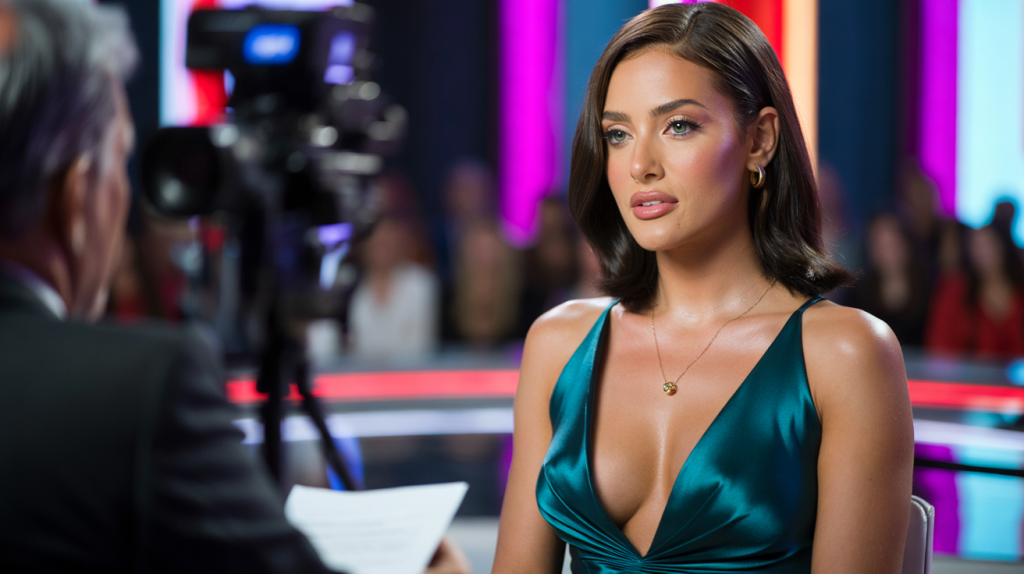
Aya Nakamura on Quotidien : a bold neckline, a bigger conversation
One look was enough. During her appearance on TMC’s show “Quotidien”, singer Aya Nakamura arrived in a plunging décolleté that instantly drew attention on and off screen. The segment, filmed in prime access and hosted by Yann Barthès, sparked waves of comments and headlines before the interview even wrapped.
Context matters here. “Quotidien” has been a key stage for pop culture moments since its launch in 2016, and its studio lighting, multi-camera pacing and social-friendly clips amplify any strong visual cue. When a global French pop star known for fearless style sits down in a striking dress, the camera reads it as a statement. Yes, the neckline was daring. The real story sits in the framing, timing and impact.
Why this TV outfit hit differently for Aya Nakamura
Main idea first : a TV set is not a red carpet. It is a controlled space where fashion becomes part of narrative. Aya Nakamura came to talk work – music, shows, projects – but the outfit spoke first because television compresses everything into a few seconds of impression. That is the problem fans and viewers face: a captivating look risks overshadowing the message if context is thin.
Observation next. “Quotidien” regularly attracts big audiences for its second part. According to Médiamétrie, the show hovered around the 2 million viewers mark in 2023, which means any bold choice will ripple widely the same evening. Multiply that by social replay and short clips, and a neckline becomes a headline. Not by accident, by media mechanics.
Perspective matters. Aya Nakamura’s public image has long intertwined with fashion-forward choices. Her breakthrough hit “Djadja” topped the Dutch charts in 2018 – a rare No. 1 abroad for a French-language single by a French female artist – and ever since, visuals have been central to her storytelling. The album “DNK” dropped on 27 January 2023, with artwork and styling that leaned into assertive femininity. Television simply magnifies that thread.
Common misreads, and how to read the moment like a media pro
A frequent mistake is to see only provocation. On a live or taped talk show, wardrobe serves three classic goals : recognisability, control of conversation, and alignment with current promo. A low neckline can push attention in the first seconds, then the interview steers it back to the topic – music, dates, collaborations. If the balance holds, both the look and the substance land together.
Another blind spot is the TV grammar itself. The “Quotidien” set uses close-ups and mid-shots that emphasize face and upper body. A deep décolleté reads stronger in that crop than it would on a wide-shot stage. That is why viewers feel the impact even more on mobile. A 15-second clip cut for social – the show’s team often posts highlights the same evening – can inflate a style cue into a cultural flashpoint.
A concrete example helps. When artists tour a promo cycle, the wardrobe evolves by step: neutral for morning radio, graphic for magazine shoots, iconic for prime-time TV. That laddering is planned days in advance with stylists and labels. The “Quotidien” appearance fits that mid-to-peak rung – high visibility, controlled length, clear imagery. The risk is simple: if the first frames get all the attention, the rest of the message must work harder to be heard.
What this says about image control, and what was still missing on set
Logical analysis first. Television compresses identity into a few images and quotes. Aya Nakamura’s choice leaned into a brand built over years – assertive, glamorous, unbothered – and the show’s format amplified it. With a studio known for quick edits and a lively audience, the visual took the lead by design. The interview then needed to lock in the artistic angle – new tracks, stage plans, collabs – to re-balance perception.
There is a practical solution that keeps both sides intact: pair a striking outfit with a single, crystal-clear news hook delivered early in the conversation. It could be a release date, a festival slot, or a chart milestone backed by a source. That anchor reduces drift. For an artist whose catalogue streams globally and whose “DNK” era started on 27 January 2023, the strongest move is to attach every standout look to a verifiable update. That way, the spotlight does not wander, it compounds.
One last point sits quietly behind the buzz. “Quotidien” is a mass-audience springboard, built since 2016 to turn culture into daily talk. When a star steps in with a powerful silhouette, the show does what it does best: it captures, reframes, circulates. The fashion moment is not the whole picture. It is the entry point – and, used smartly, the door to the art. Even if a few millons only came for the look, many stay for the music.