
Choosing the best caviar gift for Christmas made simple: taste profiles, trusted labels, real data and serving tips, in one fast read.
The right caviar gift lands softly but makes a statement. A small tin, a cold sparkle, and suddenly the table looks like Christmas should. The question is not whether caviar dazzles – it does – but which style, origin and size turn a pricey idea into a thoughtful present.
Here is the straight answer for most people right now : pick a fresh, malossol Oscietra or Siberian from a reputable farm, in a 30 g tin for two or 50 g for four, kept super cold and carrying a full CITES code on the lid. It tastes generous, feels luxurious, and stays on the right side of sustainability as most caviar sold today comes from aquaculture.
Best caviar for Christmas gifts: flavor first, then prestige
Main idea: the best gift caviar balances crowd-pleasing flavor with consistent texture. Oscietra (Acipenser gueldenstaedtii) brings nutty, buttery notes with medium grains. Siberian, often labeled Baerii (Acipenser baerii), is silkier and elegant, slightly briny with cocoa or dried-fruit hints. Beluga (Huso huso) remains the showstopper, but supply is tighter and prices jump fast.
Many shoppers get lost in color and grain size. Lighter amber is not automatically better. Freshness, handling and salting matter more than hue. Malossol – low salt – preserves nuance, typically under 5 percent salt according to Petrossian’s definition of the term (Source : Petrossian, brand literature).
Quick picks by profile and budget below. Short, practical, no jargon.
- Oscietra: medium grains, nutty-buttery, versatile gift that suits most palates.
- Siberian/Baerii: refined, clean, often better value at the same size.
- Sevruga: smaller grains, punchier sea notes, loved by classic purists.
- Beluga: large, delicate grains and long finish – prestige choice when splurge is the brief.
How to choose like a pro: labels, grading and that CITES code
Observation: the smartest caviar gifts are traceable. Every legitimate tin carries a non-reusable CITES code showing species, country of origin, year and lot number. Example codes include species abbreviations like HUS for Beluga, GUE for Oscietra and BAE for Siberian, as set by the universal labelling system adopted in 2004 and revised at CoP19 in 2022 (Source : CITES Resolution Conf. 12.7 Rev. CoP19).
Grading, often seen as 1 or 2, relates to grain firmness and homogeneity, not “quality” in some absolute sense. Fresh, non-pasteurized tins preserve the finest texture. Pasteurized caviar travels well and keeps longer, but texture tightens. For gifts that will be eaten within days, fresh usually delights more.
One practical check: tap the closed tin lightly. You want minimal movement – a sign the roe are well packed and cold. And yes, cold chain is everything. Caviar should arrive chilled, ideally around fridge temperature on ice packs, never warm to the touch.
Price, origin and sustainability: what the data really says
Problem to solve: gifting indulgence without ignoring the species behind it. In July 2022, the International Union for Conservation of Nature reported that 100 percent of sturgeon species are now threatened with extinction, with most classified as critically endangered (Source : IUCN Red List update, 21 July 2022). That is the stark backdrop.
Today, the market has largely shifted to aquaculture. WWF notes that the vast majority of caviar sold globally now comes from sturgeon farms rather than wild catch – over 90 percent – which helps ease pressure on wild stocks when done right (Source : WWF, caviar and sturgeon conservation pages).
Regulators tightened traceability to curb illegal trade. CITES has enforced a standardized, non-reusable label and codes for all international caviar trade since the mid-2000s, with updates in 2022, so buyers can identify species and source at a glance (Source : CITES Resolution Conf. 12.7 Rev. CoP19). Choosing farmed tins from audited producers aligns quality, legality and peace of mind.
Serving, storage and the last-mile details that matter
Logical endgame: the best gift is one that eats beautifully. Portion guides help. Petrossian suggests around 15 to 30 g per person for a generous tasting, while some retailers recommend 5 to 10 g if caviar is just an accent with other canapés (Sources : Petrossian USA serving guide; retailer guidance). Pick tins accordingly.
Timing counts. Most producers advise finishing an opened tin within 24 to 48 hours for peak texture and aroma, kept tightly sealed over ice in the coldest fridge zone (Sources : Calvisius, Petrossian storage advice). Unopened, keep it refrigerated and upright. Avoid freezing – it can damage the membranes and dull the pop.
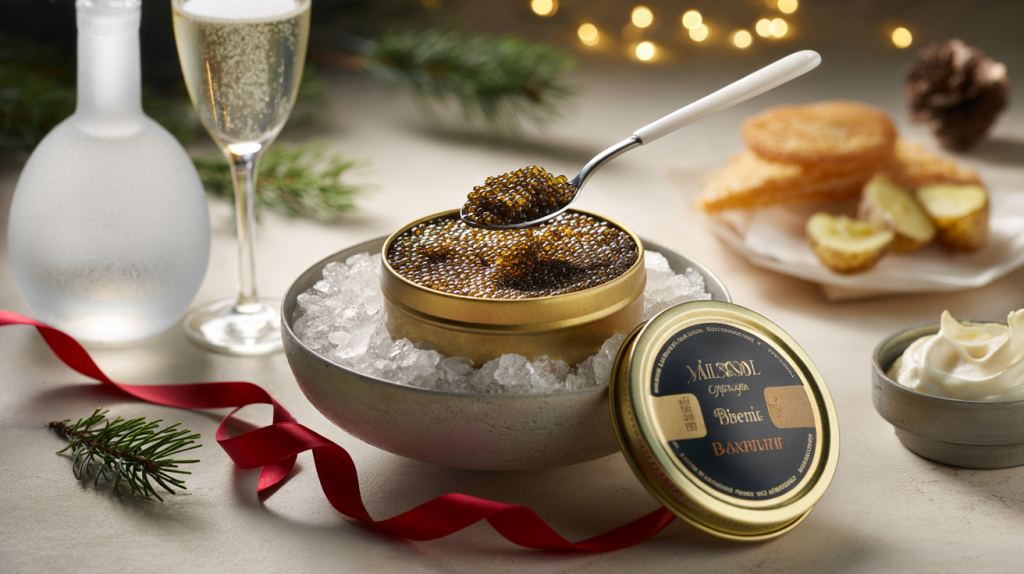
Serving is simple: spoon gently with mother-of-pearl or plastic, never metal, and keep the tin on crushed ice. Neutral carriers – blini, warm potatoes, plain toast – let the roe lead. A dry Champagne or a neat, frozen vodka is classic for a reason. One small trick that guests love: open the tin at the table, so the aroma bloom feels like part of the gift.
A short checklist to close the loop. Choose farmed Oscietra or Siberian for balanced flavor. Look for malossol and a complete CITES code. Ship chilled. Gift a 30 g tin for two, 50 g for four. Eat within 24 to 48 hours once opened. Simple, memorable, and the kind of present people actually want to recieve.