
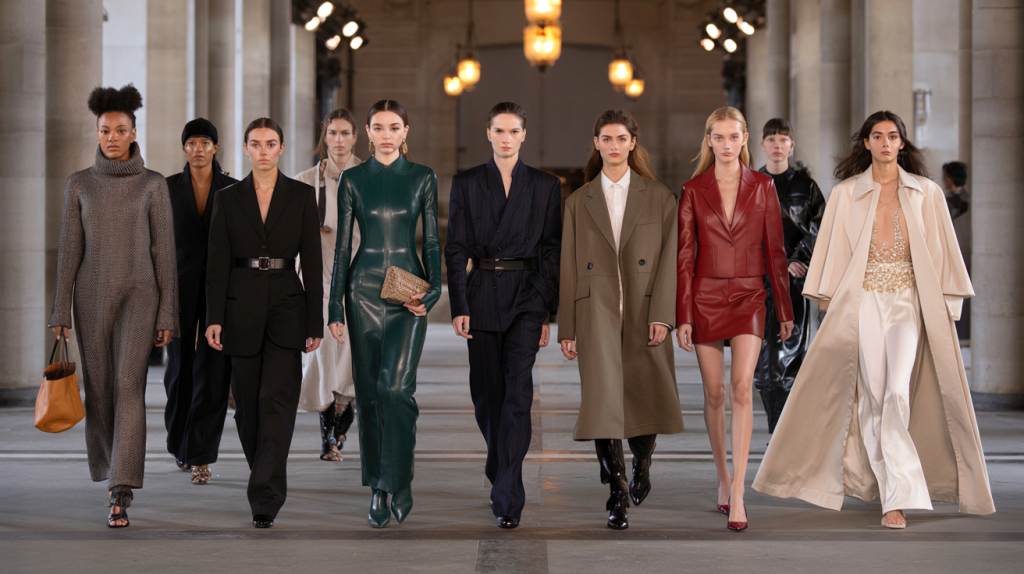
2025 arrives with a full reshuffle at the top of fashion. Creative directors switched houses, new labels drew waitlists, and heritage brands recalibrated the dream. Readers come for clarity: who are the best designers to watch right now, and what proves it beyond hype.
The picture is sharp. Fresh leadership at Valentino, Gucci, Chloé, and Alexander McQueen sets the tone, while designers like Jonathan Anderson and Matthieu Blazy keep driving craft and desirability. Industry momentum still looks resilient. The Business of Fashion and McKinsey “State of Fashion 2024” projected global growth of 2 to 4 percent in 2024, updating the baseline for 2025 planning. That is the backdrop behind the names below.
Best Fashion Designers 2025: Leaders setting the pace
Here are the designers setting style and business agendas across runways and retail in 2025.
- Jonathan Anderson at Loewe et JW Anderson
- Miuccia Prada et Raf Simons at Prada
- Matthieu Blazy at Bottega Veneta
- Demna at Balenciaga
- Sabato De Sarno at Gucci
- Alessandro Michele at Valentino
- Daniel Lee at Burberry
- Nicolas Ghesquière at Louis Vuitton
- Chemena Kamali at Chloé
- Seán McGirr at Alexander McQueen
- Phoebe Philo at Phoebe Philo
Key 2025 facts: appointments, awards, and demand signals
Alessandro Michele took the creative helm at Valentino in March 2024, as announced by the house. The move followed Pierpaolo Piccioli’s departure and instantly redirected attention to Rome. Expect the first full 2025 collections to clarify codes, accessories, and couture adjacent craft.
Gucci’s new era began in September 2023 at Milan Fashion Week when Sabato De Sarno debuted “Ancora”. The pared vocabulary continued into 2024 with a sharper daywear focus, setting up 2025 as a test of consistency and acceleration.
Chloé confirmed Chemena Kamali as creative director in October 2023 with her first runway shown in Paris in February 2024. Romantic tailoring and fluid dresses returned as signatures, which suits the house’s clientele heading into 2025.
Alexander McQueen appointed Seán McGirr in October 2023, with a first show presented in March 2024 in Paris. The approach to silhouette, leather, and sharp outerwear becomes the through line to watch this year.
Phoebe Philo launched her namesake label in October 2023 with limited online drops through 2024, often selling out in minutes. That cadence continues to shape 2025, creating scarcity and a tight wardrobe logic around tailoring, leather, and refined utility.
Context matters for demand. The Business of Fashion and McKinsey “State of Fashion 2024” report, published in November 2023, forecast 2 to 4 percent industry growth for 2024, pointing to cautious optimism into 2025. On the talent front, the LVMH Prize crowned Satoshi Kuwata of Setchu in June 2023, signaling appetite for hybrid tailoring and craft that still resonates today.
How to spot excellence in 2025 collections
Start with construction. Hand finishings, calibrated proportions, and fabric density reveal more than a viral moment. Watch how Matthieu Blazy at Bottega Veneta keeps pushing trompe l’oeil leather and knit techniques season after season. Continuity without repetition is a strong tell.
Then check silhouette clarity. Daniel Lee’s Burberry since 2023 rebuilt outerwear and check motifs with a British vernacular that read cleanly on the street and on campaign. When a house finds that line between signature and evolution, product tends to stick.
Common mistake seen every season: chasing a single viral shoe or bag without tracing the look back to the collection’s core idea. One bag can sell out, sure, yet lasting designers engineer a system of pieces that work together. If a runway’s strongest items cannot be paired three ways in lookbooks, that is a flag.
Real world signals help. Look at sell in and sell through reports when retailers share them in earnings calls, and scan image databases after shows to see which pieces reoccur. Cross check with runway to retail lag times. If key items land within eight to twelve weeks, momentum is definitly building.
Follow the calendar: where and when to watch
The big four fashion weeks map the year. Men’s shows typically cluster in January and June, while women’s ready to wear sits in February to March and again September to October. Paris dates are published by the Fédération de la Haute Couture et de la Mode each season, and schedules for Milan, London, and New York are released by their councils.
For live context, many houses stream shows on YouTube and their own sites. After the runway, Vogue Runway provides full look-by-look archives within hours, making side by side comparisons simple across seasons. That is where the designers above reveal their best arguments in real time.