
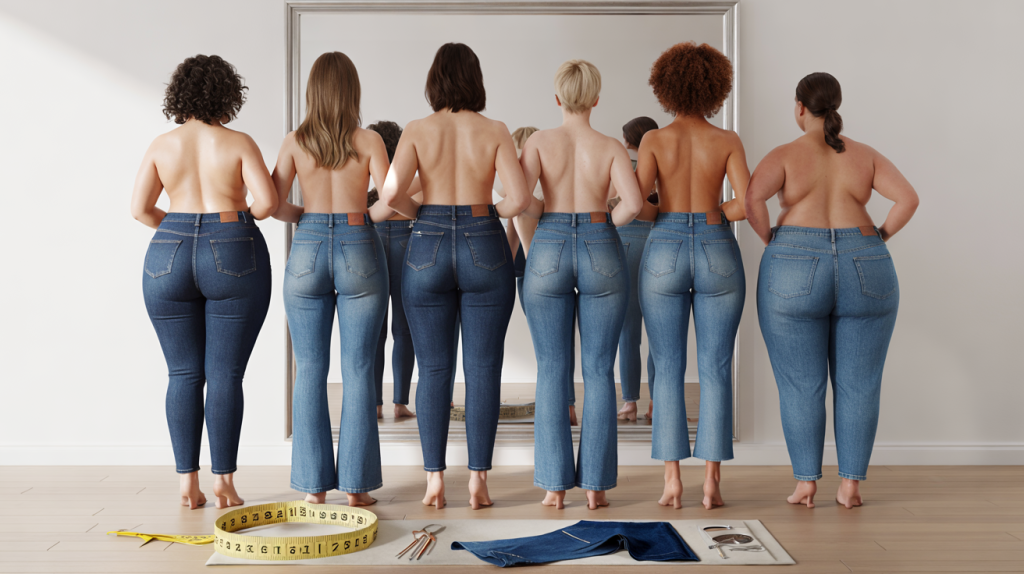
Finding the best jean cut for your body shape is not a mystical quest. It is a method. Choose the right rise and leg shape for your proportions and the mirror does the rest, no tugging, no awkward creases, no “I’ll just pull a sweater over it”.
The stakes are real. Jeans are a global staple, with revenue in the category reaching about 64.6 billion US dollars in 2023 according to Statista, Jeans segment, 2023. And when fit misses the mark, shoppers send them back. McKinsey reported online apparel return rates often land between 25 and 40 percent in 2020. The right cut saves time, money, and a bit of dignity in the changing room.
Best Jean Cuts by Body Shape : fast matches that work
The core idea is balance. If hips lead the silhouette, add room or subtle flare; if shoulders lead, bring volume to the lower half; if the waist is softly defined, let rise and contoured waistbands do the sculpting.
Pear shapes, with fuller hips and a smaller waist, usually shine in straight, bootcut, or modern wide legs. A mid or high rise hugs the waist without cutting across the widest point. Apple shapes, who carry more through the midsection and often have great legs, tend to do well with high rises that secure the torso, plus straight or gentle bootcut legs that drop clean from the hip.
Hourglass figures look balanced already. The job is to respect the waist. High-rise skinny, slim straight, and flared cuts with contoured waistbands lock in that shape without gaping. Rectangle shapes gain curves via mom jeans, tapered straight, or flares. Detail at the yoke, a higher rise, or a paperbag waistband can create a waist that reads sharper. Inverted triangle bodies benefit from wide-leg or flare to add weight below the hip, while relaxed straight styles keep lines even without clinging.
How to Measure Rise, Inseam, and Waist for a precise fit
Numbers calm the noise. Measure a favorite pair flat. Rise : place the tape from crotch seam up to the top of the waistband. Inseam : run the tape from crotch seam straight to the hem. Waist : lay the waistband flat, measure across, then double it.
Match rise to torso length and comfort. Shorter torsos often prefer mid-rise around 9 to 10 inches, longer torsos can take 11 to 12 inches and up. For inseam, plan around shoes. Flats and sneakers pair with ankle to regular inseams, heeled boots often need one to two inches more so the hem brushes the top of the shaft instead of bunching.
A quick tailor note saves a thousand micro-adjustments in daily wear. Hem to the shoe height worn most. Ask for an original hem on vintage-style jeans. A simple darts-at-the-waist tweak can remove back gaping on curvier shapes, and some stores will credit alterations, so check what you recieve before paying out of pocket.
Fit mistakes to skip, and what the data says
Buying for the thighs and ignoring the waistband creates gaping that no belt really fixes. Seek contoured waistbands and back-yoke shaping when curves are pronounced. On the other side, sizing down for a tight thigh can cause whiskering at the crotch and knee, a sign the fabric is fighting your movement rather than following it.
Return fatigue is real, and the numbers back it up. McKinsey flagged that online apparel return rates can run 25 to 40 percent, frequently linked to size and fit mismatches, 2020. Precise measurements cut that risk in half, especially when comparing product size charts that list rise and thigh measurements, not just waist.
Body measurements vary more than size labels suggest. The Centers for Disease Control and Prevention reported mean waist circumference for U.S. adults 20 and over at roughly 38.7 inches for women and 40.2 inches for men in 2015 to 2018, CDC, National Center for Health Statistics, 2021. Translation in the fitting room : a labeled size is not a judgment or a fixed rule, it is a starting number. Use the tape, then the mirror.
Your Denim Action Plan : one list to shop smarter
Here is a quick-reference list that connects body shape to jeans that tend to flatter, plus the fabric details that keep them comfortable over a full day.
- Pear shape : mid or high rise, straight or bootcut, wide-leg; look for contoured waistbands, a hint of stretch 1 to 2 percent elastane, and minimal whiskering at the hips.
- Apple shape : high rise for core support, slim straight or gentle bootcut; prioritize firm stretch blends with recovery, front-panel smoothing helps.
- Hourglass : high-rise skinny, slim straight, flared; contoured waistband, back-yoke shaping, heavier denim 12 to 14 oz to hold form.
- Rectangle : mid to high rise, mom jeans, tapered straight, flare; try detailing at the yoke or pockets, rigid or low-stretch denim to build structure.
- Inverted triangle : straight to wide-leg, full-length flare; soft drape fabrics, balanced back pockets placed mid to low for proportion.
- Petite across shapes : cropped inseams 26 to 28 inches, clean hem, avoid heavy stacking; keep flare openings narrower for visual lift.
- Tall across shapes : longer rises, 33 to 36 inch inseams; choose substantial denim to avoid knee blowouts, adjust hems to preferred shoes.
One last check in the cabin : sit, stride, and squat. The waistband should stay put, the rise should not dig, the knee should bend without strain. If three moves feel natural, that cut aligns with your morphology, and that pair earns its spot in rotation.