
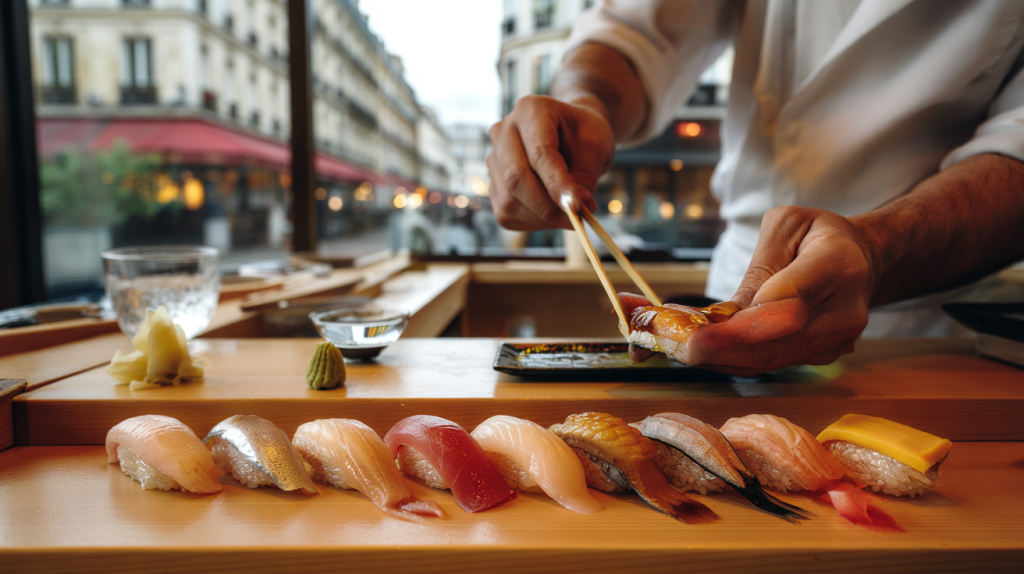
Looking for the best sushi in Paris right now means one thing: hand-formed nigiri shaped in front of you, pristine fish, rice warm and slightly airy. Good news : Paris now competes with Tokyo-quality counters, from discreet omakase experiences to lively neighborhood spots where the knife work speaks first.
Here is the gist. For purist nigiri, Jin in the 1st arrondissement delivers a refined, calm counter experience listed by the Michelin Guide 2024. Classicists still whisper about Isami by Île Saint‑Louis. Love sake pairings and a polished menu? EnYaa near Palais‑Royal stays sharp. Craving a more creative twist, Blueberry in Saint‑Germain plays with textures and rolls without losing balance. Different energies, same aim : clean cuts, seasoned rice, and respectful sourcing.
Best sushi in Paris : where to go first
Paris is wide – 20 arrondissements, many scenes – so a smart path helps. Start central for omakase counters around the 1st and 2nd, then branch to Left Bank for inventive maki or quieter lunches. Book the counter when possible. That’s where skill is visible, bite after bite.
Quick tip : if a place only shines in delivery, skip for a first visit. Nigiri asks for timing and temperature. In the room, you taste the chef’s rhythm. That’s the point.
Below, a concise list that matches different budgets and moods. Each place has a clear identity, no duplicates, no tourist traps. Cross‑check availability before heading out – seats go fast.
- Jin, Paris 1st – omakase counter, refined and precise, listed by the Michelin Guide 2024.
- Isami, Île Saint‑Louis – old‑school intimacy, tight nigiri selection, loyal Paris crowd.
- EnYaa, Palais‑Royal – sushi et sake focus, elegant atmosphere, careful pairings.
- Kura, Batignolles – compact counter spirit, seasonal specials, low‑key service.
- Blueberry, Saint‑Germain – creative maki and chirashi, playful but clean flavors.
How to spot great sushi in Paris : the three signals
Rice leads. It should be slightly warm, grains defined, seasoned with discretion. If the rice collapses or tastes sweet like candy, quality drops. Fish follows. Look for natural shine, no watery sheen, no aggressive perfume. The cut matters too: clean edges, no ragged lines. Ten seconds on the tongue tells the story.
Second signal : knife work at the counter. The chef’s motions are small and efficient, not theatrical. If you see repeated re‑cutting or heavy pressure, texture will suffer. One more tell : soy served in a shallow dish and brushed lightly by the chef on neta, not drenched at the table.
Safety is non‑negotiable. For raw fish served in the EU, freezing is required for parasites. Regulation (EC) No 853/2004 sets the benchmark at -20 °C for at least 24 hours for fish intended to be eaten raw, or equivalent time‑temperature treatment (European Commission, 2004). Good restaurants know it and say it with ease when asked.
Prices, reservations et the best time to go
Plan by slot. Lunch menus are usually the gateway – lighter omakase or nigiri sets that show technique without the full evening price. Dinner brings the chef’s longer sequence, seasonal fish and a slower pace. Counter seats are limited, sometimes 8 to 12, so booking a week ahead helps. Same day? Call at 12:00 sharp and ask for late‑service releases.
Labeling can guide your choices. EU Regulation No 1379/2013 requires fishery products to display the commercial designation and catch area, and whether previously frozen (European Commission, 2013). If the menu or staff explains origin clearly – Atlantic, Mediterranean, Pacific – trust rises. Not a guarantee, but a good sign.
Cultural note that explains the rise in standards here : in 2013, UNESCO inscribed “Washoku, traditional dietary cultures of the Japanese” on the Representative List of the Intangible Cultural Heritage of Humanity (UNESCO, 2013). Paris followed with a wave of chefs doubling down on craft, temperature control and sourcing networks. You feel that shift in the nigiri today.
What most diners miss : small details that change everything
Ask for the counter if you care about pacing. Nigiri should arrive one by one, not all at once. That keeps rice alive and the fat of the fish just loosened. If offered, start with lighter white fish, then move to silver‑skinned, then tuna cuts, finishing with uni or a clean tamago. It sounds classic, it works.
Soy et wasabi should be restrained. If the chef seasons the piece already, taste before dipping. A discreet brush of soy amplifies acidity in the rice. Too much and the balance goes flat. Ginger is a palate cleanser, not a topping. Tiny habits, big results.
One last thing that definetly elevates a meal : ask about the day’s neta the way you ask a sommelier about a vintage. Two questions, max. Origin and cut. The reply tells you if you should lean nigiri, sashimi or a chirashi that night. Then relax – and pick the counter seat closest to the action.
Sources : Michelin Guide 2024 – France selection; European Commission – Regulation (EC) No 853/2004; European Commission – Regulation (EU) No 1379/2013; UNESCO – Intangible Cultural Heritage, 2013 inscription of “Washoku”.