
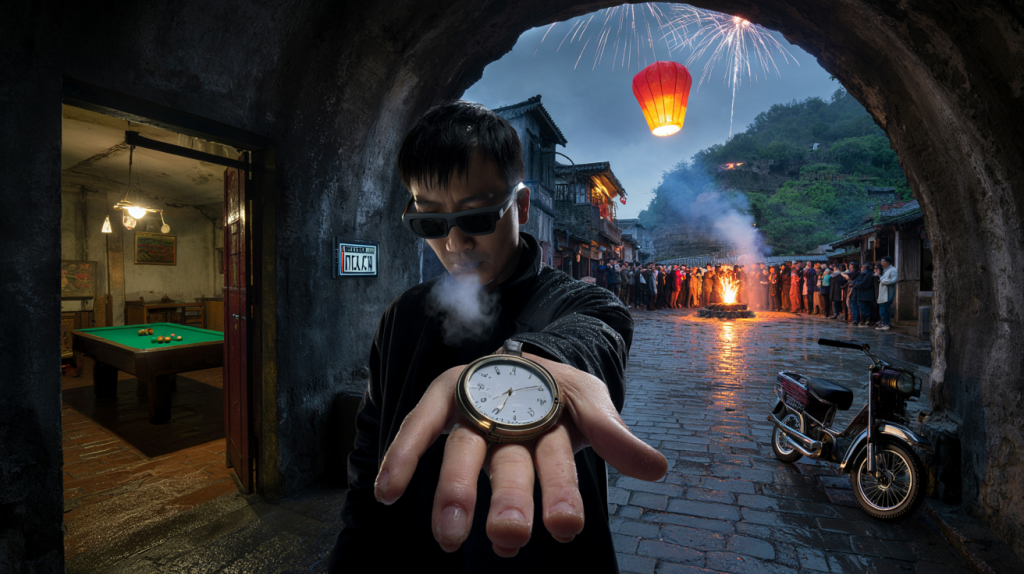
Viewers leave Bi Gan’s “Long Day’s Journey into Night” with one burning question: does the ending resurrect the past or rewrite it. The final hour, famous for its unbroken 3D take, looks like a dream yet behaves like a decision. Clicked for answers? The key sits in plain sight: time returns to the body.
Context matters. Premiered at Cannes in 2018 and released in China on 31 December 2018, the film runs 138 minutes and closes with a 59-minute shot that turns memory into space. A man drifts through a cinema, then slips into another world where gravity loosens and midnight arrives. That shift is not a trick ending. It is the plot, finishing what the first half starts.
Bi Gan ending explained: a resurrection of time, not a twist
The word “resurrection” makes sense here because the film brings a dead timeline back to life. The hero does not find a missing woman in a conventional way. He recovers a self that time and grief had split apart. When the glasses go on and 3D begins, the movie stops describing memory and starts inhabiting it.
Nothing supernatural needs to happen. What revives is agency. The camera tracks the body as it climbs, rides, waits, kisses, listens. Time is no longer a distant voice. It is tactile – breath on the microphone, footsteps in a mine, a village choir marking the turn of the year. The film’s last act resurrects presence.
This is Bi Gan’s signature construction. “Kaili Blues” in 2015 already tested it with a 41-minute long take in a riverside town. Here, the scale grows and the payoff is cleaner: the ending does not solve a riddle, it restores continuity between a man’s past and the moment he is living.
What the final one-shot really shows – and where it shifts
The pivot is visible. A cinema scene closes the first half. The protagonist puts on glasses. The screen goes 3D. From there, the camera follows a path through a tunnel to a hill town and across rooms where names and faces echo earlier scenes in altered order.
Midnight matters. The village counts down. Fireworks flare. A sky lantern lifts. Those cues do two things at once: they date the moment and unmoor it. The film anchors us in a specific night yet lets time feel elastic inside the shot.
Because the take never cuts, space behaves like thought. A billiards hall becomes a staging post for memory. A long ride on a motorbike streches the second half’s rhythm until ordinary action feels ceremonial. By the time the camera rises and tilts, the world has accepted the character’s decision to live inside his own time again.
Common viewing traps – and how to read the clues
Plenty of viewers expect a puzzle-box answer. Bi Gan plays a different game. Read the details as signals, not riddles. Here is a compact way to track them without getting lost :
- The format shift: 2D to 3D exactly when the character re-enters his memory world – the body now leads the story.
- The watch motif: a handless or unreliable watch reappears, which shows time as feeling rather than measurement.
- Midnight markers: countdown, fireworks, and a lantern give a precise clock while the shot stretches a single hour into a lifetime.
- Mirrored people and places: a singer, a mine, a pool table return in altered form, indicating memory rearranging, not repeating.
- Camera movement: low glides and a late tilt announce a shift from drift to choice – gravity slowly loosens when he stops looking for proof.
Dates, numbers, context: how Bi Gan built that feeling
Facts ground the mythology. The film premiered at the 2018 Cannes Film Festival in the Un Certain Regard section. China saw it on 31 December 2018, with a marketing push around New Year screenings that amplified the final countdown’s setting. The total runtime is 138 minutes, capped by a 59-minute take in 3D that was staged to play in real time.
Form links to theme. The first half fractures people and places across flashbacks. The last hour stitches them with uninterrupted motion. That shift does not claim the dream is “truer” than reality. It simply stops splitting what the character sees from what he feels. The movie quietly tells us memory and place have the same weight when carried by a body.
So the “resurrection” lands in a practical way. The man stops being a spectator of his past. He acts inside it. Time returns, but not as calendar pages. It returns as movement, voice, touch. Watching in 3D intensifies that change, yet the 2D version still delivers the same structure, especially if the sound mix is given room. Turn off distractions. Let the last hour breathe. What seems opaque at first seperates into beats – entry, drift, midnight, ascent – and the ending reveals itself as a living present, not a code to crack.