
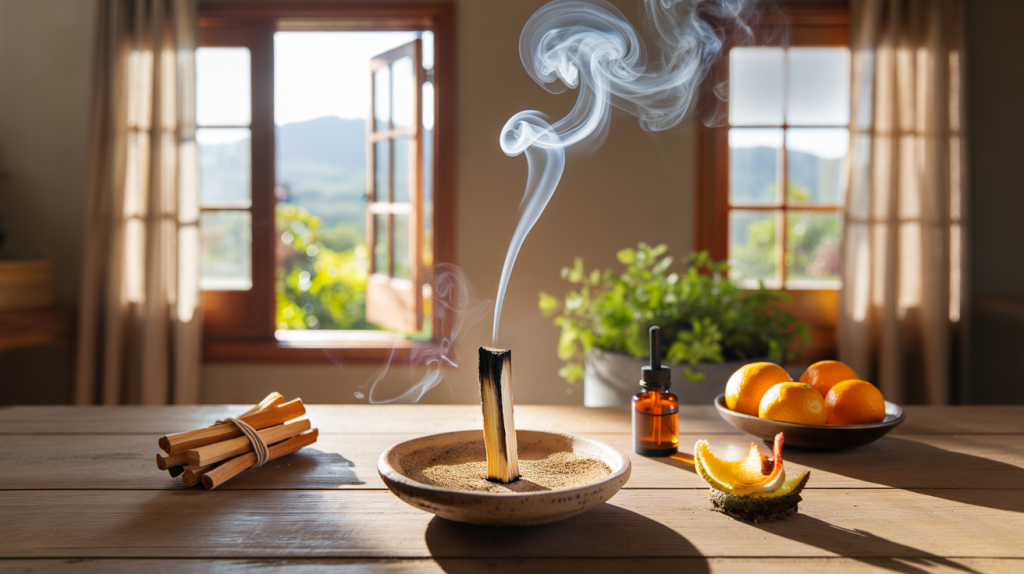
The warm, resinous scent of palo santo gets credit for a lot: calmer mood, clearer spaces, even a sense of reset at the end of a long day. People search for the bienfaits du palo santo to know what is real and what is ritual. Here is the short answer with no fluff: palo santo can create a soothing sensory cue, help deodorize a room, and set intention. Scientific proof for medical effects remains limited, yet some data on aromatic compounds and smoke give useful context.
Palo santo comes from Bursera graveolens, a tree native to dry forests of Ecuador and Peru. The wood is naturally aromatic and often burned in short sessions. Benefits tied to relaxation make sense for many because scent and routine calm the nervous system. Evidence points to two things worth knowing: smoke from medicinal botanicals can reduce some airborne bacteria in controlled settings, and the wood’s essential oil is rich in d limonene, a familiar fragrance molecule. That said, this is not a cure, and responsible, sustainable use matters as much as the mood it creates.
Palo santo benefits explained: what people feel, what studies suggest
Most turn to palo santo to switch off racing thoughts. A simple ritual anchors attention and breath, which already lowers perceived stress. The aroma adds a distinct signature that the brain associates with winding down. That is the experiential part, and it is valid because routine changes state.
On the data side, research does not position palo santo as a medical treatment. Still, there is relevant context. In 2007, a study in the Journal of Ethnopharmacology reported that medicinal smoke from a mixture of wood and herbs reduced airborne bacterial counts by 94 percent after 60 minutes of smudging, with effects that persisted for 24 hours in a closed room. The experiment did not test palo santo specifically, but it shows how controlled smoke can shift indoor microbial load in the short term.
Another piece of the puzzle is chemistry. Analyses of Bursera graveolens essential oil consistently identify d limonene as a major constituent, the same citrus like molecule found in orange and lemon peels. The United States Food and Drug Administration lists limonene as generally recognized as safe for use as a flavoring substance, which speaks to exposure safety in small amounts, not to therapeutic claims.
How to use palo santo safely: simple ritual, realistic results
A small stick often does the job. The benefit is less about smoke volume and more about a moment of focused, sensory calm. Ventilation matters, and so does frequency. Think minutes, not hours.
Many struggle because they treat it like a heavy incense and then feel irritated airways. A few adaptions fix that quickly. Keep windows slightly open, avoid burning near children, pets or anyone with asthma, and do not use in place of cleaning or ventilation when air quality is poor from other sources.
Here is a quick, practical routine that respects both body and space.
- Light the tip of a dry, ethically sourced stick for 10 to 20 seconds, then blow out to let a thin plume form.
- Walk slowly, wafting the smoke upward while breathing normally, 1 to 3 minutes is usually enough.
- Set the stick in a fire safe dish to go out, or press the ember into sand.
- Use no more than once daily, and skip if the room feels stuffy. Open a window for cross ventilation.
- Prefer essential oil in a diffuser if smoke bothers you. Two or three drops are typically sufficient.
The science behind the aroma: limonene, smoke and air quality
Why does the scent feel uplifting to many? Limonene’s bright, citrus note is known to be pleasant at low concentrations. That sensory pleasure, paired with a brief mindfulness pratice, often shifts mood. People notice fewer racing thoughts because attention moves to breath and smell.
What about air purification claims? The 2007 Journal of Ethnopharmacology study documented a 94 percent reduction in airborne bacteria after one hour of medicinal smoke exposure and noted that the effect lasted for a day in the tested room. Again, palo santo was not part of that protocol, and smoke composition varies widely, so results cannot be copy pasted. High smoke exposure also introduces particulates, which can irritate sensitive airways. Balance is the key: short, well ventilated burns if you choose smoke, or use a diffuser for scent without combustion.
As for safety, the FDA’s recognition of limonene as GRAS concerns flavoring amounts, not long sessions of inhaled smoke. Essential oil remains potent. Always dilute on skin and avoid use during pregnancy unless a qualified professional advises otherwise.
Sourcing and sustainability: Bursera graveolens and ethical buying
Demand surged these past years, and that raises a fair question. Is palo santo endangered. As of 2025, Bursera graveolens does not appear on the CITES Appendices, which regulate international trade in threatened species. That does not mean every stick is responsibly sourced.
In Peru, the forestry authority SERFOR has published rules allowing collection of palo santo from naturally fallen, dead trees and logging residues, rather than cutting living trees. Ecuadorian community projects often follow similar guidelines to protect dry forests while supporting local livelihoods. Reputable sellers can name the region, the community or concession, and the harvest method.
Look for suppliers who work with managed concessions, document chain of custody, and season the wood for aroma instead of rushing it. If a brand cannot answer basic sourcing questions, that is a red flag. Sustainable choices keep the ritual available without harming the ecosystem where it originated.