
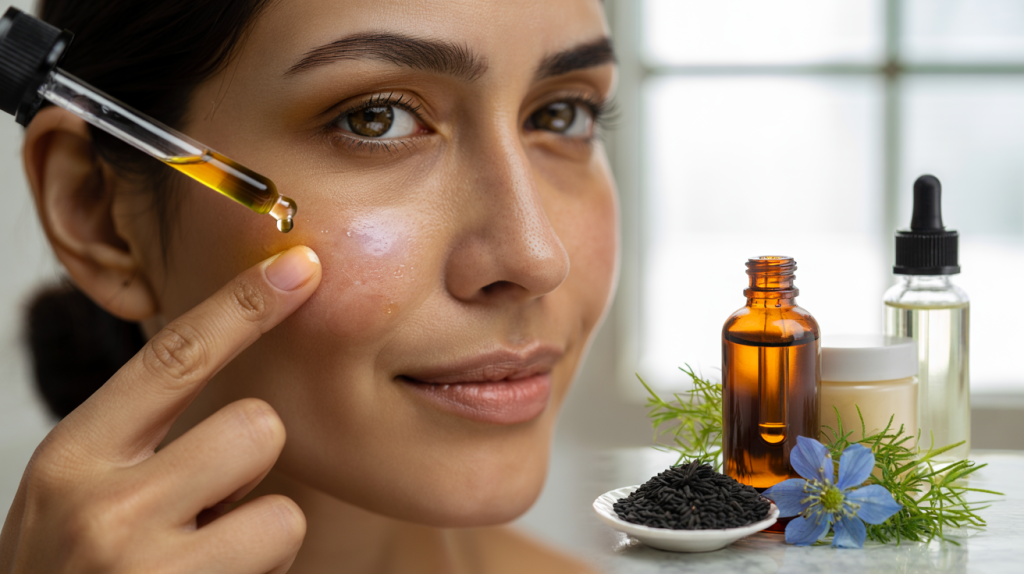
Want calmer skin fast? Learn how to use black seed oil on face and body with expert-backed steps, science and mistakes to avoid for real results.
Black seed oil – also called Nigella sativa oil – has a reputation for soothing tricky skin. The quick method many dermatology pros accept: start with a patch test, then apply a tiny amount to damp skin after cleansing, ideally at night. Mix 1 to 2 drops with a light neutral oil like jojoba or squalane, massage for 30 seconds, and let it seal in your serum or moisturizer. A lean, consistent routine works better than a heavy, greasy layer.
For acne, irritation or dry patches, go slow. Use it once a day for the first week, keep actives simple, and avoid pairing on the same night with strong retinoids or high-dose acids. Sensitive or eczema-prone skin tends to prefer dilution and short ingredient lists. If stinging or redness shows up, pause and reassess – the goal is comfort, not a quick fix.
How to use black seed oil for skin : the problem it solves
Between breakouts, tightness and post-blemish marks, skin asks for calm plus barrier support. Black seed oil brings both: a rich emollient texture that softens and an active profile led by thymoquinone, studied for anti-inflammatory and antibacterial actions that matter to blemish-prone faces. People often reach for it when moisturizers feel too light and spot treatments too harsh.
Reality check helps. Acne is common – up to 50 million Americans are affected each year, according to the American Academy of Dermatology (AAD, 2023 : https://www.aad.org/media/stats-numbers). Eczema is, too. The National Eczema Association estimates 31.6 million people in the U.S. live with some form of eczema, more than 10 percent of the population (NEA, 2023 : https://nationaleczema.org/research/eczema-facts/). That volume explains why a multi-tasker oil keeps trending in bathroom cabinets.
What science actually says has been growing. Reviews of Nigella sativa and its key molecule thymoquinone describe antioxidant, antimicrobial and anti-inflammatory effects relevant to acne lesions and irritated skin, while noting that clinical trials remain small and early stage (Avicenna Journal of Phytomedicine, 2018 : https://www.ncbi.nlm.nih.gov/pmc/articles/PMC5633670/). Translation : there is promise, but consistent, gentle use beats hype.
Nigella sativa benefits and the evidence behind them
Thymoquinone, the signature compound in Nigella sativa, has been investigated for calming inflammatory pathways and discouraging bacterial overgrowth on skin – both central to acne flare-ups. Reviews published in 2013 and 2018 summarize these mechanisms and call for larger, well-controlled studies before making disease claims (PMC articles hosted by the U.S. National Library of Medicine : 2013 and 2018). That has guided a practical approach in derm practice: treat it as a supportive oil, not a medicine.
For everyday use, the appeal sits in texture and tolerance. Lightweight compared with heavier plant butters, black seed oil layers well under sunscreen and over water-based serums. People with combination or oily skin often tolerate a few drops, while very dry or eczema-prone skin prefers mixing it into a cream for extra occlusion. One tiny caveat that sometimes gets missed : some bottles on the market are essential oil or extracts – skin needs cold-pressed seed oil instead.
Patch testing is non-negotiable. The AAD recommends applying a small amount to a quarter-sized spot on the inner arm twice daily for 7 to 10 days before using a new product on the face (AAD guidance : https://www.aad.org/public/everyday-care/skin-care-secrets/face/patch-test). No itching, swelling or rash during that window suggests you can proceed to the cheeks or jawline.
Step by step : applying black seed oil on face and body
Routines that stayed simple tended to work better. Start after cleansing, on slightly damp skin, then lock in hydration with a small amount. Morning use is fine, yet many prefer nighttime to avoid shine and to give actives space to work.
- Face : after a hydrating serum, blend 1 drop black seed oil with 3 to 4 drops of jojoba or squalane, press into skin, then moisturizer if needed.
- Acne spots : dab a diluted mix only on dry areas around the spot, not inside an open lesion.
- Eczema-prone patches : mix a pea-size of fragrance-free cream with 1 to 2 drops of the oil, apply twice daily during flares if tolerated.
- After shaving : smooth 1 to 2 drops over damp skin to calm razor-induced redness on face or body.
- With actives : alternate nights with retinoids and high-dose acids to reduce piling irritation.
An SPF note for daytime. The AAD advises broad-spectrum sunscreen SPF 30 or higher, every day, as the last step in a morning routine (AAD Sunscreen FAQs : https://www.aad.org/media/stats-sunscreen). Oils do not replace sun protection, and some post-acne marks darken faster in the sun without it.
Who should skip it, common mistakes and how to store it
Allergic contact dermatitis can occur, even with natural oils. Stop if burning or hives appear and speak with a board-certified dermatolgy professional. Avoid applying over open cuts, fresh peels or immediately after microneedling. People with a history of nut or seed allergies should patch test longer and consider medical advice first.
Three missteps come up again and again. Using too much – a few drops suffice. Layering it over a long list of actives on night one – wait and introduce slowly. Confusing essential oil with cold-pressed seed oil – essential oils are potent and not meant for leave-on facial use. Small corrections here often turn a frustrating trial into a good experience.
Storage matters for stability. Keep the bottle tightly closed, in a cool, dark place, ideally amber glass. Many plant oils maintain best quality for several months after opening; if the scent turns sharp or the texture thickens, swap for a fresh bottle. Expect gradual results rather than overnight change – most people review progress after 2 to 4 weeks of steady use, then decide whether to continue or adjust the routine.