
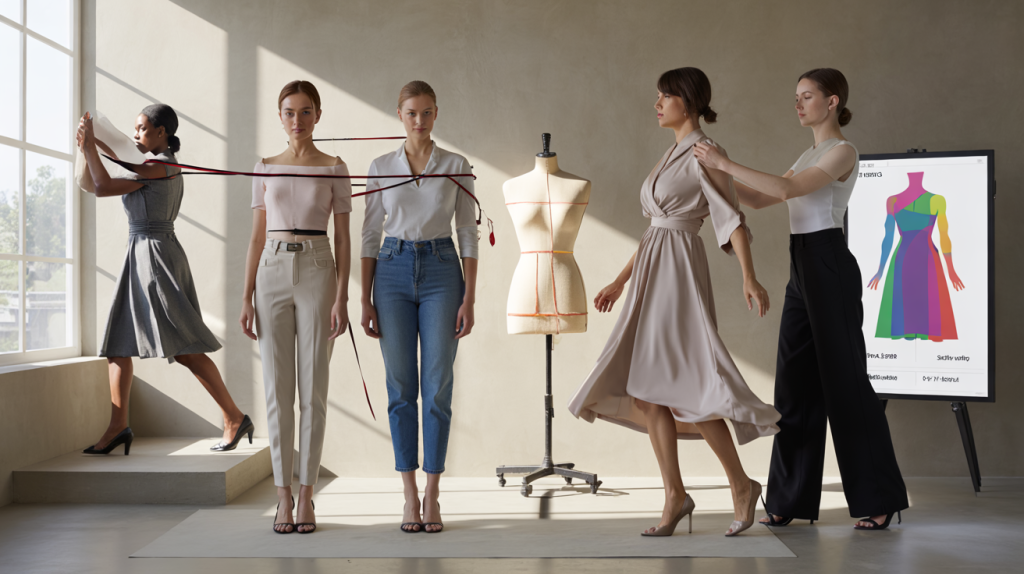
Limits of body shape dressing: what no one tells you
Heard it a thousand times: “dress for your shape”. It sounds foolproof, quick, even kind. Yet those rules often shrink style options, not expand them. They turn a moving, changing body into a fixed label and call it guidance.
Here is the gap that keeps showing up in real life. The average U.S. woman wears between a size 16 and 18, according to the International Journal of Fashion Design, Technology and Education study led by Deborah A. Christel in 2016. Still, plus-size accounted for just 19 percent of U.S. women’s apparel sales in 2021, reported The NPD Group. And returns are costly: retailers saw a 14.5 percent return rate in 2023, with online at 17.6 percent, said the National Retail Federation and Appriss Retail. The promise of neat morphology rules meets the messy reality of fit, supply and identity.
Body shape rules: where they help, where they fail
At their best, morphology tips teach proportion. A darker bottom can quiet volume. A defined shoulder can balance curvier hips. Great for a quick fix when time is short.
But bodies are not static. Weight shifts, hormones fluctuate, posture changes, cultures dress differently. Two people share the same measurements, yet fabric drape, muscle distribution and mobility make clothes sit in totally different ways.
There is also the mental side. Research on “enclothed cognition” from Northwestern University in 2012 showed that what we wear can influence attention and performance. If rules push people to hide or feel lesser, the outfit works against confidence, not for it.
Common mistakes with morphology dressing, and what to try instead
One-size-fits-all bans. “No skinny jeans if you are a pear.” Then someone tries stretch denim with a mid rise and it looks great. Because fabric, rise and fit trump a blanket rule.
Chasing symmetry at all costs. Many spend energy erasing hips or shoulders. Style often comes alive when something is left slightly off balance by design.
Ignoring movement. A skirt that measures right on paper can twist while walking. Fit checks need motion: sit, reach, climb a stair.
Over-trusting labels. A size M is not a standard. Brands cut to different base blocks. Many do not accomodate height or torso length, which skews how “rules” land.
Try these practical pivots that keep agency in your hands :
- Start from intent: power, ease, romance, utility. Then build the outfit to serve that feeling, not the label on your body.
- Pick one anchor: shoulder line, waist, or hem. Make that point crisp, let the rest relax.
- Use three proportion levers: rise height, sleeve volume, and hem width. Adjust one at a time and mirror-check.
- Test in motion: 10 steps, a seat, an overhead reach. If it shifts oddly, it is not you, it is the pattern.
- Fit hierarchy: shoulder first, waist second, length last. A tailor can fix two and transform the piece.
Sizing, returns and inclusivity: what recent data really says
Market numbers tell a story that shape rules alone cannot solve. The average U.S. woman’s size 16–18 cited by Christel and Dunn in 2016 sits far from many brands’ base blocks, which still center on smaller fit models. That mismatch shows up in carts and returns.
The National Retail Federation and Appriss Retail reported a 14.5 percent overall U.S. retail return rate in 2023, with online returns at 17.6 percent. Apparel is a heavy contributor, as size and fit variability drives send-backs and exchanges that drain margin and patience.
NPD data placed plus-size at 19 percent of women’s apparel sales in 2021. When the majority of women live at or above size 14, but selection and pattern variety lag, the “dress for your shape” script hits a wall. The supply side constrains the outcome long before personal styling begins.
Beyond morphology: a flexible fit method that works day to day
Think of dressing as problem solving in layers. First, identity and context: work, weekend, ceremony. Clothes should serve the moment and the person, not a fruit category.
Next, fabric physics. Woven vs stretch, drape vs structure. A fluid crepe drops weight vertically and softens curves. A compact ponte skims and supports without squeezing. Different fabrics change the same body map.
Then, micro-adjustments. Shorten a sleeve to open the wrist line. Nudge a pant hem to meet the shoe vamp. Swap a standard belt for a soft sash to hold shape without digging. Small moves shift the whole silhouette.
Finally, build a repeatable check: two photos in daylight, front and side. If the eye goes where you want it to go, keep. If not, adjust one lever and retest. Confidence grows because the process is yours, not a rulebook.
Where morphology maps run out, this mix of intent, fabric and proportion keeps fit real. The data points to system gaps, yes. The method above hands back control, piece by piece, outfit by outfit.