
From Azza Fahmy to new Cairo ateliers, discover contemporary Egyptian jewelry: key designers, symbols, hallmarks, and smart buying tips that actually help.
In Cairo’s humming workshops, gold and silver catch the light while lotus, cartouches, and Arabic words slide into sleek, everyday shapes. Contemporary Egyptian jewelry is not a relic. It is living craft, heritage translated for right now.
The look stands on a clear idea : design anchored in antiquity, built for modern wear. Names such as Azza Fahmy, founded in 1969, and Jude Benhalim, launched in 2011, turned hieroglyphic lines, talismanic gemstones, and Arabic calligraphy into clean cuffs, rings, and ear climbers. That script’s cultural weight grew again when “Arabic calligraphy” entered UNESCO’s Representative List of the Intangible Cultural Heritage of Humanity in 2021. The result travels easily, from Cairo to London and Dubai, for people who want meaning without losing everyday ease.
Why contemporary Egyptian jewelry stands out : heritage, design, identity
Here is the core idea. Designers rework ancient symbols into distilled geometry, then soften it with hand finishing that still happens on Cairo benches. Pieces feel protective and graphic at once, a balance many shoppers search for after years of plain minimalism.
One worry keeps coming back : authenticity. Buyers love the story, yet fear tourist trinkets, uncertain alloys, or overpriced gold. The fix starts with materials. Eighteen karat gold is 75 percent pure and usually hallmarked “750”. Sterling silver reads “925”, meaning 92.5 percent silver. Those stamps, plus a maker’s mark, remain the first checkpoint worldwide.
There is also a training story. The Design Studio by Azza Fahmy, launched in 2013 with the Prince’s Foundation School of Traditional Arts in Cairo, trained new artisans in chasing, filigree, and stone setting. That pipeline matters when reviving techniques like repousse or inlay that give Egyptian work its quiet depth.
Egyptian designers and houses to know : styles, dates, signatures
Shoppers often ask where to start. A few houses shaped the scene with clear signatures and steady craft.
- Azza Fahmy Jewellery : founded 1969, known for hand-engraved Arabic script, talismanic motifs, collaborations in 2010 with Matthew Williamson and in 2017 with Peter Pilotto.
- Jude Benhalim : launched 2011 in Cairo, bold resin and metal contrasts, architectural ear pieces, limited editions that read fresh in photos and in person.
- Dima Rashid Jewellery : established 2003, gemstone-forward with turquoise, coral, and hammered gold finishes worn by international celebrities.
- Feriel Zerzour and Naila Ezzat Studios : small Cairo ateliers focusing on cartouche-inspired pendants and mixed-metal cuffs with precise hand engraving.
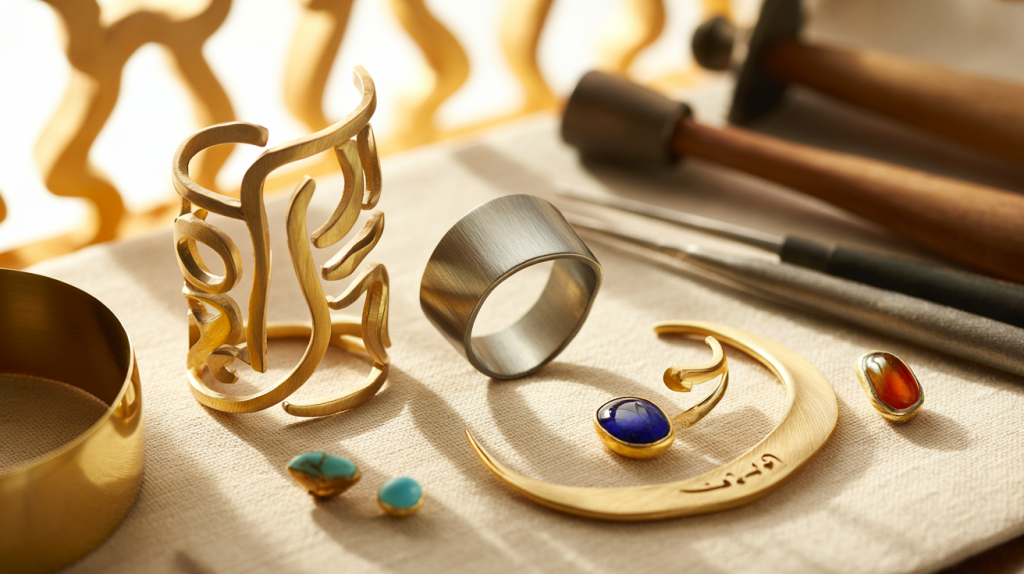
The aesthetic varies. Some brands cut sharp silhouettes in brushed silver. Others lean into warm 18 karat gold with lapis lazuli, carnelian, or turquoise, stones long associated with Egyptian ornament in museum collections at the British Museum and beyond. The throughline is clarity : clean forms, readable symbolism, patient handwork.
Materials, hallmarks, and techniques : how to read quality fast
Numbers help. Eighteen karat equals 75 percent gold. Twenty two karat equals 91.6 percent. Sterling silver equals 92.5 percent. Look for “750”, “916”, or “925” hallmarks plus a maker’s stamp. In Egypt, reputable workshops align pricing with the global gold rate published daily, then add labor for chased, engraved, or filigree details.
Techniques tell another story. Hand engraving leaves faint, micro irregularities under a loupe. Laser marks look perfectly uniform. Repousse and chasing give subtle relief to lotus petals and scarab backs, a soft topography that machine stamping rarely replicates. Arabic calligraphy on cuffs or rings should read cleanly, with balanced negative space. That is not decorative fluff, it is cultural literacy.
Practical tip. Ask for the metal weight in grams and the labor fee separated from the metal value on the invoice. It brings clarity on what you are really paying for : material versus craft. For gemstone pieces, request the stone type, origin if known, and treatment disclosure. Lapis and turquoise often receive stabilization. That is fine, as long as it is disclosed.
Smart buying, care, and sustainability : make the piece last
There is a basic checklist that saves time and avoids regret. First, authenticity : check the hallmark and maker’s mark, then match them to brand documentation or a vendor registry when available. Second, sizing : open bangles and cartouche pendants travel well, but narrow rings in thick 18 karat gold can be expensive to resize later.
Pricing rises with gold swings, so some shoppers choose silver or mixed metal designs to enter the look, then add one statement 18 karat piece later. That ladder works. Keep in mind, patina can be your friend. Silver darkens slightly with wear, letting engraved Arabic letters stand out more clearly.
Care is simple. Store each piece separately in a soft pouch, avoid harsh chemicals, and clean gently with a non abrasive cloth. Replate rhodium on silver if you want a bright finish, or embrace the natural tone. For gold with stones, skip ultrasonic cleaners unless a jeweler confirms the setting and treatments are safe.
Ethics count. Many Cairo studios now reuse scrap gold from their own benches and source small-batch stones locally when possible. Ask the brand what they do. A straightforward, specific answer signals a workshop that respects its craft and your trust. That is how a beautiful piece of jewelery becomes part of a longer, better story.