
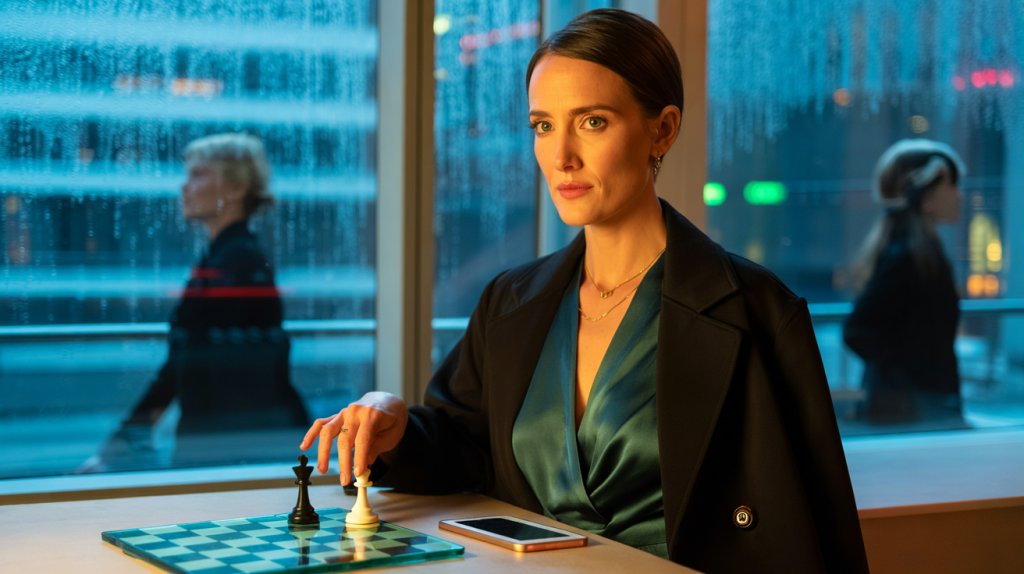
Two minutes on screen and the temperature drops. Camille Cottin’s arrival in Killing Eve as Hélène injects a cool, razor precise menace that unsettles Villanelle and reorders the game. For anyone searching how and when she appears, here is the clear timeline and why it mattered to the series.
Built from Luke Jennings’ novellas and launched in 2018, Killing Eve ran for four seasons through 2022 with eight episodes per season. Camille Cottin steps in during Season 3 in 2020, then returns with bigger stakes in Season 4 in 2022 as a senior force within The Twelve. The dynamic with Sandra Oh’s Eve Polastri and Jodie Comer’s Villanelle tightens, then snaps late in the final season with a brutal reckoning.
Camille Cottin and Hélène in Killing Eve : the essential timeline
Season 3 brings Hélène into view, controlled and unfazed, as a handler who speaks softly but decides loudly. The tone shifts the instant she enters a room. That is the point. Power sits still with her while everyone else scatters.
By Season 4 in 2022, Hélène stands as a visible nerve in The Twelve. Negotiations, tests, a few delicate traps. She faces Villanelle, toys with Eve, and pulls in new assets. The story keeps her close to the engine without overexplaining the network she serves, which keeps tension high across episodes of roughly 40 minutes.
The series context helps too. Killing Eve turned into a global hit after its 2018 debut, drawing awards attention as Jodie Comer won the Emmy for lead actress in 2019 and Sandra Oh won the Golden Globe in 2019. Camille Cottin’s entry aligns with that momentum, and her scenes lean on silence, tiny smiles, and a sense that Hélène already knows the ending.
Why Hélène matters to The Twelve, Eve and Villanelle
Casting a French star best known for “Call My Agent!” was a precise choice. The character needed elegance with a knife edge, someone who could walk through Paris or London and never look rushed. Yes, that icy smile did a lot.
Hélène clarifies The Twelve without spelling it out. Orders come clean. Consequences arrive cleaner. Viewers see an antagonist who does not rant or posture, which makes the threat feel closer. It also gives Eve and Villanelle a different surface to push against, more chess than chase.
The chemistry clicks on contact. One tense dinner, a hallway glance, a promise that sounds like a warning. Small beats build pressure, and in late Season 4 the thread snaps with a decisive act that changes the final stretch.
How to watch Camille Cottin’s arc without getting lost
Jumping in mid story often backfires with Killing Eve. The series layers motives, so skipping too far can flatten Hélène’s impact. A careful path avoids that.
Short on time or just curious about Camille Cottin’s highlights Here is a simple route that still preserves the payoffs.
- Start Season 3 to catch Hélène’s introduction, then continue straight into Season 4 for the full evolution and the late season turn.
A common mistake is treating the show like a procedural. It is not, and Hélène thrives on build up. Another slip is overreading The Twelve before watching. The organization stays intentionally opaque on screen, so let the scenes do the work. That way the quiet power plays land as intended.
From Call My Agent to global thrillers : Camille Cottin’s rise
Camille Cottin already anchored a phenomenon at home. “Call My Agent!” ran from 2015 to 2020 across four seasons, exploding internationally on Netflix and turning her into a household name outside France. The comedic timing from that series meets a different register in Killing Eve.
Film roles widened the range. In 2021 the actress appeared in Ridley Scott’s “House of Gucci” and in Tom McCarthy’s “Stillwater”. Back in 2019, she led “Mouche”, the French take on “Fleabag”, which loops back to Killing Eve’s creator Phoebe Waller Bridge. That path shows why Hélène feels so assured on screen. The craft traveled accross formats and languages, then landed in a thriller that rewards precision.
There is one last piece that completes the picture. Killing Eve delivers its story in compact seasons, eight episodes at a time, which concentrates character arcs. Place Hélène inside that structure and the design makes sense. Fewer scenes, sharper choices, and a finale that seals the line between allure and danger without lingering on it.