
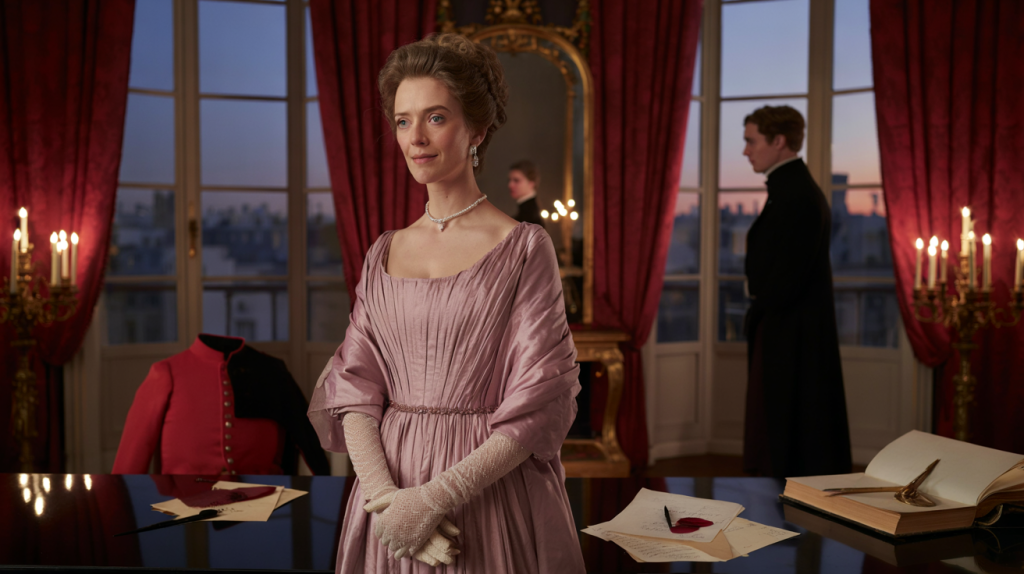
Meta: Camille Razat stirs buzz around a new mini-series of Stendhal’s classic. Dates, cast, platform: here is what is public now and how the project could take shape.
All it takes is one name to set a classic back on fire. Camille Razat is suddenly the most searched face tied to a fresh mini-series take on Stendhal’s “Le Rouge et le Noir”, and curiosity spikes fast: when, where, who else.
Context lands quickly. Stendhal published the novel in 1830, a razor sharp portrait of ambition and class that still grips. Screen versions already exist, from the 1954 film to a two part French TV adaptation in 1997 with Kim Rossi Stuart and Carole Bouquet. Razat’s global profile grew with Netflix’s “Emily in Paris”, whose season 4 rolled out in two waves on 15 August and 12 September 2024. The timing feels right, the appetite is here.
Le Rouge et le Noir mini-series: what is official right now
Public information remains focused on the project’s intent rather than locked logistics. A new limited adaptation is in discussion circles with Camille Razat cited in connection, yet key elements such as a confirmed release date, episode count and named broadcaster have not been publicly detailed.
The core story is set. “Le Rouge et le Noir” follows Julien Sorel, his entanglement with Madame de Rénal in provincial Verrières, then his ascent and collision with Mathilde de la Mole in Paris during the 1820s. Any modern mini-series will balance romance and politics, and that usually dictates format. Recent French literary adaptations on television often land between 2 and 6 episodes, designed to keep tension tight while giving characters room to breathe.
There is precedent to manage expectations. The 1997 French TV version arrived as a two part event, each feature length, and it stayed close to the book’s social climb and moral fall. A new iteration is expected to revisit those axis points while updating pace and visual language for today’s viewers who binge.
Camille Razat: a precise fit for a high visibility French classic
Camille Razat, born in 1994, is best known internationally for “Emily in Paris”, which has run four seasons since 2020. That exposure matters in practical ways. It expands potential international pre sales and opens distribution doors, especially for a French language period title that seeks reach beyond France.
Track record helps. When a contemporary star fronts a heritage story, marketing angles multiply across fashion, culture and travel beats. That is not fluff, it drives placements and trailers, then visibility at festivals ahead of broadcast. For audiences, the attraction is simple. Recognizable talent invites new viewers to a nineteenth century text they may not have opened since school.
A small note many miss when chasing rumors. Real casting confirmations in France arrive through official press releases, trade announcements or listings with regulators. The Centre national du cinéma et de l’image animée publishes production filings, and broadcasters like France Télévisions, Netflix, Canal Plus and Prime Video maintain newsrooms. Until those channels name roles, every character assignment remains unconfirmed, even if it looks definitly plausible.
Release window, episodes and where to watch while waiting
Without a dated slot, a realistic window comes from standard timelines. For a prestige period mini-series, filming often runs several weeks, with post production stretching months, especially given costume builds, location work and music. If cameras turn in the first half of a year, a debut late that year or early the next is common. That is a pattern, not a promise.
Episode design will likely reflect the novel’s two distinct arcs. Part one centers on Verrières and Besançon, part two accelerates in Paris. Modern limited series tend to favor compact runs that hold momentum, and they often group finales around event scheduling periods like year end holidays or spring festivals. Broadcasters program accordingly.
In the meantime, there is a smart way to stay current and revisit the material. Watch the 1954 feature to chart how cinema once framed Julien Sorel’s rise, then sample the 1997 two part TV version to see pacing built for living room evenings. Pair that with the book’s 1830 text, accessible in the public domain in many regions. When official updates drop, the context is fresh, and casting announcements make immediate sense.
Bottom line for readers scanning for hard facts. The project is gathering attention around Camille Razat, the source is a cornerstone of French literature, and past adaptations set a clear bar. The moment a platform, date and full cast are locked, they will appear in official publisher feeds and industry listings, not only on social clips. That is the piece that turns anticipation into an actual night on the couch.