
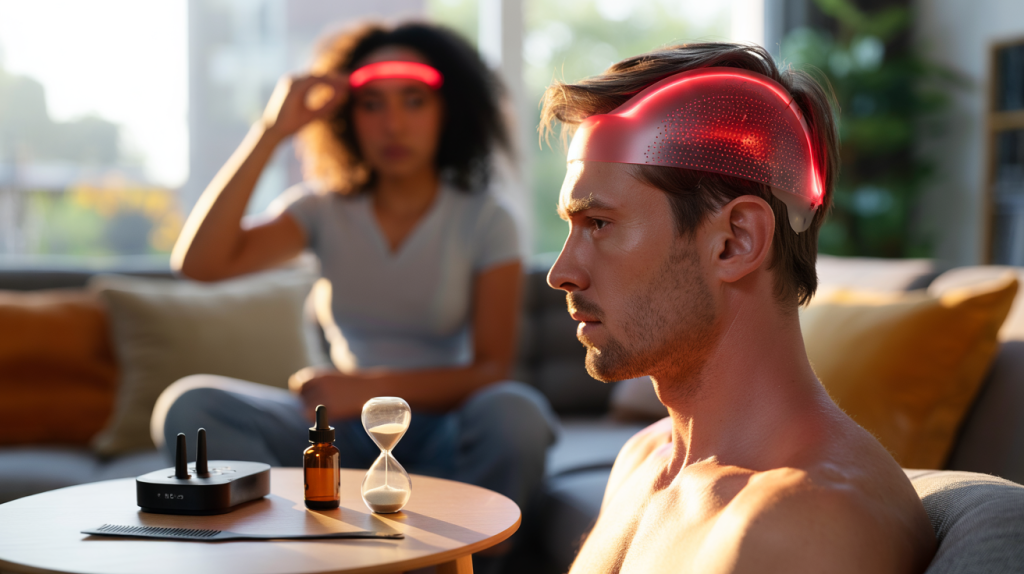
LED hair helmets are everywhere right now. Search feeds are packed with “casque LED cheveux avis”, glossy before afters, and timelines that look almost too good. The core question is simpler than the hype: can a helmet of red light genuinely bring back thinning hair, or is this a shiny detour?
Short answer with context: low level laser therapy is not sci fi. The U.S. Food and Drug Administration first cleared a laser comb for androgenetic alopecia in 2007, and later cleared multiple helmet and cap devices as class II tools. Controlled trials have shown measurable gains in hair counts over months of steady use. The gains are not magic or instant, and results depend on the type of hair loss, but the tech has real clinical backing.
How a LED hair helmet is supposed to help thinning hair
LED and laser devices used for hair target red to near infrared wavelengths, typically around 630 to 680 nanometers, to deliver low level light to the scalp. The goal is to nudge follicles stuck in resting mode back toward growth by improving cellular energy and signaling. That is the theory behind low level laser therapy.
Dermatology groups describe LLLT as a supportive option for pattern hair loss when used consistently and for months. The American Academy of Dermatology notes that at home devices may help some people when used several times per week and often work best as part of a routine that can include minoxidil or prescription treatments. This is not a one week hack. It is a slow, cumulative approach.
What studies and regulators actually report on results and safety
Regulatory timeline first. The FDA granted the first clearance for a hair growth laser device in 2007 and has since cleared multiple helmets and caps in the same category for men and for women via the 510(k) pathway, meaning they are considered substantially equivalent to a previously cleared device.
Now the numbers readers look for. A systematic review and meta analysis in the Journal of the American Academy of Dermatology in 2017 by Ahmed Adil and Michael Godwin reported that LLLT significantly increased hair density compared with sham devices across randomized trials, with mean gains on the order of tens of hairs per square centimeter after about 16 to 26 weeks of use (JAAD, 2017). The authors also reported no serious adverse effects.
Individual device trials echo that pattern. Published clinical studies on FDA cleared combs and helmets have shown statistically significant increases in terminal hair counts versus sham after roughly 24 weeks, alongside improvements in investigator assessments. Adverse events in those trials were typically mild and infrequent, such as transient scalp warmth, dryness, or pruritus reported by a small percentage of participants.
One more practical point from the studies and device labeling: consistency is the lever. Most protocols asked participants to stick with sessions several times per week for months before the primary evaluation window. Stopping early is the most common reason people think the tech did not work.
Price, sessions, and real life use : what to expect day to day
This is not the cheapest lane in hair care. Consumer roundups show a wide price band, with helmets and caps listed from roughly 199 to 2,999 dollars depending on diode count, materials, and brand claims. That spread fits what major retailers and product tests have tracked through 2023.
Session time varies by device. For example, Capillus programs daily 6 minute sessions on certain caps according to its user guides, while iRestore schedules 25 minute sessions every other day in published instructions. Many other helmets fall in the 15 to 30 minute range, two to four times per week. The rule of thumb is to follow the exact schedule in the manual of the chosen device.
Who tends to benefit the most based on the evidence and dermatology guidance: adults with androgenetic alopecia in early to moderate stages, where follicles are miniaturizing but still present. Scarring alopecias, active shedding from medical triggers, or chronic telogen effluvium are different stories that need medical evaluation first.
Buying smarter : casque LED cheveux avis turned into a clear checklist
Readers looking for practical, non fluffy guidance often ask what separates a credible helmet from a gimmick. A quick checklist helps filter noise.
- Look for FDA 510(k) clearance specific to hair loss, and note the exact model name on the clearance.
- Check wavelengths in the red range commonly used in trials, and a diode layout that covers the full scalp, not just the crown.
- Read the usage schedule in minutes per session and sessions per week, then ask if that realistically fits your routine for six months.
- Scan published studies tied to that device or technology for hair count changes and the evaluation window, ideally 16 to 26 weeks.
- Ask about return windows and warranties, since response is variable and consistency costs time.
- Plan combination care: dermatologists often pair devices with minoxidil or prescription therapies for stronger outcomes.
- Avoid brands promising overnight regrowth, dramatic percentages without citations, or unclear contact details.
A common mistake is quitting at week eight when growth still looks stalled. In clinical timelines, visible change often appeared after the three month mark and consolidated closer to six months. Another misstep is using the helmet while also cycling through new shampoos and supplements, then not knowing what helped or hurt. Keeping variables steady for a full evaluation window matters.
If the goal is to translate “casque LED cheveux avis” into a result that shows in the mirror, the missing piece is usually a plan. Confirm the diagnosis of pattern hair loss with a board certified dermatologist, choose a cleared device with published data, commit to its precise schedule for several months, and evaluate with photos under the same light. That is the path readers report as defintely more predictable than chasing ads.