
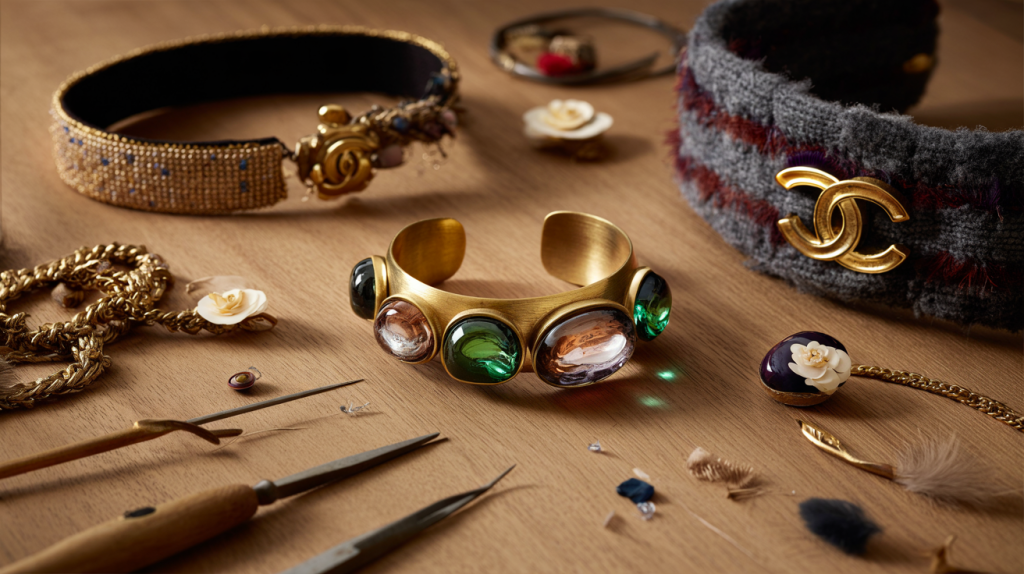
A Chanel cuff that catches light like stained glass. A camellia feathered by hand. These are the small but mighty stars of the Métiers d’Art collections – accessories that turn runway moments into heirlooms. Launched by Karl Lagerfeld in 2002, the annual show champions the maisons d’art that Chanel has nurtured for decades, from Paris to the world.
The stakes feel real because availability is tight and demand runs high. The collection drops once a year in December, in a different city each time. Dakar on 6 December 2022. Manchester on 7 December 2023. That nomadic stage is more than a backdrop. It explains why collectors chase the belts, brooches, minaudières and costume jewelry that appear for a blink and then move to boutique legend.
Chanel Métiers d’Art accessories explained: purpose, timing, impact
The main idea is simple: spotlight the craft houses that transform Chanel silhouettes with specialized techniques, and do it in pieces people can actually wear. Accessories carry that mission fast. They frame a look, then live beyond the runway in wardrobes and archives.
Observation from recent seasons confirms it. Métiers d’Art accessories often showcase one maison at a time – a Goossens cuff with poured glass, a Lemarié feather comb, a Lesage embroidered belt. Chanel states the collection exists to sustain these workshops long term, and the accessories are its clearest bridge to clients.
There is a problem to solve for readers: what truly sets Métiers d’Art accessories apart from Chanel’s seasonal line. Two answers arrive quickly. First, the ateliers. Second, the density of handwork per square centimeter. Chanel’s 19M site in Paris – opened in 2021 – unites these crafts under one roof for collaboration, with the brand reporting more than 25,000 square meters and hundreds of artisans working there.
From Lesage to Goossens: the ateliers behind the sparkle
Dates and names tell the story. Lesage, the embroidery house founded in 1924, is known for elaborate beading that can redraw a cuff or belt into a jewel-like surface. Desrues, created in 1929, develops clasps, ornamental chains and the signature camellia buttons. Goossens, founded in 1950 by Robert Goossens, forges gilded metal and poured glass into couture-like jewelery with a deliberate patina.
Feathers and flowers come from Lemarié, a house tracing roots to the 19th century, while Maison Michel – established in 1936 – shapes hats and headpieces that often become the most photographed accessories of a Métiers d’Art show. Massaro, founded in 1894, handcrafts shoes that anchor the looks. Pleating specialists like Lognon and embroidery house Montex add relief and structure. Chanel’s holding Paraffection, created in 1997, safeguards these names so the know-how stays in daily production rather than in museums.
Context adds clarity. The annual December show is a research lab as much as a spectacle. In Dakar 2022, the jewelry leaned into warm metals and rhythmic beadwork. In Manchester 2023, tweed-adorned chains and punk-tinged chokers nodded to the city’s music heritage. Those references matter – they steer what arrives in boutiques in limited runs after the show.
How to recognize authentic Métiers d’Art accessories
Shoppers often hesitate – the pieces look unique, the codes subtle. A few concrete checks help reduce the guesswork without breaking the spell.
- Look for atelier signatures : Goossens Paris stamps on metal jewelry, Desrues marks on clasps and buttons, Lemarié labels on floral or feather work.
- Inspect construction up close : hand embroidery from Lesage or Montex shows micro-variation in beads and thread tension rather than machined uniformity.
- Read the season code : Métiers d’Art is marked as a special pre-collection between fall and spring – staff can confirm the code on tags or receipts.
- Materials feel intentional : poured glass, gilded brass, painted mother-of-pearl, horsehair, or raffia appear frequently in these drops.
- Provenance matters : Chanel sells fashion in its own boutiques – not online – while vintage and past seasons surface through vetted resale platforms that provide documentation.
A concrete example helps. A metal cuff from Goossens will often pair carved rock crystal or poured glass with gilded brass, carry a Goossens Paris mark, and show tiny bubbles or tonal shifts inside the glass – a sign of artisanal casting, not a flaw.
Prices, rarity, and where to find Métiers d’Art accessories today
Demand keeps building because supply is anchored to craft time. Chanel highlights that Métiers d’Art pieces involve manual steps across several workshops, which naturally limits volumes. The show appears once per year, then selected items reach boutiques in the weeks that follow – not months later – so timing counts.
Numbers frame the ecosystem. Métiers d’Art began in 2002 to actively commission work from the maisons each year. The 19M site launched in 2021 to cluster that production and training. The 2022 show in Dakar on 6 December and the 2023 event in Manchester on 7 December underlined the traveling format that places accessories in dialogue with a city. These dates come directly from Chanel’s public show calendars and fashion-press reports such as Vogue and WWD.
So where to look now. First, speak with a Chanel fashion advisor right after the show season if a specific accessory caught the eye on the runway – availability can be brief. Second, track capsule deliveries tied to 19M collaborations that sometimes echo Métiers d’Art techniques. Third, for past seasons, work with established resale partners that provide atelier stamps in photos and authentic receipts. That last step closes the loop – at once pragmatic and faithful to the craftsmenship that defines these accessories.