
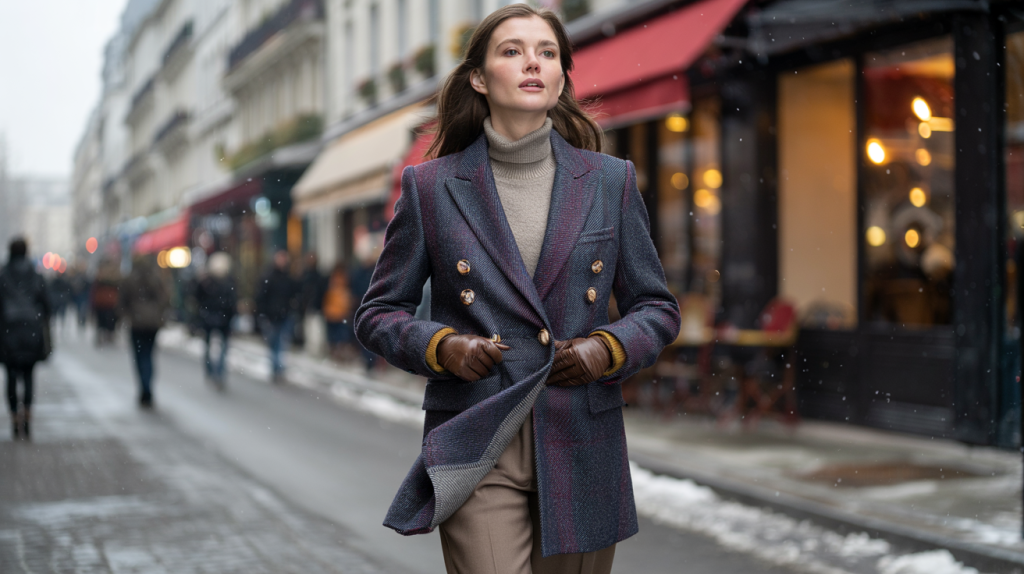
Cold mornings, crowded commutes, office to dinner on the same day. A warm women’s blazer that looks sharp and actually keeps heat solves that daily puzzle. The winning recipe is simple : wool rich fabric, smart lining, considered length, and a cut that layers cleanly over knitwear without bulk.
Here is the point : a blazer for winter must be both insulating and polished. Go for dense wool, tweed, or a wool with cashmere blend, ask for full lining or light quilting, prefer slightly longer silhouettes, and secure closures that block drafts. That mix delivers the sought French keyword vibe people search for with “blazer chaud hiver femme style chic”, while staying practical in real life.
Warm women’s blazer essentials : fabric, lining, length
Start with fabric. Wool traps air naturally and still breathes, so it warms without overheating. The Woolmark Company reports wool can absorb around 30 percent of its weight in moisture without feeling wet, which helps when weather flips from drizzle to metro heat in minutes.
Lining matters. A full viscose or cupro lining glides over sweaters and adds a thin thermal buffer. Some brands add discreet light quilting at the chest or back. You will feel the difference the second the door opens to a gust of wind.
Length plays a role. A slightly longer blazer covers more of the torso and sits better over high waists or dresses. Double breasted closures seal the front and create a clean vertical line. Single breasted stays easier to layer under coats. Different days, different needs.
Common buying mistakes and how to avoid them
Many shoppers pick a thin polyester blazer and hope a thick sweater will fix the cold. The result : bulk at the arms, no structure, still chilly. A dense wool or tweed does the heavy lifting so the knit can stay light and soft.
Size is the next trap. If sleeves crush your cardigan, the blazer will sit stiff and lose elegance. Try on with a mid weight knit and reach forward. If the back pulls, size up or choose a cut with more room at the armhole and shoulder.
Ignore only the price tag and you miss value. The State of Fashion 2024 by McKinsey and The Business of Fashion forecast industry growth of 2 to 4 percent in 2024, and quality still drives repeat wear. Paying once for fabric and construction that last beats buying twice. On the circular side, ThredUp’s 2024 Resale Report projected the US secondhand apparel market to reach 73 billion dollars by 2028, which makes trying pre loved blazers a smart move for style and budget.
What actually keeps a blazer warm : the facts
Insulation comes from fiber, density, and design. Wool and tweed trap air pockets. Dense weaves stop wind sneaking through seams. A careful chest canvas and lining reduce cold spots at the front where you feel it most.
Care extends warmth over time. Brush wool to lift the nap, steam lightly to restore shape, and rest it on a wide hanger. Clothes that keep structure keep heat. The Ellen MacArthur Foundation highlighted in 2017 that clothing utilization had fallen by 36 percent in the preceding 15 years. Choosing a blazer built to be worn often counters that slide and saves money.
Trends can help rather than distract. Quiet, tailored pieces keep leading office and dinner looks. McKinsey and The Business of Fashion pointed to premium basics and enduring tailoring as resilient in 2024. A winter ready blazer rides that wave with ease, without shouting.
Here is a quick checklist that readers keep on their phone when shopping.
- Fabric : wool or tweed for warmth, wool with cashmere for softness
- Lining : full lining or light quilting for smoother layering
- Cut : room at shoulder and armhole to fit a knit without strain
- Length : slightly longer for coverage, cropped only with high waists and indoor days
- Closures : double breasted for extra seal, quality buttons that stay put
- Certification : RWS for wool, OEKO TEX Standard 100 for finishes
- Care : steam not high heat, brush wool, rotate wear days
- Where to buy : mix retail and trusted resale to stretch budget
Styling ideas that work now for a chic, warm winter look
Office to after hours can be easy. Try a gray tweed blazer over a thin merino rollneck, tailored trousers, and leather ankle boots. Swap the knit for a silk shirt indoors. The blazer does the warming, not the sweater bulk.
Weekends invite texture. A herringbone blazer with straight jeans and a ribbed henley reads relaxed but sharp. Add a scarf when the temperature drops, then pocket it when the sun shows. Definitly a no fuss uniform.
For dress days, a longer navy blazer over a knit midi dress balances softness and structure. If wind picks up, button the front and slide gloves into the side pockets. The silhouette looks polished, still practical on icy pavements.
Final tip that ties it all together : treat the blazer as outerwear on mild days and as a mid layer when the freeze hits. A tailored coat sized to fit over your blazer locks warmth, then peels off at the restaurant without crushing the look. That is how a “blazer chaud hiver femme style chic” moves through real life, from coffee runs to night trains, without drama or shivers.
Sources : The Woolmark Company, absorption property page. McKinsey and The Business of Fashion, The State of Fashion 2024. ThredUp, 2024 Resale Report. Ellen MacArthur Foundation, 2017 report on the new textiles economy.