
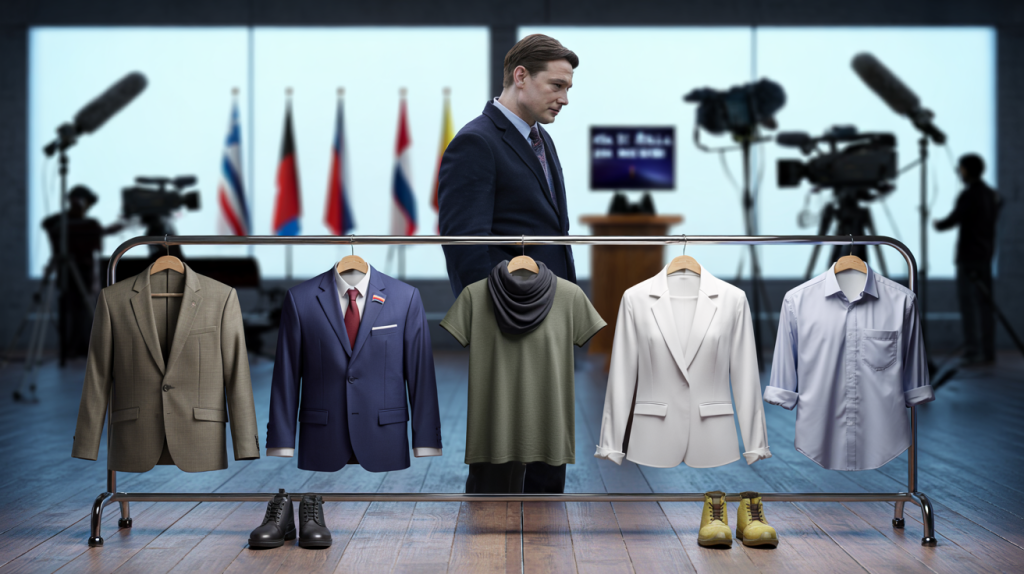
Before a word is spoken, an outfit speaks. In politics, clothing functions as a message channel, shaping trust, authority and proximity in a few seconds. Campaign veterans treat jackets, ties, dresses and shoes like copy on a poster, because voters read them just as fast.
There is data behind the instinct. A 2013 national survey by Lake Research Partners for the Women’s Media Center project “Name It. Change It.” found that mentioning a female candidate’s appearance, whether positive or negative, reduced voter support by up to 7 percentage points. That single number explains why wardrobe strategy sits inside political communication plans alongside slogans and media buys.
Political communication and clothing : the signal before the speech
The main idea is simple and stubborn. Clothing sets the frame for how a leader is heard, especially in the first ten seconds that decide attention. Formal cut signals competence, a softer fabric invites warmth, a rolled sleeve quietly says action.
Campaigns run into a recurring problem. The wrong visual can drown the message, creating a day of headlines that no policy can fix. The 2014 debate over Barack Obama’s tan suit showed how a color can hijack a news cycle, even without a quote to dissect.
Observation from the field comes back to context. What works in a factory town can feel off in a parliament hall. The same jacket reads diferent under fluorescent lights or on a smartphone screen. That is why teams test outfits like they test lines.
Research on color and formality : what studies suggest
Experimental psychology gives some contours. In 2012, Hajo Adam and Adam Galinsky published “Enclothed cognition” in the Journal of Experimental Social Psychology, showing that wearing clothes associated with a role can change cognitive performance. It was not fashion gossip, it was measurable behavior in a lab.
In 2015, Michael Slepian and colleagues reported in Social Psychological and Personality Science that formal clothing increased abstract thinking. Translated to a rally or a debate, formality can nudge a leader toward big picture framing, while casual wear may invite concrete, here and now talk. That match between form and message helps speeches land.
Media effects research adds a caution for women in public life. The “Name It. Change It.” finding from 2013, based on a national sample, showed that any focus on a woman candidate’s looks damaged her voter standing by as much as 7 points. Communication teams use that number to actively redirect interviews and to avoid wardrobe choices that attract appearance chatter.
Real world case studies : Obama, Melania Trump, Volodymyr Zelensky, Alexandria Ocasio Cortez, Jacinda Ardern
August 2014, Washington. Barack Obama’s tan suit appeared at a press conference and generated a wave of commentary that overshadowed policy talk. The clothing became the news peg, a textbook case of framing drift.
June 21, 2018, Texas. Melania Trump boarded a plane wearing a jacket printed with “I really do not care, do u?” The image raced across global media within hours. Whatever the intended meaning, the garment set the agenda for that trip’s coverage.
From late February 2022, Volodymyr Zelensky chose olive T shirts and fleeces during daily wartime addresses. The utility look, consistent for months, aligned with the role of commander in a country under attack and helped compress distance with citizens and soldiers.
September 13, 2021, New York. Alexandria Ocasio Cortez attended the Met Gala in a white dress with “Tax the Rich” across the back. Supporters and critics debated the juxtaposition, but the communication logic was clear. The outfit carried a policy slogan into a pop culture arena.
March 2019, Auckland. After the Christchurch attacks, Jacinda Ardern wore a black headscarf while meeting families. The choice signaled solidarity and respect within hours of the tragedy. No speech could have moved that fast.
Campaign playbook : how to use clothing without noise
The analysis points to a practical gap. Teams often plan the backdrop and forget the person inside the frame. Closing that gap reduces message leakage and earns credibility.
Here is a tight checklist used by advanced operations, adaptable to local culture and law:
- Start from the message goal : choose fabrics, color and formality that fit the tone of the day, not personal taste.
- Map the audience and the room : what reads as respectful at a memorial may look distant at a doorstep visit.
- Stress test under cameras : sit, stand, walk, mic up, and film in the actual light to catch glare, fit issues or unintended symbols.
- Minimize novelty during crises : repeat a simple, neutral uniform so attention sticks to the update, not the outfit.
- Pre brief the press team : give one crisp sentence on the visual choice if asked, then pivot back to policy.
The missing element is continuity. Voters learn a visual language over time. Angela Merkel’s consistent blazers in many colors built a recognisable silhouette that never competed with her words. The same logic applies to a mayor in work boots or a legislator in restrained suits. Choose a lane, align it to strategy, and keep it steady across dates and platforms.