
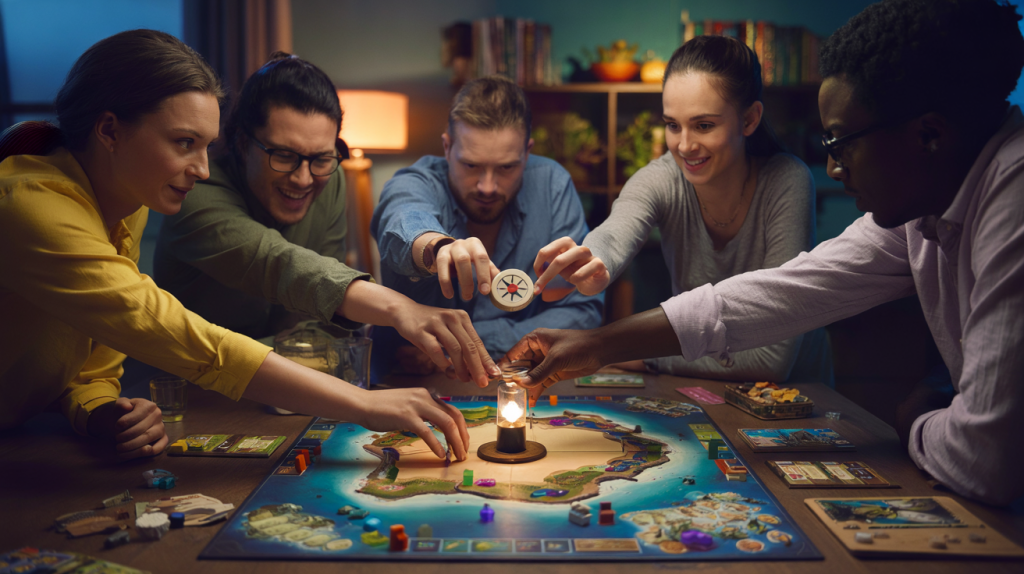
Arguments over rules, one winner, everyone else sulking. Collaboration mode flips that script. Cooperative board games ask the table to beat the puzzle together, share ideas in real time, and celebrate one outcome. No bystanders, no sore losers, just a shared mission.
The trend is not a niche. Families and friend groups moved fast toward co-op play as staying home reshaped habits. According to The NPD Group, U.S. toy sales rose 16% in 2020, with Games and Puzzles up 18% year over year. Awards followed the shift: “Hanabi” won Spiel des Jahres in 2013, “The Crew : The Quest for Planet Nine” took the 2020 Kennerspiel des Jahres, and legacy campaigns such as “Pandemic Legacy : Season 1” pushed collaborative storytelling into mainstream chatter.
Cooperative Board Games : Why Collaboration Mode Changes Everything
The main idea is simple: the table plays against a system. That could be a spreading virus in “Pandemic” (2008), ancient spirits defending an island in “Spirit Island” (2017), or a tight communication challenge in “The Crew” (2019). Each turn asks for coordination and small sacrifices. The reward is collective, not individual.
Observation from living rooms is clear. Co-op mode lowers the barrier for mixed-experience groups. Newcomers can ask questions without fear of being targeted, kids feel included, and seasoned players still get depth. The problem many groups want to solve is classic: less tension, more togetherness, while keeping brains switched on.
There is a catch. Co-op play can slip into one voice dominating. The so-called alpha player tells everyone what to do. That drains agency and fun. Some games counter this with hidden information, timed rounds, or constrained communication. Others need a social fix: quick table agreements before the first shuffle.
Avoiding Alpha Player Syndrome : Common Mistakes et How To Fix Them
One mistake appears in minute one: explaining strategies while teaching rules. Let the first game breathe. Learn by doing, then debrief. The second mistake is open hands when the design expects secrecy. “The Crew” works because players share limited clues; reveal everything and the tension evaporates.
Another trap is over-scheduling. A 120-minute epic like “Gloomhaven” (2017, 1 to 4 players) shines on focused nights but flops when people drop in and out. Short formats exist for a reason. “Forbidden Island” (2010, 2 to 4 players) runs 30 minutes and still delivers a tight arc.
Concrete example that keeps tables happy: agree on table talk limits before starting. For “Pandemic”, try this simple rule – ask questions, do not give orders. For “Spirit Island”, assign quick roles like threat scanning or power reminders so everyone contributes. These small choices prevent drift into quarterbacking and keep decisions distributed.
Numbers That Matter : Sales, Awards, et Milestones Shaping Co-op Play
NPD data set the stage : U.S. toy industry sales climbed 16% in 2020 while Games et Puzzles jumped 18% year over year (source : The NPD Group). Retailers reported sustained demand into 2021, with puzzles and games staying in the weekly baskets as social plans slowly returned.
Awards anchored legitimacy. “Hanabi” took the 2013 Spiel des Jahres for its clever limited communication twist. “Pandemic Legacy : Season 1” landed in 2015 and popularized campaigns that change the board permanently between sessions. “The Crew : The Quest for Planet Nine” released in 2019 and won the 2020 Kennerspiel des Jahres for sharpening the co-op trick-taking concept. Dates matter because they mark an evolution : from puzzle fireworks to narrative arcs to quick, replayable missions.
Release cadence did not slow. “Mansions of Madness : Second Edition” (2016) paired app support with teamwork to handle complex mythos logic. “Arkham Horror : The Card Game” (2016) built expandable, story-driven cooperation in 60 to 90 minutes. A pattern emerges: shorter rules, clearer roles, and tension curves that peak by the last turn.
How To Choose A Collaboration Game : Fit The Table, Not The Hype
Pick by group size, time window, and tolerance for rules. Theme matters too – saving cities feels different than decoding silent clues. Start from need, not the box art.
Here is a quick field guide with proven co-op picks by situation :
- Fast family night : “Forbidden Island” (2010, 2-4 players, 30 minutes) for accessible teamwork and rising water tension.
- Brainy duo or trio : “The Crew : The Quest for Planet Nine” (2019, 2-5 players, 20 minutes) for tight communication puzzles across 50 missions.
- Deep strategy group : “Spirit Island” (2017, 1-4 players, 90-120 minutes) for asymmetric powers and layered planning.
- Narrative fans : “Arkham Horror : The Card Game” (2016, 1-2 players out of the box, campaigns) for story arcs and deckbuilding.
- Big box adventure : “Gloomhaven” (2017, 1-4 players, long campaign) for tactical combat and persistent character growth.
- Classic outbreak fight : “Pandemic” (2008, 2-4 players, 45 minutes) for clean systems and escalating pressure.
A logical path emerges once preferences are clear. If alpha play worries the group, favor designs with constrained communication like “The Crew” or hidden hands like “Hanabi”. If long campaigns sound thrilling, “Pandemic Legacy : Season 1” (2015) delivers a finite, evolving story in roughly 12 to 24 sessions. Want a quick resettable rush after dinner? “Forbidden Island” lands in under half an hour.
The missing piece many tables overlook is pacing. Rotate who makes the final call each turn to distribute spotlight. Add a sand timer for discussion if choices balloon. And when a scenario is lost, resist restarting immediately. Debrief the failure, tweak one strategy, try again next week. That rhythm keeps challenge high and the experience definitly shared, which is exactly why collaboration mode in board games keeps winning nights.