
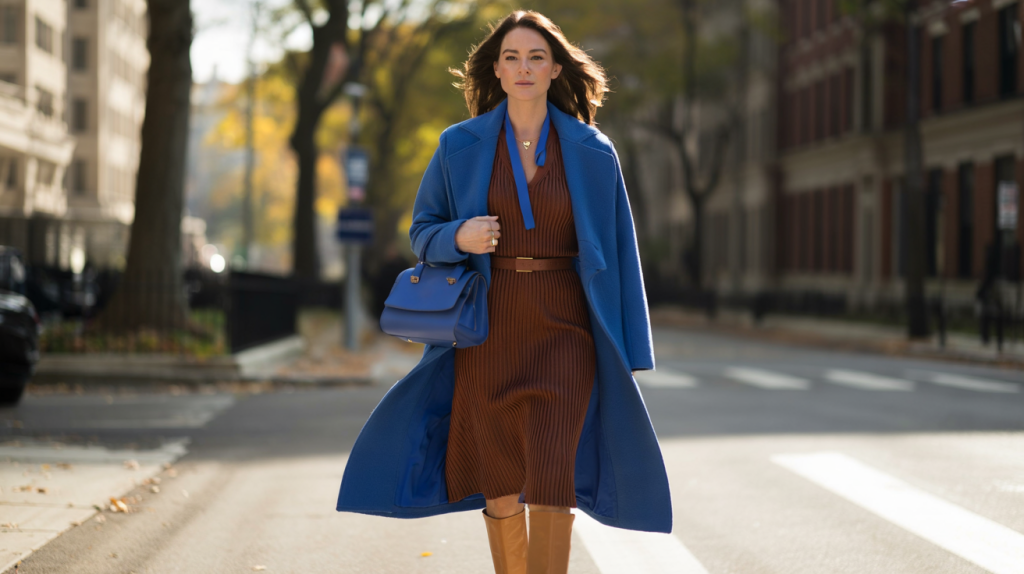
Fall often pushes wardrobes toward camel and charcoal. Then comes the twist that wakes everything up: color block looks that brighten cold mornings, lift a mood, and make last year’s coat feel new again.
This is not about clashing for the sake of it. Color blocking is a precise way to pair solid hues so the whole reads polished, not loud. The method returns every autumn on runways and sidewalks because it gives structure to strong color and layers. Think saturated red with burgundy, forest with teal, cobalt with chocolate. Recent seasonal palettes support it, from Pantone’s 2024 focus on comforting warmth to autumn trend decks spotlighting earthy greens and lively oranges. Source : Pantone, 7 December 2023.
Color block autumn looks for women : what works now
One clear observation keeps coming back: color blocking thrives in fall because layers let shades stack without visual noise. A coat, a knit, a bottom, a bag. Four planes, clean edges.
There is also psychology behind the appeal. Research shows perceived color carries emotional signals that people read quickly, which helps bold outfits feel intentional. Warm hues skew energetic while blues calm. Source : Andrew J. Elliot and Markus A. Maier, Annual Review of Psychology, 2014.
The solvable problem is fear of looking overdone. The fix starts with families of hues that like each other in cold weather: red to burgundy, orange to rust, moss to emerald, cobalt to navy, chocolate to camel. Then decide who leads and who supports. When one shade clearly sets the tone, the rest fall in line.
How to build a color block outfit for fall layers
Begin with a simple structure. Pick a hero color you enjoy wearing near the face, add a supporting shade on a larger surface, ground with a quiet neutral. That is the three step formula for crisp blocks.
Real outfit example that works in minutes: cobalt coat, chocolate knit dress, tan knee boots. Or swap to a burgundy blazer, soft pink turtleneck, oxblood trouser. The edges between pieces do the talking, not prints.
Texture matters in autumn light. Matte wool tames neon. Satin catches sun at 5 p.m. Leather sharpens pastels. A ribbed knit next to smooth twill helps each color read clean rather than blended.
Looking for structure you can repeat without thinking. Try this once, then remix all season:
- Lead color on the outer layer : coat or blazer
- Support color on knitwear : crew or turtleneck
- Ground color on the bottom : denim, tailored trouser, midi skirt
- Echo color in an accessory : scarf, bag, tights
- Metal finish to unify : gold warms reds and browns, silver cools blues and greens
Color blocking mistakes in fall outfits and how to fix them
Too many hues at once is the classic trap. Cap the palette to three clothing colors. The 60 30 10 rule still saves the day: one dominant, one secondary, one accent.
Another misstep is mixing saturation levels that fight. A vivid sweater next to a dusty skirt can look off. Either lift the skirt to a cleaner tone or mute the knit one notch. Similar intensity equals harmony.
Undertones get ignored, then the outfit feels uneasy. Warm reds, oranges, olives want other warm neighbors and creamy neutrals. Cool blues, violets, teals pair best with optical white, charcoal, ink. Check the foot of the mirror and notice if skin reads tired. If yes, shift the neck color warmer or cooler by a shade.
One more glitch appears with proportions. If the hero color sits only in a tiny bag, the message gets lost. Move it to a bigger plane like a cardigan or wide scarf. Small accessories can then repeat it cleanly.
Shopping and wardrobe strategy : palettes, textures, budget
Start in the closet before buying anything. Pull three pieces in one family, three in a second family, plus two strong neutrals. You just built a nine piece mini capsule that mixes into at least 18 outfits across the month.
When adding new items, shop by fabric and color first, not by trend name. Wool coat in cobalt, ribbed merino in rust, velvet skirt in forest. These surfaces are why fall blocks look rich on camera and in real life.
Keep costs in view with a simple math check. If a red coat at 180 is worn twice a week for ten weeks, cost per wear drops to 9 by the end of the season, then halves again next year. Rotate with a neutral coat to extend life and avoid style fatigue.
Runway and industry calendars can guide timing. Autumn palettes roll out from February to September each year as brands present and deliver collections, which means the best color ranges hit stores before the first cold snap. Many retailers quietly restock core shades mid season, so revisiting a saved page two weeks later often pays. Source : Vogue Runway, February 2024 reporting on fall shows.
The last missing piece is small but powerful: connectors. Tights, scarfs, gloves, knit beanies. Add one in your lead color and the whole look locks together, even on the busiest days.