
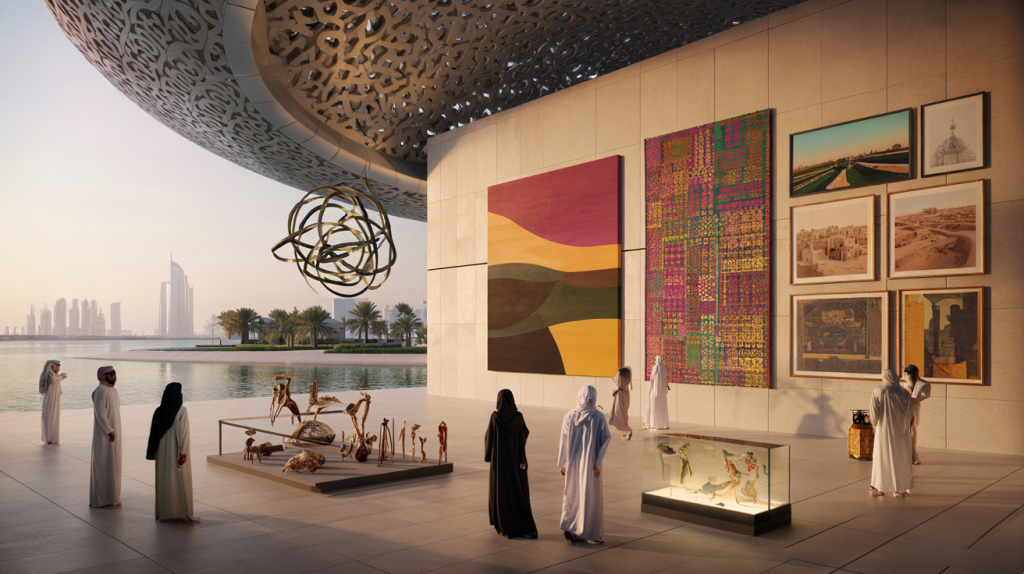
From Sharjah to Riyadh and Doha, contemporary Arab art is stepping into the spotlight. Here are the facts, places and names shaping this fast rise.
Across the Middle East and North Africa, contemporary Arab art has shifted from niche to headline. New museums, biennales and serious collectors are redrawing the map, while artists from Casablanca to Baghdad push bold ideas into the global conversation.
The infrastructure tells the story. Louvre Abu Dhabi opened in 2017 as a world museum on the Gulf waterfront (Louvre Abu Dhabi). Mathaf: Arab Museum of Modern Art launched in Doha in 2010 to foreground regional modernity usually left out of textbooks (Qatar Museums). Sharjah Biennial 15 gathered more than 150 artists from over 70 countries in 2023, a pointed scale-up that echoed far beyond the region (Sharjah Art Foundation, 2023). The first Diriyah Contemporary Art Biennale in Riyadh ran December 2021 to March 2022, signaling a long term Saudi cultural program (Diriyah Biennale Foundation). On the market side, Christie’s held its first auctions in Dubai back in 2006, laying a commercial runway that now intersects with global sales of about 65 billion dollars in 2023 (Art Basel and UBS Global Art Market Report 2024).
Contemporary Arab art now: themes, cities, names
The main idea is clear: artists are narrating present tense histories. Memory, migration, ecology, language – all take center stage, not as labels but as lived material.
Lebanon-born Etel Adnan turned color and poetry into luminous modernity untill her passing in 2021. Mona Hatoum compresses displacement into objects that look domestic and feel charged. Saudi artist Ahmed Mater filters archaeology and urban change through X-rays and aerial views. Morocco’s Hassan Hajjaj flips fashion and street culture with electric patterns. In Egypt, Wael Shawky revisits chronicles with puppets and song to probe how stories travel.
None of these practices sit in a single box. Some are conceptual, some tactile. Many are fluent in video or sound and just as comfortable in printmaking or tapestry as in sculpture. Audiences meet voices that refuse a single narrative line.
Hard facts: fairs, biennales and the rise of new institutions
The regional calendar has become a backbone for visibility and research.
Sharjah Biennial 15 – running February to June 2023 – presented works by more than 150 artists from over 70 countries across multiple venues, a scale confirmed by the organizer’s own roll-out (Sharjah Art Foundation, 2023). That breadth helped curators and journalists look again at under-seen archives and practices.
In Saudi Arabia, the Diriyah Contemporary Art Biennale opened its inaugural edition in December 2021, closing March 2022, marking the country’s first major biennale dedicated to contemporary art and embedding education as a pillar (Diriyah Biennale Foundation). It joined a wave of non-profit initiatives developing curatorial training and residencies.
Institutional anchors keep multiplying. Louvre Abu Dhabi’s 2017 launch created a civic museum with global loans and a permanent collection that places the region inside a shared art history (Louvre Abu Dhabi). Mathaf’s 2010 opening established a dedicated home for Arab modern art, an essential reference for early and mid twentieth-century movements from Baghdad to Khartoum and beyond (Qatar Museums).
Markets have followed the energy. Christie’s early move to Dubai in 2006 validated a collector base that has since diversified across the Gulf and the diaspora (Christie’s). At the global level, the Art Basel and UBS Global Art Market Report 2024 estimated total art sales at around 65 billion dollars in 2023, a context where galleries cite growing interest from Middle Eastern buyers and institutions.
How to discover and collect without the unecessary stress
Many newcomers feel overwhelmed by labels or geopolitics. The fix is practical and slow, not expensive.
- Start with public programs: museum talks at Mathaf or Louvre Abu Dhabi and biennale walkthroughs offer context straight from curators.
- Track artist-led spaces and residencies in Beirut, Amman or Marrakech to spot early careers before the fair season.
- Read catalogues from Sharjah Art Foundation and Diriyah Biennale Foundation for timelines, not just images.
- If collecting, request provenance and condition reports and ask about artist royalties or resale rights in the gallery’s country.
- Build relationships: follow studio visits, commission small works, support archives or publications that keep the scene documented.
Concrete example helps. A first-time buyer might begin with a print by Hassan Hajjaj at a gallery in Dubai, then visit a research show on Sudanese modernism in Doha to understand how current practices echo earlier schools. Costs stay reasonable while knowledge compounds.
What shifts next: education, archives and digital reach
Education is the missing infrastructure that is now appearing. University courses and curatorial fellowships attached to regional institutions are turning oral histories into shared syllabi, so exhibitions no longer start from zero each time.
Archives matter just as much. Cataloguing estates from artists who worked in Baghdad, Damascus or Algiers during the twentieth century helps protect works and stabilize markets. It also prevents misattribution when pieces surface at auction.
Digital channels change access. Artists post works in progress, biennales stream talks, and museum databases improve searchability. That visibility encourages collaboration with South American, African and Asian scenes facing similar questions of translation, migration and modernity.
The throughline is simple to read. Since 2010, durable institutions, high level biennales and engaged collectors have created a structure that artists can lean on. The result is not a trend but a field with its own timelines, ready to be read in full view.