
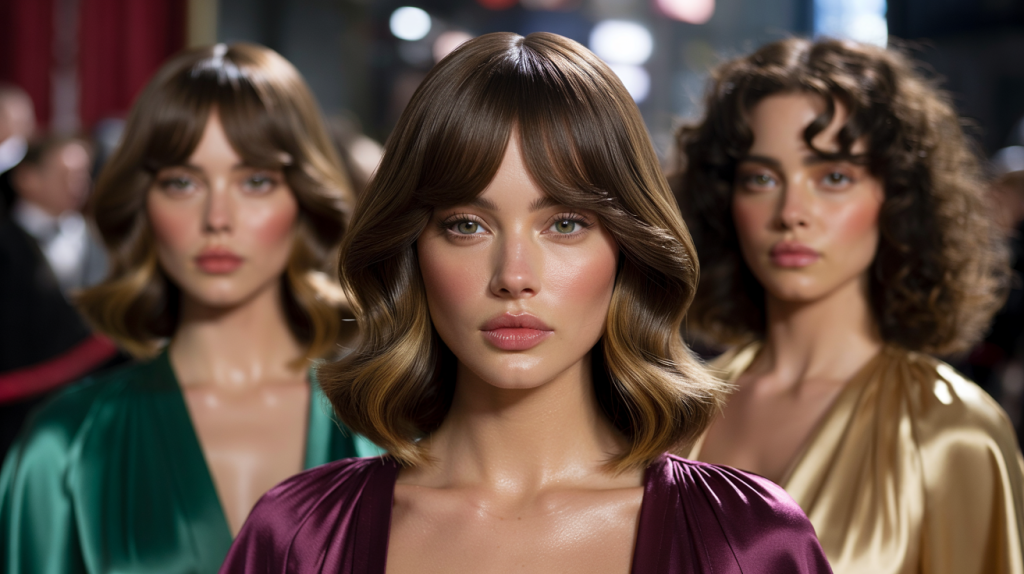
Curtain bangs celebrities : the fast-track fringe everyone keeps copying
Spot a red carpet, a tour backstage, or a just-left-the-salon selfie, and there it is again : the soft, center-parted fringe that skims cheekbones. Curtain bangs have become a quiet uniform for stars who want change without the shock, from Dakota Johnson’s long, parted veil to Jennifer Lopez’s airy, shoulder-blending layers, and Sabrina Carpenter’s stage-friendly swoop.
The look is not new. Brigitte Bardot wore it in the 1960s, Goldie Hawn turned it playful in the 1970s, then a modern wave hit mid-2010s as Dakota Johnson’s 2015 press tour made the cut a signature. By 2021 the style flooded social feeds and stayed there, which says a lot in beauty years. Why this fringe, and why now? Because it frames, softens, and grows out nicely. That solves the everyday fear of bangs regret.
Curtain bangs on celebrities : what it is, why it works
Think of curtain bangs as a fringe with a middle split that drapes to each side, starting shorter near the center and lengthening toward the jawline. The result : cheekbones look higher, foreheads look softer, and layers get movement without committing to a blunt line.
Celebrities use it like a switch. Alexa Chung leans effortless cool, Suki Waterhouse makes it romantic, Camila Cabello wears a choppier version that reads fresh on camera. In 2024, soft, grown-out curtains on Sabrina Carpenter show how the cut survives touring schedules and constant styling. It reads polished in photos and still looks lived‑in off duty.
There is a practical side : the grow-out phase is kinder. Instead of that awkward mid-forehead line, the fringe simply becomes face-framing layers within 6 to 8 weeks, which is why stylists keep recommending it during seasonal refreshes.
Face shapes, hair types : who curtain bangs flatter
Oval and heart shapes get instant balance because the parted fringe narrows the upper face while spotlighting eyes. Round faces benefit from longer corners that hit below the cheekbone to create vertical lines. Square jaws soften when the inner pieces sit around the brow and taper below the jaw.
Texture matters. Straight hair delivers the swish with the least effort. Wavy hair gets that French-y bend naturally. Curls can absolutely wear curtain bangs too – the key is cutting dry and keeping the shortest center pieces long enough to bounce without springing too high. A 70 – 30 off-center part can help if cowlicks fight a dead-center split.
Daily life test. This fringe still ties back into a bun, still tucks behind ears, and blow-dries in under 10 minutes with a round brush or a large curling barrel. That mix of pretty and practical explains its celebrity staying power as much as any runway trend.
How to ask your stylist, without missteps :
- Bring 2 to 3 reference photos of the exact length you want at the center and at the corners.
- Specify the end point : cheekbone, jaw, or collarbone – and say which side you naturally part on.
- Request soft point-cut ends and invisible layers so it grows out as face-framing pieces.
- For waves or curls, ask for a dry cut and a slightly longer center to prevent shrinkage.
- Book a micro-trim in 6 to 8 weeks, not a full reshape, to keep the drape intact.
Pro technique and maintenance : celebrity hairstylist playbook
The cut usually starts at the bridge of the nose or the top of the cheekbone, then descends diagonally toward the jaw. That gradient is what opens the face like curtains. A center part is classic, but many on-camera looks cheat a couple of millimeters to the stronger brow side for symmetry on photos and video.
Blowout cue : lift the fringe up and forward at the roots with a medium round brush, then let it fall to each side as it cools. A large barrel tong rolled away from the face for 3 to 5 seconds sets the curve. To avoid helmet vibes, pinch the ends with a pea of lightweight cream or a mist of texturizing spray.
Maintenance stays light. Oil-prone hair can wash the fringe alone between shampoos. Gym days call for a quick blast of dry shampoo from underneath. Color grows out safely because the longest corners blend into the haircut. And if a role, shoot, or season calls for change, the fringe can be tucked, pinned, or reshaped into longer layers without a big chop. Effortlesly adaptable, which is the point.
For those chasing a specific celebrity reference, timing helps. A 1960s Bardot-inspired version sits shorter and flips more. A 1970s Farrah Fawcett nod needs bigger layers through the crown. For today’s camera-first life, the modern Dakota Johnson approach keeps the center at or just below the brow bone so it reads sleek under flash and studio lights. That last tweak is often the missing step between a nice cut and a camera-ready one.