
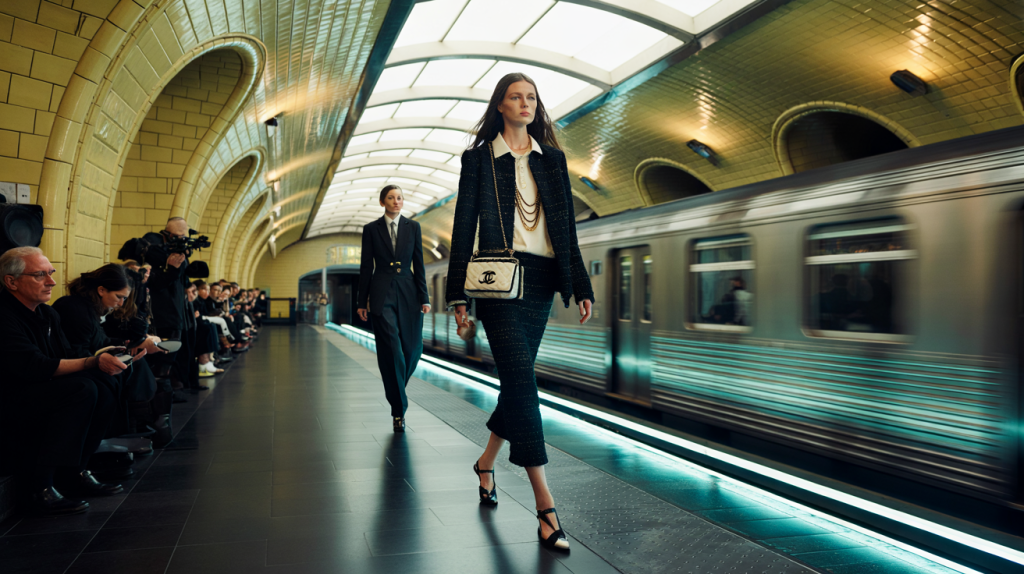
Chanel in the NYC subway. Feasible, buzzworthy, and far from random. Here is what a New York metro runway would actually involve, where it could happen, and why it fits.
Fashion meeting turnstiles in New York catches attention fast. A Chanel runway slipping underground is the kind of cultural moment that makes global headlines, blending a century-old transport network with a house built on spectacle.
The context already exists. The New York City Subway, opened in 1904 and counting 472 stations according to the Metropolitan Transportation Authority, has long doubled as a cinematic stage. Chanel has history in the city too. On 4 December 2018, the house presented its Métiers d’art collection at the Metropolitan Museum of Art inside the Temple of Dendur, a statement night documented by Vogue Runway. So the question readers care about is clear : could a défilé Chanel happen in the New York subway, what would it look like, and which stations make sense.
Chanel x New York Subway : why the pairing makes sense
The brand thrives on civic icons. Under Karl Lagerfeld, the Grand Palais in Paris turned into a supermarket in March 2014, an airport for October 2015, and even a spaceport with a rocket set in March 2017. New York carries that same theatrical power, only rawer, faster, louder.
The subway brings a democratic edge that luxury keeps chasing. Pre-pandemic weekday entries topped 5 million in 2019, according to MTA ridership data, which shows the daily pulse Chanel would be tapping. It is not just backdrop. It is audience energy, movement, steel, tile, and neon.
There is also memory. The 2018 Met show proved Chanel can anchor a high craft narrative in New York without losing French identity. Swapping museum marble for vaulted stations would extend that storyline, not break it.
Stations, permits, logistics : what it would actually take with the MTA
Two historic sites sit at the top of any credible shortlist. City Hall station, opened in 1904 and closed to passengers in 1945, is famed for its Guastavino tiles and skylights. The New York Transit Museum periodically offers member tours there. In Brooklyn, the decommissioned Court Street station opened in 1936 and closed in 1946. It now houses the New York Transit Museum itself, which frequently hosts private events through its MTA-partner program.
Operationally, events in active stations are possible but strict. The MTA and the City’s film and events offices require insurance, safety plans, trained security, and coordination of crew access outside peak hours. Crowd control, electrical isolation, and surface protection are non-negotiable. Grand Central Terminal – although a Metro-North hub rather than a subway station – demonstrates how large-scale shoots and galas can run within a live transit environment.
For readers mapping locations, here are the most realistic backdrops by function and look :
- City Hall station : decommissioned jewel with curved platform and skylights, accessed via the Transit Museum.
- Court Street station – New York Transit Museum : controlled environment, period rolling stock, museum-run events program.
- Grand Central Terminal’s Vanderbilt Hall : landmark grandeur with transit DNA, used for exhibitions and galas.
Precedents that matter : from the Met to Chanel’s Grand Palais world-building
Chanel has already set the bar for immersive storytelling. The “Chanel Shopping Center” in March 2014 recoded luxury through everyday aisles. “Chanel Airlines” in October 2015 made check-in desks feel couture-level. The March 2017 rocket liftoff at the Grand Palais delivered a show built for news cycles and social video.
New York got its own headline moment on 4 December 2018 when Chanel staged Métiers d’art at the Met. Guests moved among ancient sandstone, with work from specialty ateliers placed at museum scale. That precedent matters because it shows the house navigating New York permitting, unions, logistics, and late-night installs on a tight clock.
Other luxury players have also used transport romance. Louis Vuitton sent a full-scale train into the Cour Carrée of the Louvre for its March 2012 show, a spectacle catalogued by Vogue Runway. The takeaway is simple : when a city is the co-star, the set becomes the story.
Timing, audience, impact : how a subway runway would land
Off-peak timing would dictate the schedule. Most controlled shoots in transit-heavy spaces load in after last trains and clear before the morning rush. That balances safety with speed. It also suits the kind of midnight-to-dawn precision fashion crews already know.
Audience would likely be a hybrid. A core guest list on site – editors, artists, friends of the house – and a digital-first broadcast for everyone else. The subway, with its echo and geometry, favors moving cameras and tight sound design. Good news for phones and short-form video.
What would complete the picture is a narrative bridge. Chanel’s craft story – embroidery, tweed, jewelled buttons – needs a local thread. New York offers it through cultural institutions and artisans, including partnerships the Met show publicy hinted at. Tie that to a station with history, and the set stops being a stunt. It becomes a living archive with trains.
The final practical layer is logisitics choreography. From MTA approvals to union schedules, from platform load limits to third-rail clearances, the checklists are long. Still, the city has a playbook. The MTA, the New York Transit Museum, and the Mayor’s Office of Media and Entertainment run established processes for special events and filming. With that machinery in place, a défilé Chanel in the New York subway reads less like fantasy and more like a timed operation waiting for a green signal.