
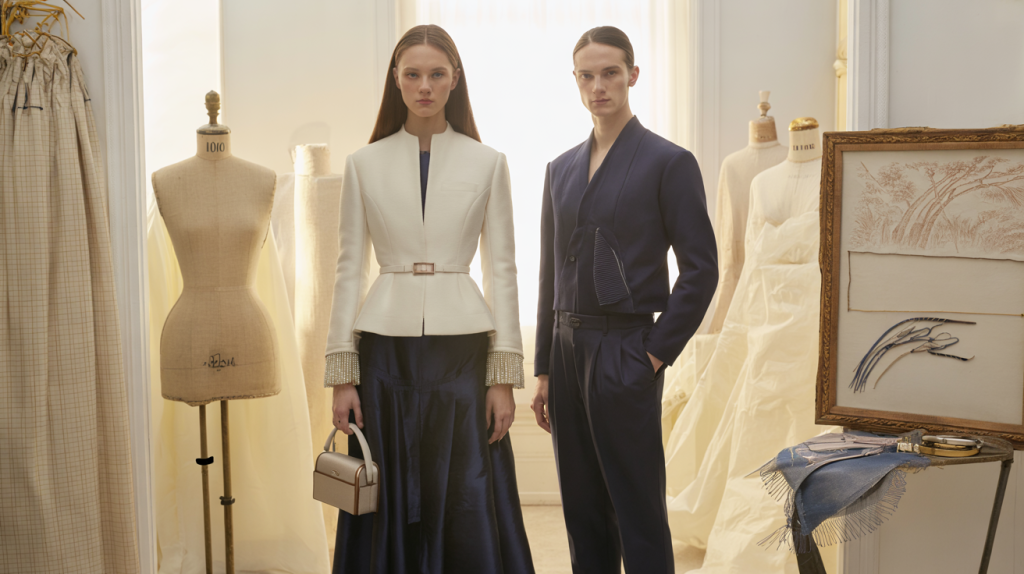
What will matter in wardrobes in 2026 According to Dior, the answer is already on the table: couture level craft, sculpted tailoring, and a calm kind of luxury that reads assured rather than loud. The signals are consistent across womenswear under Maria Grazia Chiuri and menswear under Kim Jones, pointing to pieces built to last and silhouettes that sharpen posture instead of chasing novelty.
Context supports the mood shift. LVMH reported 86.2 billion euros in revenue in 2023, with Fashion and Leather Goods at 42.2 billion euros, a reminder that craft driven houses still anchor global style. Bain and Company estimated the personal luxury goods market at 362 billion euros in 2023, and McKinsey with The Business of Fashion projected luxury growth of 4 to 6 percent in 2024. Momentum stays positive, yet selective, which is exactly where Dior leans in with heritage and technique.
Dior 2026 fashion trends: the house signals now
The main idea unfolds clearly. Dior advances a refined uniform built around the Bar jacket line, nipped waists, fluent skirts or trousers, precision knits, and evening looks that prioritize construction over flash. On the mens side, Kim Jones keeps merging couture ateliers with daywear, elevating soft suiting, pleated trousers, and elevated sneakers or Mary Janes into something quietly exacting.
The observation on runways and lookbooks is steady. Fabrics carry the message first: compact wool, silk faille, technical taffeta, beaded tulle, and raffia style embroideries that track handwork. Color stays strategic rather than decorative, with black, ivory, navy, and muted metallics framing occasional floral or archival toile motifs. Accessories complete the structure instead of stealing the show.
Here is the problem many readers want to solve: how to buy and dress now without feeling dated by 2026. Dior’s response lands on investment dressing with a couture backbone. That means proportion becomes the trend, not micro silhouettes that vanish next season.
Savoir faire in plain sight: craft, tailoring, materials
Dior keeps craft visible rather than hidden. The 30 Avenue Montaigne site reopened in 2022 with La Galerie Dior, underlining that archives and artisans drive current collections. Under Maria Grazia Chiuri since 2016, the womens wardrobe revisits 1947’s architectural lines, but with lighter construction and ease for everyday movement. Kim Jones, artistic director of menswear since 2018, applies haute couture techniques to tailoring and knitwear so pieces drape instead of cling.
Advice lands here with empathy. Many shoppers over index on trend prints or novelty finishes and overlook fit, fabric density, and finishing. Dior’s path suggests reversing that order. Start with shoulder line, waist placement, and hem length. Then consider texture and embroidery as punctuation, not the headline. A Bar inspired jacket with straight leg trousers can handle a day to dinner agenda without costume energy.
Concrete signals match market data. LVMH’s 2023 results highlighted the strength of Christian Dior Couture, even if brand level revenue was not broken out, and the group confirmed sustained investment in ateliers and retail spaces through 2024. Bain and Company’s 2023 study noted resilient local spending and a tilt toward timeless categories, which aligns with Dior’s focus on tailoring and leather goods that age well.
What the numbers suggest for 2026
Stats set expectations rather than hype. The personal luxury goods market reaching 362 billion euros in 2023, per Bain and Company, came with guidance of moderate growth in 2024. McKinsey and The Business of Fashion projected luxury’s 4 to 6 percent rise in 2024, with top houses continuing to outperform. For consumers, this means fewer big trend swings and more refinement cycles. Dior already plays that long game, prioritizing silhouette clarity and artisanal texture.
Logical takeaway for wardrobes in 2026: quality per wear will outrank novelty per post. That does not mean austere. It reads like subtle shine on satin, hand pleating that moves, and jewelry that mirrors archive lines. The aim is coherence from head to toe so the look holds together on camera and in real life.
How to wear Dior’s 2026 codes now
Translating runway signals into daily dressing works best with small, precise steps. Avoid the urge to replace everything. Edit, then build with intent. Here is a compact plan that respects budget and rhythm.
- Anchor with one structured jacket that shapes the waist and frames the shoulder. Pair with fluid trousers for balance.
- Shift to deep neutrals plus one archival print scarf to light up the face without noise.
- Choose one crafted texture per look, like beaded tulle or raffia effect embroidery, so details read crisp not busy.
- Upgrade finishing touches: leather belt with a clean buckle, Mary Jane or sleek loafer, and a small top handle bag.
- Prioritize lining, seam work, and fabric density. They decide drape, comfort, and how often a piece gets worn.
A common mistake is chasing viral micro lengths or hyper logos. Dior’s current direction frames a different path. Let proportion and craft do the talking, then layer in heritage motifs when the outfit already has structure. If a tailor can easily adress shoulder slope or sleeve length, the piece is probably worth keeping.
The missing element that makes this approach complete is time. Give garments a season to settle into routine. Pieces with real construction reveal their best shape after a few wears and a gentle press. By 2026, that patience pays off as Dior’s core codes remain right where the market is heading.