
Inside Dior’s denim innovation, from Oblique jacquard and couture tailoring to lower‑impact processes, with hard numbers and what it means for your wardrobe.
Denim at Dior has shifted from casual standby to a laboratory for craft and technology. The house treats the fabric like a tailored jacket fabric, not a weekend basic, and it shows in the weave, the cut, the finish.
There is a clear business and sustainability context. LVMH, Dior’s parent group, reported 42.2 billion euros in Fashion and Leather Goods revenue in 2023, an advance confirmed in its results on 25 January 2024, so innovation at fabric level carries real weight across millions of products and clients worldwide. At the same time, fashion faces pressure to cut impact and add traceability, which changes how a brand handles denim from loom to store.
Why Dior is betting on denim innovation now
Denim keeps its cultural pull while luxury wardrobes turn pragmatic. Clients want pieces that work daily, with the ease of jeans and the polish of couture. That mix rewards a house that can elevate construction and still feel effortless.
The market is large enough to matter. The global denim jeans market was valued at 64.6 billion dollars in 2022, with a projected rise to roughly 95 billion dollars by 2030, at a 6.7 percent CAGR, according to Grand View Research in 2023. When a luxury name refines denim, the ripple is not niche, it is mainstream.
There is also a heritage angle. Dior’s Oblique motif, designed by Marc Bohan in 1967, now appears as a woven jacquard in denim, not a surface print, turning a workwear fabric into a signature canvas that can be cut, tailored, even pleated without losing identity.
From Oblique jacquard to couture seams, what makes Dior denim different
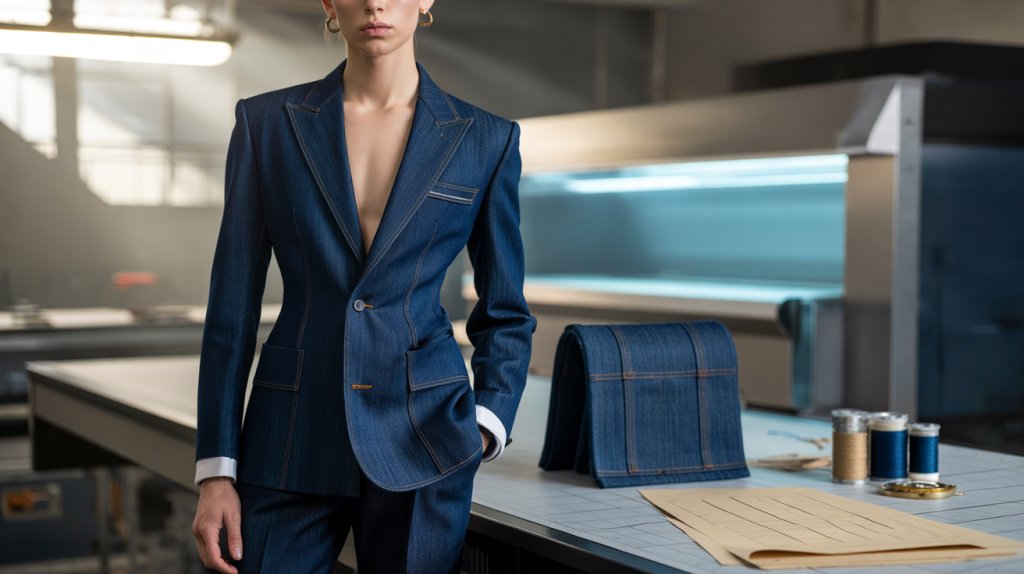
Look closely, the innovation sits in structure. The house uses dense twills and jacquards that hold a crease, so a denim blazer has a clean line and a soft roll at the lapel rather than collapsing like a trucker jacket.
Finishing changes the feel. Edges are taped, pockets are bagged like on suiting, hardware is calibrated to weight, and topstitching aligns with panel lines the way saddle work follows a curve. The result reads quiet, then precise.
Color work shifts too. Instead of heavy stonewashing that flattens the cloth, you often see enzyme or laser treatments that keep the warp and weft definition visible, which keeps the fabric alive under light. That is where denim suddenly looks couture, not rugged.
Impact and numbers, the sustainability bar Dior must meet
The baseline problem is documented. A typical pair of jeans requires about 3,781 liters of water across its life cycle, production and consumer care included, per Levi Strauss and Co., Life Cycle Assessment update in 2015. Multiply by volume and the water story becomes central.
Recycling is still the weak link. Less than 1 percent of clothing is recycled back into clothing in a true textile to textile loop, reported the Ellen MacArthur Foundation in 2017. That makes design for longevity and repair a practical lever now, not a distant ideal.
On the process side, technology exists to slash impacts. Jeanologia cites up to 85 percent reductions in water use for denim finishing through laser and ozone systems, data communicated in 2020. These are the benchmarks clients now expect luxury to deploy.
Dior operates inside LVMH’s LIFE 360 framework, announced in 2021, which sets targets on climate, creative circularity, transparency and biodiversity across the group. LVMH also launched Nona Source in 2021, a platform to reallocate deadstock fabrics from its maisons to new uses, a concrete route for upcycled materials inside the ecosystem. That infrastructure shapes how a Dior denim capsule can be sourced, finished and communicated.
What to watch next, real innovation cues in Dior denim
Shoppers do not need a lab to spot progress. A few simple cues help decode whether the house is pushing denim forward or coasting on a logo.
Here are pragmatic checkpoints when handling a Dior denim piece in store or online product pages :
- Weave definition, a woven Oblique jacquard holds its motif on the reverse, a surface print does not.
- Construction clues, taped seams, bagged pockets, clean hem allowances, these signal tailoring applied to denim.
- Finish language, laser whiskers and ozone fades look precise and soft, heavy stones look random and harsh.
- Material claims, look for specific mill names, cotton origin, or a traceability QR code, vague wording is a red flag.
- Aftercare guidance, clear washing and repair instructions extend life, silence here often means design stops at checkout.
The next frontier is traceable fibers and modular design. If components, from rivets to linings, are chosen for disassembly, denim becomes easier to repair and to recycle later, answering that 1 percent bottleneck with design logic instead of green gloss.
Scale matters too. With Fashion and Leather Goods at 42.2 billion euros in 2023 for LVMH, shifts in a staple fabric can move impact and client experience at once, especially when rolled out across men, women and accessories. A jean, a jacket, a bag panel, this is where innovation becomes visible day to day.
For a millenial or a collector, the appeal is simple. Couture discipline makes denim look sharper, new processes make it feel lighter on the planet, and a recognisable signature like Oblique keeps it Dior without shouting. That mix is why this fabric, so familiar, suddenly feels new again.
Sources : LVMH, 2023 Results Press Release, 25 January 2024. Grand View Research, Denim Jeans Market Size Report, 2023. Levi Strauss and Co., The Life Cycle of a Jean, 2015 Update. Ellen MacArthur Foundation, A New Textiles Economy, 2017. Jeanologia, Environmental Savings Data, 2020.