
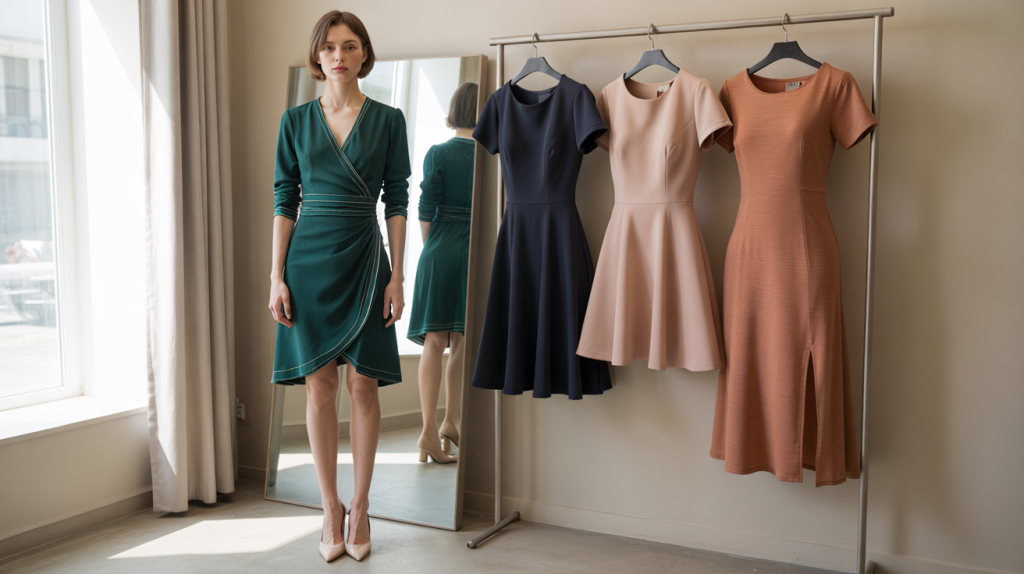
Under 1.60 m and struggling with dress lengths? Discover the cuts, hemlines and petite brands that elongate the figure, with data-backed tips you can use today.
Short stature should not mean short on style. If height sits under 1.60 m, the right dress can lengthen the figure instantly: wrap silhouettes, sharp V necks, high waist seams, clean vertical lines. From the first look in the mirror, the aim is clear — stretch the eye upward, never sideways, while keeping movement and comfort.
Here is the quick context that matters. Many major retailers design dedicated petite lines for women 5 ft 3 in and under, which equals 1.60 m. ASOS lists petite as “5’3/160 cm and under” in its size guide, and Nordstrom’s fit guide mirrors that threshold. For reference, the average height of adult women in the United States is 63.5 inches, or about 161.3 cm, according to the Centers for Disease Control and Prevention using 2015–2018 measurements published by the National Center for Health Statistics in 2021. So yes, the market exists, and the options are real.
Petite under 1.60 m : the dress cuts that elongate
The main idea is simple. Choose silhouettes that create a long vertical column and break the body into balanced thirds. A wrap dress cinches the narrowest point and draws the eye diagonally upward. A fit and flare with a defined high waist lifts the leg line. A clean A line skims without drowning the frame. Monochrome or low-contrast color pairings keep the silhouette continuous from shoulder to hem.
Volume still plays the game, yet in moderation. Fabrics with gentle drape — think crepe, soft twill, fluid jersey — give movement without bulky weight. Strong shoulders or puff sleeves look great when they are scaled to the body. A crisp V neck opens the neckline and visually lengthens from clavicle to chin, a tiny change that reads taller right away.
Length, then. Many petites thrive with hemlines just above the knee, mid knee, or an ankle-grazing maxi that does not puddle. Midi can be superb when the hem hits slightly above mid-calf to avoid cutting the leg at its widest point. If the hemline lenght is off by a few centimeters, the whole proportion slips, which is where a quick alteration saves the day.
Common mistakes that shrink the frame, and how to fix them
Oversized tent shapes hide curves and shorten the torso. So trade a boxy shift for a belted shift, or add a slim belt to define the waist. Drop waists sit low on the hip and drag the eye downward; a higher waist seam lifts everything. Loud horizontal stripes widen; vertical seams, buttons or tonal piping lengthen.
Maxi dresses that pool on the floor steal height. Hem to just cover the ankle bone or skim the top of the foot. Big florals can overwhelm a smaller frame; choose tighter prints or spaced motifs. Shoes matter more than expected — a pointed toe or nude tone to skin extends the leg visually, even in flats.
If shopping online, filter for “petite” before looking at anything else. Retail petite garments adjust more than length: shoulder width, sleeve length, bust dart position and knee placement shift to match a shorter torso and rise. That saves multiple alterations later.
Proportions backed by data : height thresholds and fit reality
Benchmarks help set expectations, especially when deciding between standard and petite sizing. ASOS defines petite as “5’3/160 cm and under” in its public size guide. Nordstrom’s fit advice uses the same 5 ft 3 in ceiling for petite. J.Crew and Banana Republic state petite is designed for women 5 ft 4 in and under, a slightly broader range that can suit those near 1.62 m who still need shorter rises and sleeves.
For context on where most shoppers sit, the Centers for Disease Control and Prevention reports an average height of 63.5 inches for U.S. women aged 20 and over using 2015–2018 National Health and Nutrition Examination Survey data, published by the National Center for Health Statistics in 2021. That average lands just above the common petite cut-off, which explains why many standard dresses run long through the waist and hem for anyone under 1.60 m.
Translation for searchers of “robes pour petite taille moins d’1m60” : you are looking for dresses cut to petite proportions, not only shorter lengths. That distinction reduces returns and trims alteration costs, since the knee, waist and hip are already placed where they should be on a shorter frame.
Where to find petite dresses that actually fit
Dedicated petite lines adjust the full pattern, which means less tailoring and better drape out of the box. Several retailers publish clear height targets and consistent size charts, useful when comparing brands.
Below, a quick-hit guide to silhouettes that work across dress codes.
- Wrap dress : adjustable waist, diagonal lines, wearable from office to wedding.
- Fit and flare : defined high waist with a soft skirt that moves and flatters.
- Column or sheath with vertical seams : a long uninterrupted line under blazers.
- A line mini or knee length : skims the hip, lifts the leg line without bulk.
- Petite-tailored shirt dress : set-in shoulder and belted waist keep structure.
- Sleek knit midi just below the knee : stretch plus a gentle slit to lengthen.
For shopping, look to ASOS Petite for trend-led options sized to 160 cm and under, Nordstrom Petite for multi-brand curation and in-store alterations, Petite Studio New York for petite-exclusive design, and J.Crew or Banana Republic Petite for tailored workwear. Before checkout, check the garment length on the product page and compare it to a dress you already own, measuring shoulder to hem in centimeters. That small step avoids surprises and keeps the silhouette in proportion.