
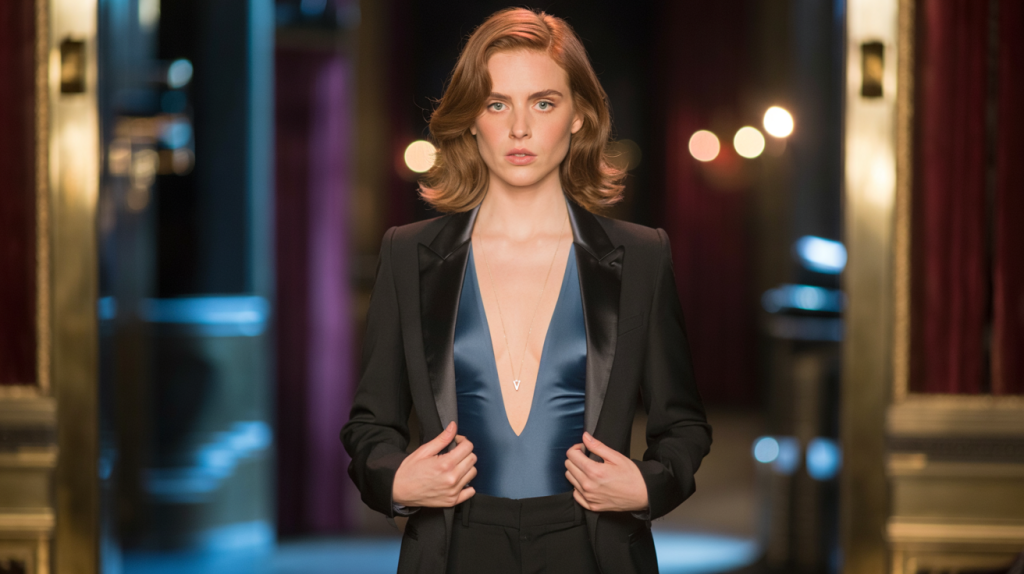
Spotlight on Élodie Frégé and a body échancré that steals attention without shouting. The French singer has leaned into the plunging bodysuit across stages, shoots and red carpets, proving this sleek piece can look precise, not risky.
The context matters. Élodie Frégé broke out after winning “Star Academy” in 2003, then refined a visual signature during her 2013 “Amuse Bouches” era and as a “Nouvelle Star” juror in 2015. Across these milestones, one idea stayed steady : a sculpted neckline that elongates the silhouette and adds ease under tailoring.
Élodie Frégé and the body échancré trend
There is a reason the look keeps returning. On stage, a plunging bodysuit frees movement and eliminates constant readjustments. In photos, it frames the face and collarbones. The result reads sharp under a blazer and fluid with high-waisted trousers, which explains why the piece suits Élodie Frégé’s concert and city schedule.
Fashion never starts from zero. The bodysuit grew from the leotard that performer Jules Léotard made famous in 1859. Designers then translated it for everyday wear: Claire McCardell in the 1950s shaped the idea for American sportswear, then Donna Karan placed the bodysuit at the center of her 1985 “Seven Easy Pieces” to simplify a modern wardrobe.
Today’s body échancré borrows that lineage but adds stretch, lining and discreet support. The neckline plunges, yet the architecture holds. That balance sits at the heart of Élodie Frégé’s approach to stagewear that reads elegant and practical.
How to wear a body échancré like Élodie Frégé
Start with cut. A V that narrows toward the sternum slims the line, while a rounded plunge softens angles. Micro-edges look edgy under leather; a clean bonded edge disappears under suiting. If the torso is long, seek snap closures with multiple settings to fine-tune the fit.
Fabric changes everything. Matte stretch knits mute shine under lights. Subtle rib adds grip when layered under jackets. For evening, a double-layer jersey gives opacity without bulk. Sheer inserts can create depth without deepening the plunge.
Color strategy helps. Black photographs reliably and pairs with almost any jacket. Ivory brightens skin in low light. Burgundy or midnight blue nod to performance dressing without the harshness of true stage black. Metallics only if the rest of the outfit stays pared back.
From stage to daily life : styling ideas and slip-ups to avoid
Real life asks for coverage and support. A plunge bra with low center gore can vanish under deep V cuts. Some bodysuits include an inner sling or elastic shelf – choose those when movement is part of the plan. Tape exists, yet a build-in solution saves time when the night runs long.
Layering turns a showpiece into weekday wear. Throw on a relaxed blazer or a tweed jacket to add texture. Wide-leg trousers balance the vertical line of the neckline. For denim, a high-rise with a straight leg keeps proportions modern and comfortable.
Small details prevent distractions. A neckline that sits flat at the sternum reads polished. Side seams that meet the waist without pulling signal the right size. Jewelry should echo the V – pendant lengths that stop above the plunge work best.
Common missteps exist, and they are easy to sidestep :
- Choosing thin, shiny fabric that shows every bra outline under flash.
- Pairing a deep plunge with a low-rise bottom, which shortens the torso visually.
- Necklines cut too wide at the shoulder, leading to constant slippage.
- Skipping a test sit-stand routine – the fit changes once in motion.
Origins, dates and care : the practical side fans ask about
Timeline helps decode why the piece feels current. From Jules Léotard in 1859 to Claire McCardell’s 1950s sportswear and Donna Karan’s 1985 system dressing, the bodysuit solved real problems: clean lines, secure fit, easy layering. Élodie Frégé’s 2003–2015 public arc simply plugged that solution into a modern French pop aesthetic.
Care keeps the shape intact. Most stretch knits prefer cool hand-washing and a towel press, never a twist. Heat can snap elastane, which shortens the garment’s life. If the label allows machine cycles, a mesh bag reduces friction with zippers and hooks from other pieces.
Fit remains the deciding factor. Torso length varies more than people think, so two sizes may be needed across brands. If the neckline waves or gaps, the torso runs a touch long; if the shoulders pull inward, it runs short. Tailors can often lift straps by a centimeter or two to perfect the line, a quick fix that changes the whole adress.
Context matters just as much as styling. For a concert, the body échancré sits under a blazer and catches light at the collarbone; for a dinner, it hides beneath a cardigan and only appears when seated. That flexibility explains why the piece keeps returning to wardrobes – and why it fits the way Élodie Frégé works and moves.