
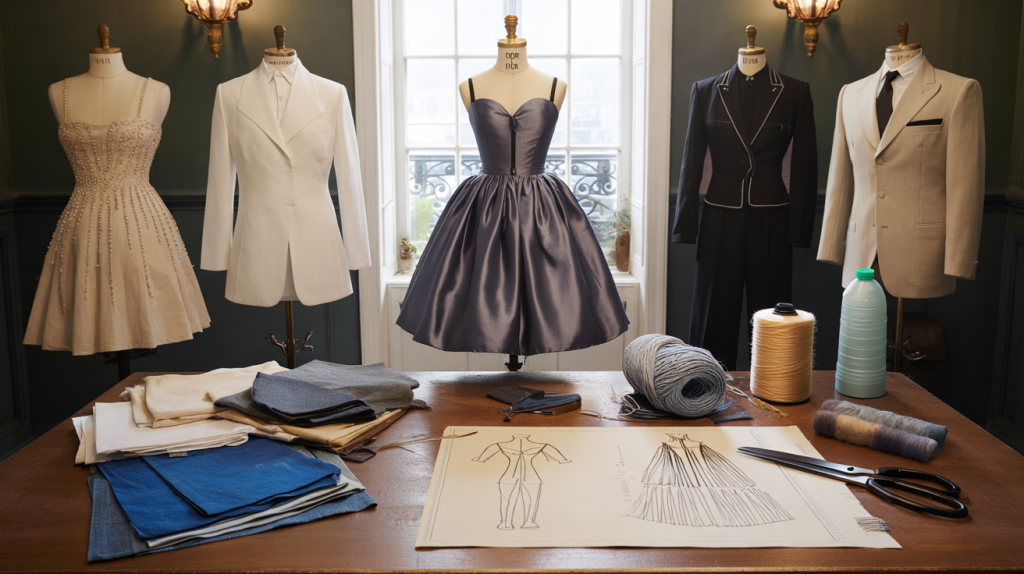
Fashion moves fast, yet it has a memory. An Encyclopédie de la mode gives readers a single, reliable map through an industry worth about 1.7 trillion dollars in 2023, according to Statista, 2024. When trends jump from runway to phone in minutes, having clear definitions, timelines, and references saves time and money.
There is another stake. The United Nations Environment Programme reports fashion produces 8 to 10 percent of global carbon emissions and nearly 20 percent of wastewater, UNEP, 2019. Knowing what materials, cuts, and practices actually mean helps anyone study responsibly, shop with intent, and tell garments apart beyond the hype.
What an Encyclopédie de la mode covers and why it matters
At its core, a fashion encyclopedia explains people, periods, materials, techniques, and vocabulary. It solves a daily problem: words like bias cut, selvedge, or drop shoulder appear everywhere, and not always correctly. A clean entry decodes the term, places it in history, and shows how it appears today.
Readers use it for quick checks during research, to compare eras while visiting a museum, or to understand why a jacket hangs differently from another. Students lean on it for citations. Shoppers use it to seperate marketing from fact when a label says sustainable or couture.
Scale adds urgency. Polyester made up about 54 percent of global fiber production in 2021, Textile Exchange, Preferred Fiber and Materials Market Report 2022. If a page explains polyester’s properties versus wool or lyocell, choices change. So does care, durability, and cost per wear.
Landmarks worth knowing: from Worth to Dior to Rive Gauche
The modern system starts in Paris. Charles Frederick Worth opened what is widely recognized as the first haute couture house in 1858, The Metropolitan Museum of Art, Heilbrunn Timeline. That move established the designer’s authorship and seasonal collections.
After two world wars, a new silhouette reset women’s wardrobes. Christian Dior unveiled the “New Look” on 12 February 1947 in Paris, with rounded shoulders, cinched waist, and full skirt, Victoria and Albert Museum. It pivoted fashion back to opulence and craft.
Then came ready to wear with cultural bite. Yves Saint Laurent launched “Saint Laurent Rive Gauche” in 1966, bringing designer style to a boutique format, Musée Yves Saint Laurent Paris. That step democratized fashion and changed how labels scale. Decades later, museum interest exploded. The Met’s Costume Institute exhibition “Heavenly Bodies” drew 1,659,647 visitors in 2018, the most in the museum’s history, The Metropolitan Museum of Art press office.
Fabrics, silhouettes, and terms you actually see online
Real life reading needs plain words, cross references, and a way to spot quality. Here are the kinds of entries a serious Encyclopédie de la mode always includes.
- Eras and movements : Haute couture origins, flapper styles of the 1920s, New Look 1947, space age 1960s, punk 1976, Antwerp Six 1980s
- Designers and houses : Charles Frederick Worth, Coco Chanel, Cristobal Balenciaga, Christian Dior, Yves Saint Laurent, Rei Kawakubo, Vivienne Westwood
- Fabrics and fibers : Cotton, wool, silk, linen, polyester, polyamide, viscose, lyocell, elastane, with weight, drape, and care
- Construction and cuts : Bias cut, darts, pleats, godets, raglan, set in sleeve, princess seams, interlining, canvassing
- Accessories and finishings : Placket, facing, hem, piping, topstitch, hardware, heel shapes, bag structures
- Sizing and standards : EU, US, UK conversions, size ease, men’s versus women’s grading
- Sustainability vocabulary : Life cycle, microfiber shedding, recycled polyester, organic cotton, certifications like GOTS and FSC
- Landmark exhibitions and publications : Dates, institutions, catalog references for further study
Short entries work best when they connect. The page on bias cut should reference Madeleine Vionnet’s early twentieth century mastery, then link to fabrics that drape well, and modern designers who revisit the technique. A term like selvedge should lead to weaving methods and denim history, not just a marketing blurb.
How to use a fashion encyclopedia for research, shopping, and styling
Start with a question tied to a real decision. Researching Dior in the 1950s for a paper. Choosing between a wool coat and a polyester blend. Planning a visit to a costume exhibition. The encyclopedia acts as a hub that clarifies context, dates, and technical constraints.
During research, align names and timelines. Place Worth in 1858 Paris, Dior in 1947, and ready to wear’s shift in 1966 with Rive Gauche. Cite institutions for dates and figures. Museum press offices and catalogues provide dependable references, including that 2018 attendance figure for The Met.
While shopping, read fibers first, then construction. A page that contrasts polyester’s oil based origin with wool’s properties helps explain breathability and pilling risks, Textile Exchange, 2022. Pair that with UNEP’s emissions and wastewater figures to understand why care and longevity matter, UNEP, 2019. If a label claims couture, look for definitions that limit the term to specific rules in Paris, with handwork and fittings.
For styling, vocabulary reduces guesswork. Knowing the difference between raglan and set in sleeves predicts range of motion. Understanding a drop shoulder changes how volume sits over the torso. A bias cut skirt reads fluid on the body, which is why Vionnet’s legacy keeps returning on red carpets.
One last piece is access. A good Encyclopédie de la mode pairs concise entries with citations and images, updates annually, and indexes by era, material, and technique. Add your own notes as you go. That living layer is what turns a static reference into the tool readers keep open while they work, study, or buy.