
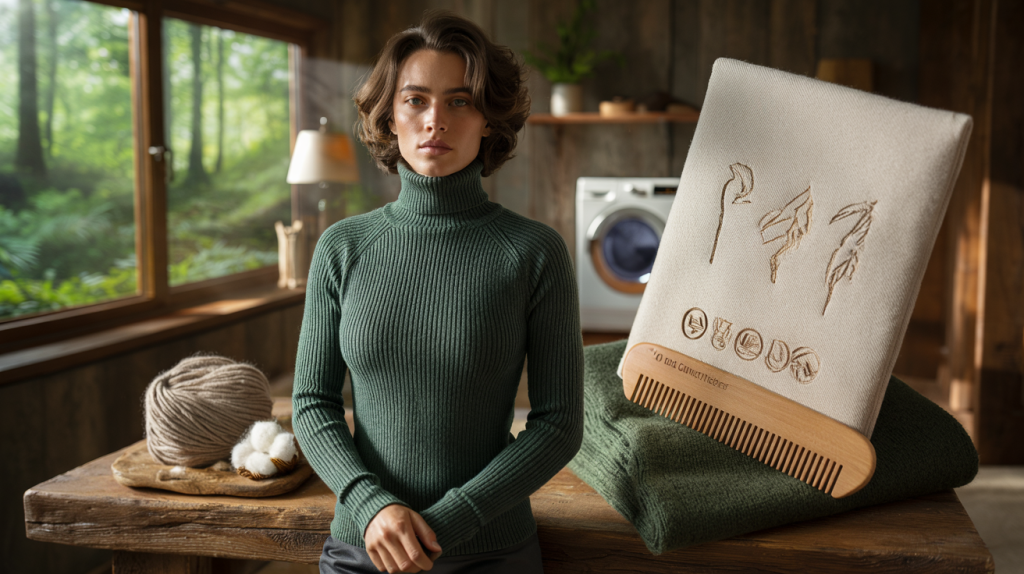
Want a soft roll neck that keeps you warm without a heavy footprint. Here is the ethical sous-pull playbook that blends style, comfort, and verified impact.
The search for a “sous-pull col roulé éthique et écoresponsable” is not a niche whim. It is the real-world answer to a winter basic that feels great on skin and stays gentle on workers and ecosystems. The short answer lands fast : choose natural or low-impact fibers, proven certifications, and long-life care. That combo cuts emissions, limits microplastics, and finally delivers a dependable second skin.
Why the urgency. Fashion generated about 2.1 billion tonnes of CO2e in 2018, roughly 4 percent of the global total (McKinsey and Global Fashion Agenda, 2020). In Europe alone, people buy around 26 kg of textiles per person each year and discard 11 kg, a flow that pushes textiles to the fourth highest pressure on the environment and climate after food, housing and mobility (European Environment Agency, 2019). Synthetic washing releases microfibres that represent 35 percent of primary microplastics in the oceans (International Union for Conservation of Nature, 2017). A base layer looks tiny, yet multiplied by millions, the impact adds up.
Why an ethical roll neck changes the game
A good roll neck is worn close to skin, washed often, and kept on rotation. That makes material choice and stitch quality decisive. Natural fibers breathe, limit odour, and often last longer when knitted tight. Lower impact blends exist, but every percentage point of synthetic brings microfibre shedding into the mix during washing.
Circularity is still lagging behind. Less than 1 percent of clothing is recycled into new clothing, which keeps pressure high on virgin resources (Ellen MacArthur Foundation, 2017). Extending garment life remains the fastest lever available to users today.
So the problem to solve is clear : a warm, soft, body-hugging knit that reduces fossil inputs, protects workers, and survives many winters without bagging out or pilling after a few spins.
Materials and proof : cotton, wool, lyocell and credible certifications
Organic cotton reduces pesticide use and can cut blue-water consumption depending on region and farm practice. Look for GOTS for fiber-to-finish checks on chemicals and social criteria, and Fairtrade Cotton for minimum price and premium mechanisms. GOTS lists certified facilities in dozens of countries and audits wet processing too.
Merino wool delivers warmth-to-weight, breathability, and natural stretch. Responsible Wool Standard verifies animal welfare and land management along the chain, and brands can also state mulesing-free sourcing via supplier documentation (Textile Exchange, RWS). Traceability matters because wool supply chains can be long.
Lyocell made with closed-loop solvents, especially Tencel Lyocell from Lenzing, comes from wood pulp with a solvent recovery rate above 99 percent the company reports. For any man-made cellulosic, prefer wood from forests certified by FSC or PEFC to lower deforestation risks.
Care, lifespan and cost : the data behind smart use
Real impact shrinks when garments last. Extending the active life of clothing by nine months reduces carbon, water and waste footprints by around 20 to 30 percent for the typical UK wardrobe (WRAP, 2017). That is exactly the role of a reliable base layer that does not lose shape.
Washing habits matter. Heating water accounts for about 90 percent of the energy used by a clothes washer cycle in standard models (ENERGY STAR). So cold or 30 degrees cycles, liquid detergent, and gentle spins help both the knit and the meter. Lower friction also limits microfiber release when synthetics are present.
Price signals quality but does not guarantee it. Dense knits, reinforced cuffs, and ring-spun yarns usually extend life. Checking grams per square meter on product pages helps : many everyday roll necks sit around 180 to 220 gsm for cotton and 160 to 200 gsm for fine merino, with heavier weights for real cold.
How to choose your ethical sous-pull without the guesswork
Decision time should feel simple. Use this quick filter when scrolling product pages or standing in a store aisle.
- Fiber first : GOTS organic cotton, RWS merino, or Tencel Lyocell. Avoid high polyester content for skin-contact layers if microplastics worry you.
- Proof on the page : visible certificate numbers and certifed scope. GOTS covers more than fiber, RWS tags trace wool, FSC or PEFC back wood pulp.
- Knit density and hand feel : tighter jersey or rib holds shape longer. Light stretch with a small percent of ROICA or natural elasticity from wool.
- Country and maker transparency : factories named, audit years listed, and chemical management policies linked.
- Care guidance that extends life : cool wash, flat dry, pilling comb or de-bobbling notes for knits, and repair options offered.
One last friction point gets in the way : sizing. A base layer must hug without squeezing. When unsure, check the shoulder width and sleeve length in the size chart, not just S to XL. Many ethical labels publish actual measurements and fabric shrinkage expectations after the first wash.
The route ahead is practical. Choose a proven fabric and certification, wash cool, keep a lint comb nearby, and favor brands that publish factory lists and audit dates. The winter drawer ends up lighter, warmer, and decidedly more enviromental. Links to dig deeper : McKinsey and Global Fashion Agenda 2020 “Fashion on Climate” report, European Environment Agency 2019 textiles briefing, IUCN 2017 microplastics study, Ellen MacArthur Foundation 2017 “A New Textiles Economy”, WRAP 2017 “Valuing Our Clothes”, ENERGY STAR guidance on washing energy.
McKinsey and Global Fashion Agenda, 2020 | European Environment Agency, 2019 | IUCN, 2017 | Ellen MacArthur Foundation, 2017 | WRAP, 2017 | ENERGY STAR | GOTS | Responsible Wool Standard | FSC | PEFC