
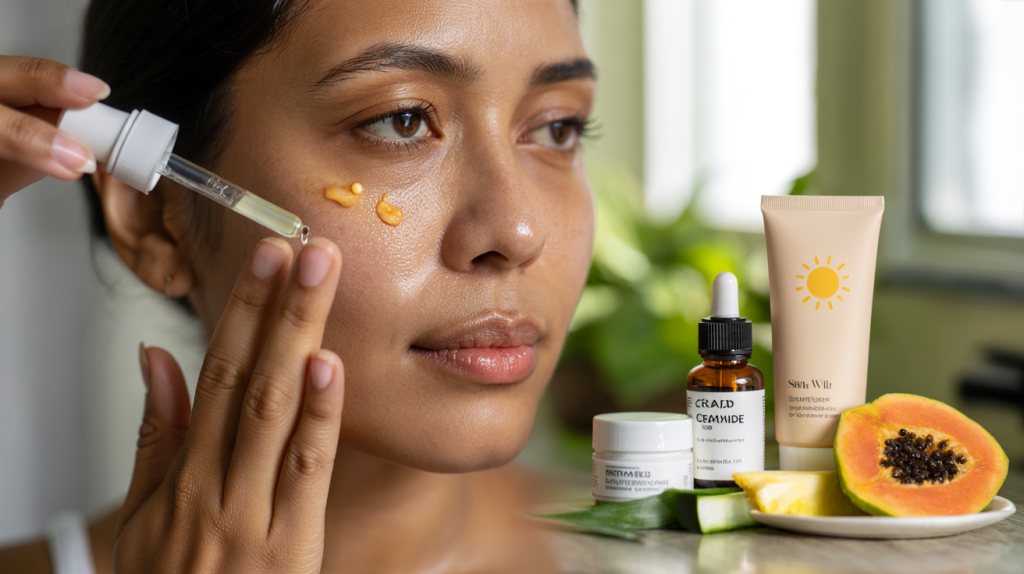
Glassy skin can happen without sting or flake. That is the promise behind “exfoliation douce visage” : a soft, smart way to lift dullness while keeping the skin barrier calm, even when complexion feels reactive.
Here is the heart of it: swap gritty scrubs and marathon peel nights for low-strength acids or enzymes, low friction, and a slow rhythm. The American Academy of Dermatology states that method and skin type matter more than the word exfoliation itself, and that people with sensitive or darker skin tones should steer clear of aggressive scrubs to avoid dark spots and irritation. The goal stays simple: smoother texture, fewer clogged pores, and more light bounce, minus the drama.
Exfoliation douce visage explained : what it is and why it works
Gentle exfoliation removes only loosened, dead cells from the skin’s surface instead of stripping deeper layers. That respects the acid mantle, whose average pH is about 4.7 according to research in the Archives of Dermatological Research in 2006 by Petra Schmid-Wendtner and Heribert Korting.
When that protective film stays intact, moisture loss drops and redness calms down. Skin looks clearer because light reflects evenly once the rough top layer stops scattering it. Not all tools do this softly. The safest path on the face leans chemical, not gritty: think mild alpha hydroxy acids, beta hydroxy acid, or fruit enzymes.
The science side : AHAs, BHAs, enzymes, SPF and actual numbers
Alpha hydroxy acids like lactic or glycolic smooth the surface. Over the counter, most leave-on products land between 5 and 10 percent for AHAs, with pH near 3.5 to 4, which the U.S. Food and Drug Administration has noted can increase sun sensitivity. That is why the AAD recommends daily broad-spectrum sunscreen.
Beta hydroxy acid means salicylic acid. The FDA’s acne monograph lists it at 0.5 to 2 percent for leave-on formulas, making it a friend for oily or clogged zones because it is oil-soluble and moves inside pores.
Sunscreen is non-negotiable on any exfoliation plan. The AAD explains SPF 30 filters about 97 percent of UVB rays, while SPF 50 rises to about 98 percent. Those numbers look small, yet that single extra percent helps when skin is a touch more photosensitive after acids.
Common mistakes that trigger irritation et how to fix them
Many faces redden not because exfoliation is bad but because the approach is rushed. Reports suggest sensitive skin is widespread: a 2009 review by Miranda Farage found around 60 percent of women and up to 50 percent of men report sensitive skin. That calls for restraint.
Using large, jagged scrubs on the face scratches. Mixing a strong retinoid and a high-strength AHA the same night spikes stinging. Exfoliating every day on a dry or rosacea-prone face keeps the barrier in a loop of tightness. And skipping SPF after acids undercuts all the gains.
The fix is boring and it works: lower percentage, fewer nights, more buffer with a bland moisturizer and fragrance-free cleansers. It reads simple because it definitly is.
A gentle routine you can keep, tailored by skin type
Think small levers: percentage, texture, and timing. Start slow, then listen to the skin for tightness, shine balance, or sting longer than one minute.
- Normal to combination : try lactic acid 5 percent two nights a week, then three if skin stays calm. Texture brightens while cheeks stay comfy.
- Oily or congestion-prone : use salicylic acid 0.5 to 2 percent on the T-zone every other night. Follow with a light, non-comedogenic moisturizer.
- Dry or sensitive : pick polyhydroxy acids like gluconolactone 4 to 8 percent or a papain or bromelain enzyme mask once weekly, short contact time, then ceramide cream.
- Dark spot tendency : avoid harsh scrubs; pair gentle AHA with daily SPF 30 or higher. Add niacinamide in the morning to steady the barrier.
- Retinoid users : alternate nights. Retinoid one night, gentle exfoliant the next, plain hydration on off nights.
Patch testing helps. Apply the new exfoliant to a coin-sized spot near the jawline for two to three nights before full-face use. Tingle that fades inside a minute can be normal; sharp burning, welts, or persistent redness means stop and switch.
Timing matters. Cleanse with lukewarm water, pat dry, apply the exfoliant on dry skin, wait a few minutes, then layer a soothing moisturizer. In daylight, finish with broad-spectrum SPF 30 or higher. The Skin Cancer Foundation and the AAD both favor that SPF level for daily protection.
There is one extra piece: pH and formula elegance. A 5 percent lactic acid serum at a well-tuned pH and no fragrance often outperforms a 10 percent toner with a harsh solvent. Formulation quality beats raw percentage every time.
If redness keeps returning, pause exfoliation and rebuild the barrier with petrolatum occlusion at night for a few days. Then reintroduce the gentlest option, or move to enzyme-only masks. Dermatology clinics can tailor an AHA peel at controlled strengths, but home care that respects rhythm tends to deliver steadier results with fewer surprises.