
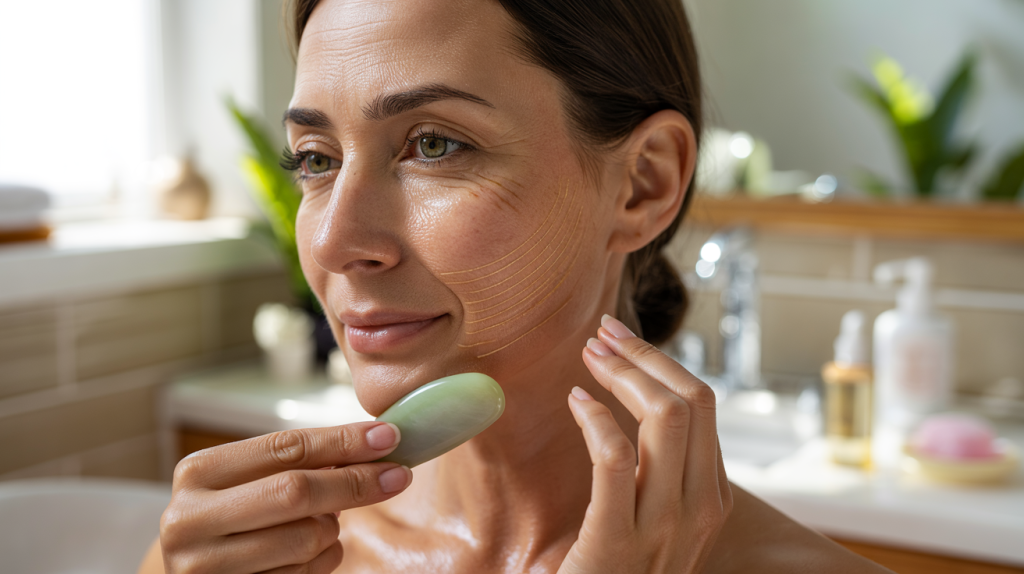
Facial fascia massage promises glow, lift, and less puffiness. Here is what research actually shows, plus a safe, fast routine that works with your skincare.
Quick lift, softer lines, a fresher jawline in minutes : facial fascia massage keeps buzzing because results can show up fast. The technique targets the connective web under the skin – the fascia – to ease tension, boost circulation, and support lymph flow. Done right, it complements retinoids, sunscreen, and dermatology treatments without replacing them.
The science is not hype only. A study in Scientific Reports in 2018 found that a 5 minute facial roller session increased facial skin blood flow for more than 10 minutes, and five weeks of daily use improved the vasodilatory response during heating. In JAMA Dermatology in 2018, 16 participants who completed 20 weeks of structured facial exercises showed improved cheek fullness and looked about 3 years younger to blinded raters. Different technique, same principle : mechanical stimulation matters.
Anti‑aging, but practical : what facial fascia massage really targets
Main idea first. Facial fascia massage addresses three everyday complaints – stiffness, dullness, and puffiness – that make the face look tired even when skincare is on point. By gliding along fascial lines and muscle attachments, manual work may free restricted glide between layers.
There is a physiological basis. A review by Robert Schleip and Divo Müller in the Journal of Bodywork and Movement Therapies in 2013 described how slow, sustained pressure on fascia stimulates Ruffini endings, nudging the nervous system toward relaxation and reducing resting muscle tone. On the face, less clenching often reads as smoother.
Real world observation matches lab data. The Scientific Reports trial in 2018 linked a single session to a measurable spike in blood flow, which helps explain that instant glow many notice. The effect was not cosmic, but it was consistent and lasted beyond the massage itself.
How to do fascia massage at home safely : a 6 minute routine
This is where most routines go off track : rushing, pressing too hard, or scraping bone. Fascia responds to patient, low load moves. Skin needs slip, not drag.
Use a pea sized layer of a light cleanser, squalane, or serum with glide. Keep strokes slow – about 3 centimeters per second – and pressure gentle enough to move skin, not deform muscle. If anything hurts, lighten up.
- Neck priming : 60 seconds of light strokes from collarbone up to the jaw, then from ear down to collarbone to open lymph pathways.
- Jaw release : 8 passes from chin to earlobe along the jawline on each side, using the heel of the hand or a smooth tool.
- Cheek lift : 8 slow sweeps from the corner of the mouth toward the top of the ear, following the zygomatic arch.
- Under eye de‑puff : feather light taps from inner corner to temple, then down to the ear and neck for drainage, 30 seconds.
- Forehead glide : 8 passes from brows to hairline, then 8 passes from center to temples.
- Finish : 30 seconds of gentle strokes from jaw to collarbone to clear.
Two to five sessions per week tend to be sustainable. Tools are optional. Hands work. If using a roller or gua sha, keep edges smooth and angles flat to the skin.
Common mistakes, risks, and timing with cosmetic procedures
Pressing too hard can backfire with redness or broken capillaries. Going fast creates friction and tugging. Long nails leave micro‑scratches. These are easy fixes.
There are no miracle claims here. The JAMA Dermatology trial in 2018 involved 20 weeks of daily exercises, with only 16 of 27 participants completing the program. Adherence matters. Massage is similar : consistency beats intensity.
Safety checkpoints help. Dermatology societies advise avoiding massage over active acne, eczema flares, open wounds, or recent sunburn. After neuromodulator injections, many clinicians recommend waiting about 24 to 48 hours; after dermal fillers, guidance often extends to 1 to 2 weeks depending on product and placement, according to the American Academy of Dermatology patient resources and the American Society for Dermatologic Surgery. Post‑surgery, follow surgeon clearance only.
Where fascia massage fits in an anti‑aging plan
Logical question : will massage replace retinoids or sunscreen. No. It sits alongside them. Sunscreen daily, retinoid nights as tolerated, a smart moisturizer, plus dietary and sleep habits drive skin health. Massage enhances tone and contour by addressing mechanics and microcirculation.
Expectations shape satisfaction. The 2018 Scientific Reports paper showed short term blood flow gains after a single 5 minute session and improved reactivity after five weeks. That signals repeatable, modest wins – glow, less morning puff, a softer jaw. Not a facelift.
Two additions make the whole set feel complete. First, breath pacing. In the Schleip and Müller 2013 review, slower exhalations paired with slow pressure shifted the autonomic balance toward calm, which definetly helps jaw clenchers. Second, product timing. Massage can transiently increase skin temperature and permeability; apply actives that play well with that – hydrating serums or peptides – while saving strong acids or retinoids for separate nights to minimize irritation.