
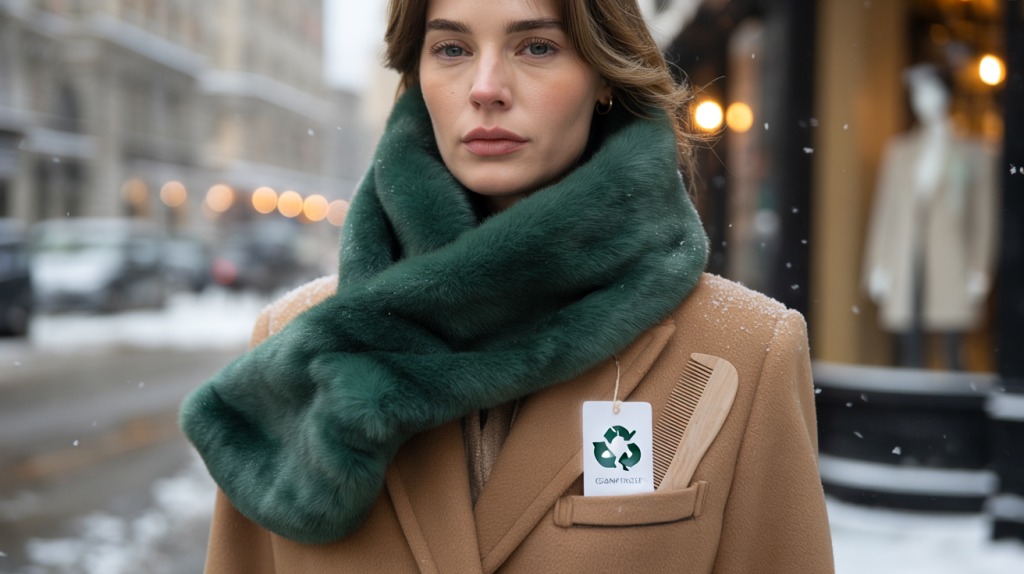
Warmth, polish, no cruelty. The écharpe fausse fourrure lifts any look and aligns with new rules of fashion. See what matters before you buy and how to care.
One accessory changes a cold commute and a plain coat. A faux fur scarf delivers plush warmth, instant texture and a guilt-free alternative to real fur, right when shoppers ask for style that feels better. Big signals backed that shift. London Fashion Week went fur free in 2018 per the British Fashion Council, California’s statewide ban on new fur sales took effect on 1 January 2023, and Israel prohibited the sale of fur for fashion in 2021.
There is another reason the move makes sense. Synthetic textiles shed microfibres, and the International Union for Conservation of Nature estimated in 2017 that 35 percent of primary microplastics in the ocean came from washing synthetic fabrics. So the right faux fur scarf and the right care routine can keep the plush look while cutting the footprint. Here is what to check, how to wear it and where innovation already changed the game.
Faux fur scarf essentials : what it solves in real life
The piece solves three daily problems at once. It keeps the neck warm without heavy layers, it finishes an outfit fast, and it avoids animal fur. Loop a short stole over a blazer for daytime polish, or drape a long scarf over a wool coat and the silhouette sharpens. A satin lining helps it glide, a hidden slit or magnet lets it close neatly, and a neutral tone makes last year’s coat feel new.
Brands moved early. Gucci, Prada and Burberry dropped real fur in the late 2010s, then designers pushed better synthetics. Stella McCartney introduced Koba Fur Free Fur in 2019 using Sorona fibers that are partly plant based, a step that aimed at lower impact while keeping softness.
Buying the right écharpe fausse fourrure : materials, labels, fit
Most faux fur comes from polyester or acrylic, and polyester dominates global fiber production. Textile Exchange reported in 2022 that polyester accounted for about half of all fibers worldwide. Recycled polyester, often from post‑consumer bottles, now shows up in scarves with certifications that verify content and safety.
Shoppers often trip on the same details, so the simple checklist below speeds the pick and avoids regret.
- Touch test : fibres should spring back, not feel greasy or shed on the hand.
- Fiber content : look for recycled polyester, GRS certification, or PETA‑Approved Vegan labeling. OEKO‑TEX Standard 100 adds chemical safety.
- Lining and closure : smooth lining prevents snagging, a slit or discreet snap holds the wrap in place.
- Color and pile : mid pile reads luxurious, colorfull hues trend but camel, black and winter white outlast seasons.
- Seams and edges : even nap direction and tight stitching signal quality.
- Source transparency : product pages that cite materials and factories beat vague claims.
Curious about innovation. Stella McCartney’s Koba uses Sorona that contains bio‑based content, and the brand explains the blend and feel on its site. That level of detail helps separate marketing from progress.
Care that keeps it plush and reduces impact
Care changes everything. Brush gently with a wide‑tooth comb to lift the pile. Spot clean first with mild soap, then hand wash in cold water inside a wash bag that catches fibres. Air dry flat away from heat, shake to fluff, and finish with a light steam at distance. Dry cleaning is possible if the label allows it, yet repeated solvent cycles can dull the hand.
Microfibre release stays a real issue. The IUCN report in 2017 tied 35 percent of primary ocean microplastics to synthetic textile washing, so a simple filter for the machine discharge and washing less often both help. Storage matters too. Hang the scarf on a broad hanger or roll it loosely to prevent creases that crush the pile.
Smart ways to wear, and where to find value
Start simple. A black faux fur scarf over a denim jacket balances casual and dressed. For evening, a short ivory stole frames the face and brightens photos. Street style leaned oversized last winter, yet proportion still rules. Petite frames do better with medium piles and shorter lengths, tall frames can carry longer stoles.
Value shows up beyond full price retail. The secondhand market grew quickly, and thredUP’s 2023 Resale Report projected the U.S. secondhand market to reach 70 billion dollars by 2027. A pre‑loved faux fur scarf often looks pristine, since the piece touches only the collar. Vintage stores list acrylic blends from the 90s that feel dense, while newer recycled polyester options appear on resale platforms after one season.
Policy keeps pushing the shift. California’s AB 44 started in 2023, Israel’s national ban arrived in 2021, and London runways cut fur back in 2018. Those dates guide the closet, not just the headlines. When a scarf adds warmth, polish and ethics in one move, the choice turns easy, then the outfit follows.
Sources : British Fashion Council 2018, California AB 44, BBC on Israel 2021 ban, IUCN 2017 report, Textile Exchange 2022, Stella McCartney Koba, thredUP 2023 Resale Report