
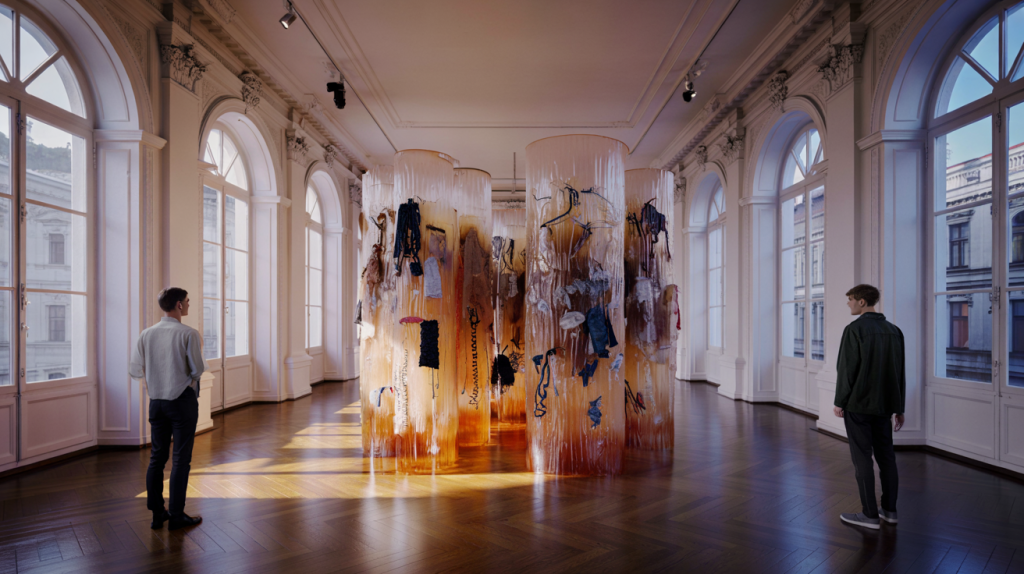
Vienna is buzzing: an exhibition centered on Helmut Lang brings one of Austria’s most influential fashion minds back to his hometown, this time as an artist. Visitors expect a shift in lens, from runway to sculpture, from garments to material memory. The city knows how to stage that kind of conversation.
The backdrop matters. Helmut Lang grew up in Vienna, launched his label in 1986 in the city, then recoded global fashion through minimal lines and sharp tailoring before leaving fashion in 2005 to focus on contemporary art. That trajectory turns a museum visit here into more than a show. It reads like a homecoming with new intent.
Helmut Lang exhibition Vienna: what this moment means
The main draw is simple: see how a pioneering designer transforms archives and materials into sculpture. The exhibition format suits Vienna, where design nests inside art history and craft.
Helmut Lang’s pivot set the stage years ago. According to The New York Times, he departed his namesake brand in 2005 to devote himself to art, after the Prada Group had acquired a 51 percent stake in 1999. Those numbers and dates track a rare path from global fashion engine to independent studio practice.
So the question visitors bring into the galleries is fresh: what remains when you distill a fashion language down to form, texture, weight, and silence. In Vienna, it resonates more strongly because the city remembers the beginning.
From runway to gallery: facts that frame the visit
Helmut Lang’s career carries a few milestones that change how one looks at the work. The Business of Fashion notes the label launched in 1986; by 1998, The New York Times reported he upended the calendar by moving his show to New York and streaming it online, a first for a major designer that season. This tech-forward turn foreshadowed an art practice that treats materials as data – and then rewrites them.
Exhibitions often surface the famous shreddings. In 2011, W Magazine reported that Lang transformed around 6,000 archived garments into resin-bonded sculptures for the series titled “Make it Hard”. The figure is striking in person. It converts memory – thousands of pieces, years of work – into solid mass.
For Vienna, institutions like MAK – Museum of Applied Arts have long bridged design et art. MAK was founded in 1864, a century-and-a-half of applied-arts context visitors feel on entry, according to the museum’s own history. That context primes the eyes.
Where to see Helmut Lang in Vienna: institutions and practical cues
Vienna concentrates design-aware venues within easy reach. MAK holds rich fashion et design programs and has previously presented dedicated shows connected to Helmut Lang’s work and legacy, as documented by the museum’s archives. Kunsthalle Wien also programs contemporary art with crossover perspectives, useful for keeping an eye on.
Exhibitions sell out faster when fashion steps into the art space. Ticketing calendars for major venues in Vienna typically open months ahead of key shows, and weekend slots disappear first. Checking official museum listings before traveling saves stress and usually money, since advance tickets lock in entry times.
For anyone building a deeper route, mix institutions. One space gives the headline; another gives context and calm. It changes the day from a single stop to a small, curated circuit.
Plan your visit: simple moves that upgrade the experience
Visitors sometimes rush the surface. Slowing down pays off because Helmut Lang’s work rewards looking at edges, seams, residue, and weight. The shift from fabric to sculpture can feel cool at first glance; a second pass reveals its heat.
Vienna accommodates an art day well, yet small tweaks make it definitly better.
– Book an early time slot to avoid crowds, then circle back later for a second look when your eye has reset.
– Read the wall labels after a first walk. The dates – 1986, 1998, 1999, 2005 – click harder once the forms settle.
– Pair the show with MAK’s permanent displays to see how applied art history reframes contemporary sculpture.
– If photography is allowed, shoot details, not full pieces. Crops keep the memory of texture and density.
– Check public talks or curator tours on the museum’s schedule. One hour of guided context often reframes an entire visit.
The logic behind this approach is straightforward. Helmut Lang’s arc – from Vienna beginnings to Prada’s 51 percent stake in 1999 reported by The New York Times, to an art-only practice after 2005 – recurs across the objects. The numbers trace a narrative of control and release, commerce and material truth. Vienna, with MAK’s 1864 foundation date anchoring applied arts in the city’s identity, closes the loop.
One element completes the picture: verify the exhibition dates and ticketing only on the institutions’ official pages. That single check aligns travel, budget, and timing with the works you actually want to see.