
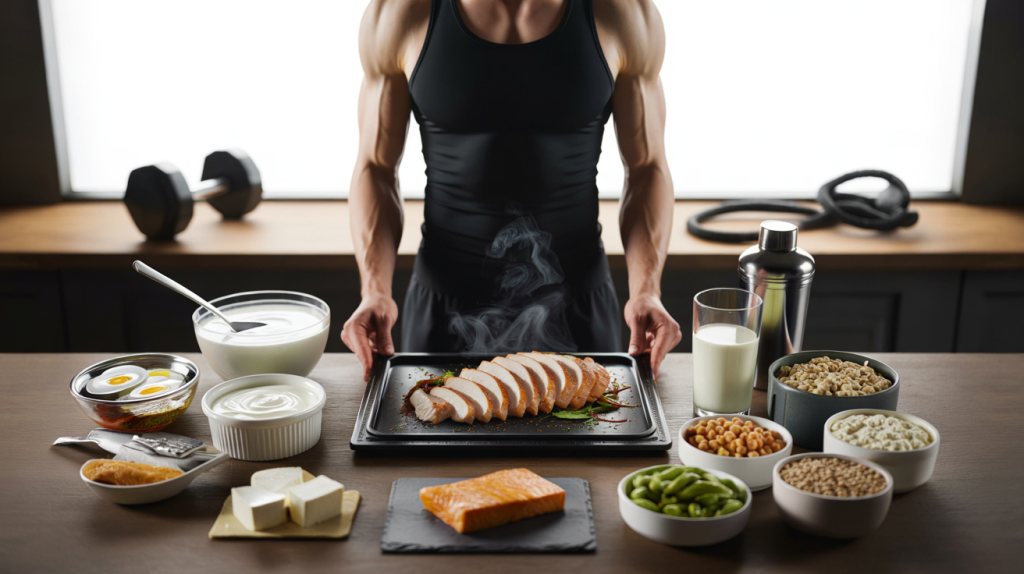
Build muscle faster with high-protein foods that actually deliver. See science-backed protein targets, smart portions, and simple meal ideas that work.
Chasing lean gains and tired of guesswork? Start with protein-dense foods that pack serious muscle-building power per bite. They make training stick, recovery faster, and plateaus less likely.
Research has been clear for years. The International Society of Sports Nutrition’s 2018 position stand advised 1.4 to 2.0 g of protein per kg per day for active people, while a 2018 meta-analysis led by Robert Morton found size gains maximized around 1.6 g/kg/day, with potential benefits up to 2.2 g/kg. Most lifters still hover near the general RDA of 0.8 g/kg/day set for the average adult, not for hypertrophy. That gap costs progress.
High-Protein Foods for Muscle Building : what actually works now
Big picture first. Muscle comes from training stimulus plus enough amino acids to repair and grow. Foods with high protein density – especially those rich in leucine – give that signal more quickly and consistently.
Modern supermarket shelves help. We have affordable canned fish, Greek yogurt, cottage cheese, tofu, and quality powders. No need for a chef’s budget or complicated prep to hit targets on busy days.
Common roadblock: under-eating on rest days. Muscles repair then, not during the last rep. Keeping protein stable day to day supports steady growth instead of a stop-start cycle.
How much protein you really need for hypertrophy
The numbers are straightforward. The RDA sits at 0.8 g/kg/day for adults, defined by the Institute of Medicine to prevent deficiency, not to maximize muscle.
For lifters, two landmarks guide the plan. The ISSN 2018 position: 1.4 to 2.0 g/kg/day. Morton et al., 2018: around 1.6 g/kg/day on average, and up to 2.2 g/kg/day at the higher end. That range covers cutting phases and hard training blocks without overcomplicating life.
Per meal, spreading intake works. Brad Schoenfeld and Alan Aragon in 2018 suggested roughly 0.4 g/kg per meal across three to four meals – a practical way to hit daily totals while giving muscles repeat building opportunities.
Best protein-rich foods and portions for muscle building
Numbers below use typical portions from USDA FoodData Central entries accessed in 2024. They help plan plates fast.
- Skinless chicken breast, cooked : about 31 g protein per 100 g
- Canned light tuna in water, drained : about 26 g per 100 g
- Lean ground beef 90 percent lean, cooked : about 26 g per 100 g
- Salmon, cooked : about 20 g per 100 g
- Eggs : roughly 6 g per large egg – two eggs give ~12 g
- Greek yogurt, plain nonfat : around 17 g per 170 g cup
- Cottage cheese 2 percent : about 20 g per 150 g
- Milk, 1 percent : ~8 g per 240 ml cup
- Firm tofu : ~8 g per 100 g
- Tempeh : ~19 to 20 g per 100 g
- Lentils, cooked : ~18 g per cup
- Chickpeas, cooked : ~14 g per cup
- Edamame, cooked : ~17 g per cup
- Quinoa, cooked : ~8 g per cup
- Whey protein powder : typically 20 to 25 g per 30 gramms scoop – check label
Timing, quality, and budget : turning numbers into meals
Timing does not need to be perfect. Hitting total daily protein matters most, then distributing it across 3 to 4 meals. A simple target: 25 to 40 g per meal. That range usually delivers 2 to 3 g of leucine – the trigger level often cited for muscle protein synthesis in lab studies.
Quality counts but can be mixed. Animal proteins generally score higher on digestibility and essential amino acid density per FAO’s 2013 DIAAS framework, yet plant-forward lifters grow well by combining sources – for instance tofu with rice, or lentils with whole grains – to cover the full amino acid profile across the day.
Real-world example helps. A 75 kg lifter aiming for 1.6 g/kg lands near 120 g protein per day. That could look like 30 g at breakfast, 30 g at lunch, 30 g post-training, 30 g at dinner. One path: eggs and Greek yogurt in the morning, chicken or tofu at lunch, a whey shake after lifting, salmon or lentil chili at night.
Watch the frequent mistakes. Counting raw instead of cooked weights confuses totals. Relying only on powders crowds out micronutrients. Skipping protein at the first meal often leads to overeating late. On tight budgets, rotate canned tuna, eggs, lentils, and milk – high impact for low cost.
Why this works has been tested. Higher protein intakes consistently improved lean mass gains in resistance-trained adults in the 2018 Morton analysis. And in 2015, Heather Leidy’s work reported that 25 to 30 g protein at a meal increased satiety and supported body-weight management – handy during cuts.
One last nudge: track for a week. Not forever, just long enough to align plates with targets and compare to training logs. When protein hits the right range consistently, workouts start to show on the mirror, not only on the bar.