
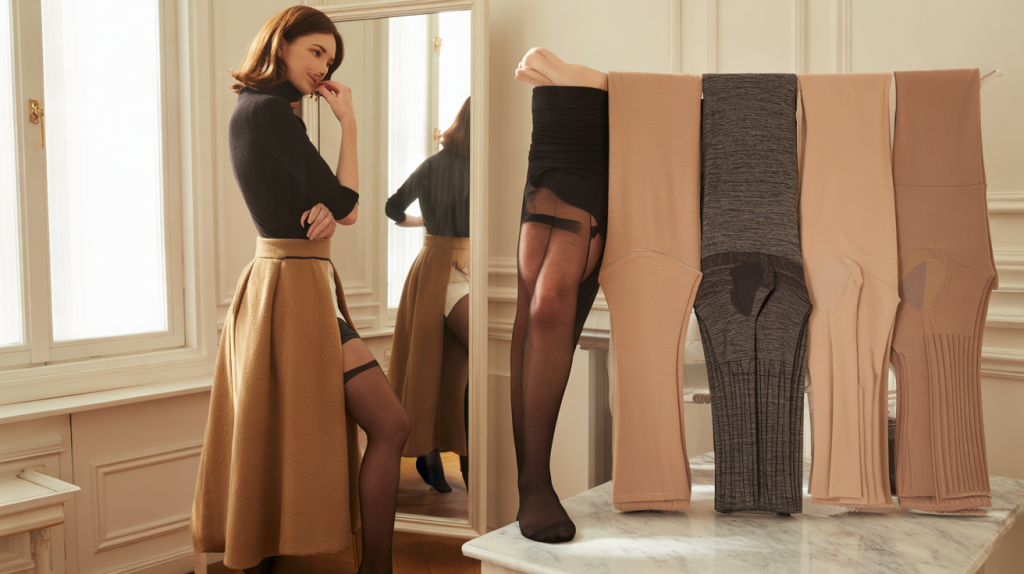
One wrong pair of tights can ruin an outfit and a morning. The right pair turns everything smoother: clean silhouette, comfy waist, no shiny surprise under bright light, no run by lunchtime.
Here is the shortcut: pick opacity by denier, fit by the brand’s height-hip chart, and comfort by fabric mix and knit. Add reinforced zones if your day is busy, and compression only if legs feel heavy. That simple frame already saves time, money, and nerves.
Denier and opacity: choosing how sheer or opaque your tights should be
Denier is a measure of fiber density: grams per 9,000 meters of yarn. Lower number, finer yarn. Higher number, thicker and tougher feel.
For everyday city wear, 20 denier lands in that classic sheer sweet spot. At 30 denier, coverage looks more even and the fabric tends to resist snags a bit better. From 40 denier upward, the finish turns opaque and camera-friendly under office lighting. Ultra-sheer 5 to 10 denier looks whisper-light on skin and pairs with evening silhouettes, yet it ladders more easily.
Need durability for commuting or long events? Step up in denier or choose styles with reinforced toes or light shaping. More denier does not mean hotter by default – breathability depends on knit and fiber blend.
Sizing and fit: reading the chart, avoiding digs and slips
Most brands size tights using height and hips or height and weight. When between two boxes on the chart, size up for comfort and a cleaner leg line. Tight fabric that must over-stretch looks shiny and strains seams.
A gusset improves mobility and reduces stress at the thigh. A soft, wide waistband prevents rolling. Control-top panels smooth under fitted skirts, while a sheer-to-waist style stays invisible under high slits and bodysuits. Petite torsos often feel better in a mid-rise band; taller frames get more anchor from high waist cuts.
If long days leave ankles tired, mild compression in 8 to 15 mmHg can help during travel or standing shifts. Daily support often sits at 15 to 20 mmHg. Medical-grade levels above that should follow professional advice.
Materials, comfort, and durability: nylon, elastane, wool, recycled fibers
Nylon entered hosiery in 1940 and changed everything. Today’s tights usually blend nylon for strength with elastane for stretch and recovery. Double-covered elastane yarns, or 3D-knit constructions, tend to feel smoother and hold shape longer.
For warmth, look for microfiber or merino blends. Merino tights insulate while wicking moisture and resist odor on cold commutes. Sheer summer pairs often use very fine microfibers that feel cooler to the touch.
On sustainability, the Ellen MacArthur Foundation reported in 2017 that only about 1 percent of clothing is recycled into new clothing. Recycled nylon from pre-consumer or post-consumer sources now appears in some tights, and OEKO-TEX Standard 100 labels indicate testing for harmful substances. These signals do not guarantee durability, yet they do reduce guesswork when comparing options on the same shelf.
Care, budget, and longevity: small habits that double wear
Care starts before checkout. Touch the fabric: does it feel slightly matte and resilient, not squeaky-plastic. Seam finishes should lie flat. Toe boxes stitched cleanly handle long nails and pointed shoes better.
At home, wash in a mesh bag at 30 °C with gentle detergent, no fabric softener. Air-dry away from heat. Slip on with moisturized hands and no rings. A dot of clear nail polish can stop a micro-snag turning into a run mid-day. Old-school trick, still useful.
Price is not a perfect proxy. Many find two mid-range pairs rotated last longer than one premium pair worn daily. Travel kits keep a backup in the tote to avoid emergency buys at the station kiosk.
Before pressing add to cart, use this quick checklist to recieve fewer disappointments:
- Match opacity to use: 10 denier evening, 20 daily sheer, 40+ opaque for work or photos.
- Pick size from the brand chart; between sizes, go up for smoother legs and comfort.
- Choose features by need: reinforced toe, sheer-to-waist, or light shaping.
- Select fabric for season: microfiber or merino for cold, fine microfibers for warm days.
- Consider mild compression 8-15 mmHg for flights or long standing.
- Scan labels for recycled nylon and OEKO-TEX Standard 100 when comparing similar styles.
If runs keep happening, a thicker denier or a different knit might be the missing piece. And if waistbands roll, switch rises or look for a bonded or double-layer band. Small tweaks, big upgrade.