
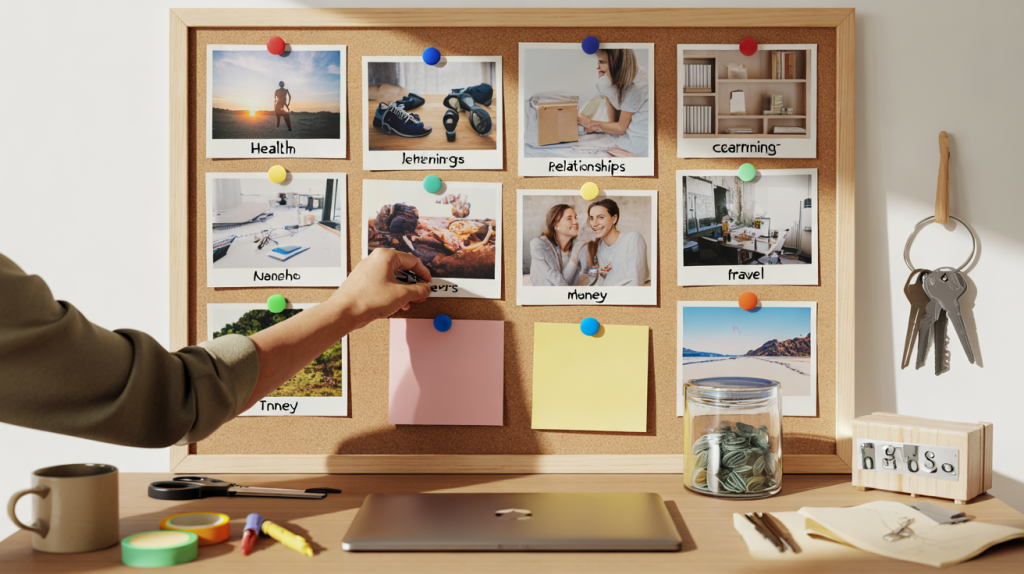
Build a vision board that actually drives results : science-backed tips, step-by-step setup, and daily rituals to keep goals front and center.
A good vision board does two jobs at once : it clarifies what matters and keeps those goals visible when motivation dips. Think of it as a daily nudge – a curated snapshot of the life you want, distilled into images, words, and micro-promises you can act on.
Here is the quick path : define 3 to 5 specific goals, gather images and words that match them, arrange everything on a board – physical or digital – then place it where your eyes land every day. Use tools many already have : a cork board, magazine cutouts, a printer, or a simple canvas in Canva, Pinterest, or Notion. Set it up in one focused hour, then return to it for 60 seconds a day.
How to make a vision board that actually works
Start with clarity. Vague dreams become concrete when written with numbers, dates, and boundaries. Turn “get fit” into “run a 10K by 30 June” or “strength train 3 times a week”. Now the board knows what to show.
Pick a format that fits your life. If you look at a home office wall daily, go physical. If your phone rules your routine, go digital and set it as a lock screen or widget. The best board is the one you actually see.
Build around themes, not clutter. Three to five goals keep the board focused. Group visuals by theme – career, health, relationships, money, learning. Leave white space so the eye can breathe. Crowding kills focus.
Why visualization helps : research and results
Written goals raise follow-through. A study led by Gail Matthews at Dominican University of California reported that people who wrote their goals were 42 percent more likely to achieve them compared with those who did not. Source : Dominican University of California.
Mental imagery adds another lift. A meta-analysis by Thomas Driskell, Carolyn Copper, and Aidan Moran found that mental practice improved performance with a medium effect size – about 0.48 on average across tasks. Source : Journal of Applied Psychology, 1994.
Blend both : write specific goals, then visualize daily scenes of doing the work – not just the finish line. The brain rehearses the steps, which makes action feel familiar, almost expected.
Step by step : build your vision board today
Step 1 : Set 3 to 5 goals for the next 6 to 12 months. Give each a number or date. Example : “Save 2,500 dollars by 15 December.”
Step 2 : Find visuals that show the process and the outcome. For the 10K, use a race bib, a sunrise run, and a weekly plan snapshot. Practical beats purely aesthetic.
Step 3 : Add words that cue action. Short verbs and identity phrases work : “Run at dawn”, “Writer at 7am”, “Call two clients”. Keep it punchy.
Step 4 : Arrange by zones. Top left for health, top right for career, bottom center for relationships – any layout you will remember. Use a seperate mini-board if one goal dominates.
Step 5 : Place it in your line of sight. Wall behind your screen, fridge door, phone lock screen. Tie it to routines you never skip, like coffee or commute.
Step 6 : Set a 60-second daily ritual. Look, breathe, then pick one tiny action that fits the board and your day. Send one email. Prep one meal. Read two pages. Small keeps you moving.
Want a quick checklist to fill the board with the right cues ?
- Images that show doing the habit, not only the result
- Numbers and dates tied to each goal
- Short action verbs and identity phrases
- One or two reminders of why it matters to you
- White space so the eye rests and the message pops
Keep it alive : daily rituals and common mistakes to avoid
Three traps show up often : too many goals, pretty collages with no actions, boards placed where you never look. If your board feels like decor, it will behave like decor.
Make it a system, not a poster. Pair the board with habit stacking : after coffee, review the board, then send one message tied to a goal. After lunch, scan it again, book one session, move on. The board cues the habit, the habit moves the goal.
Plan tiny updates. On the first Monday of each month, swap one image to reflect progress. Every 90 days, re-score each goal and refresh the board. The brain notices change – use that attention to rekindle drive.
Layer accountability without pressure. Share one snapshot of a goal section with a trusted friend and agree on a weekly check-in. Matthews’ research also found that regular updates increased success rates significantly, which aligns with what many coaches see in practice.
Digital users can add friction-reducers : place the board as the first phone screen, add a calendar link inside it, and attach one-click shortcuts to recurring tasks. Physical users can clip a pen and sticky notes to the frame for on-the-spot micro commitments.