
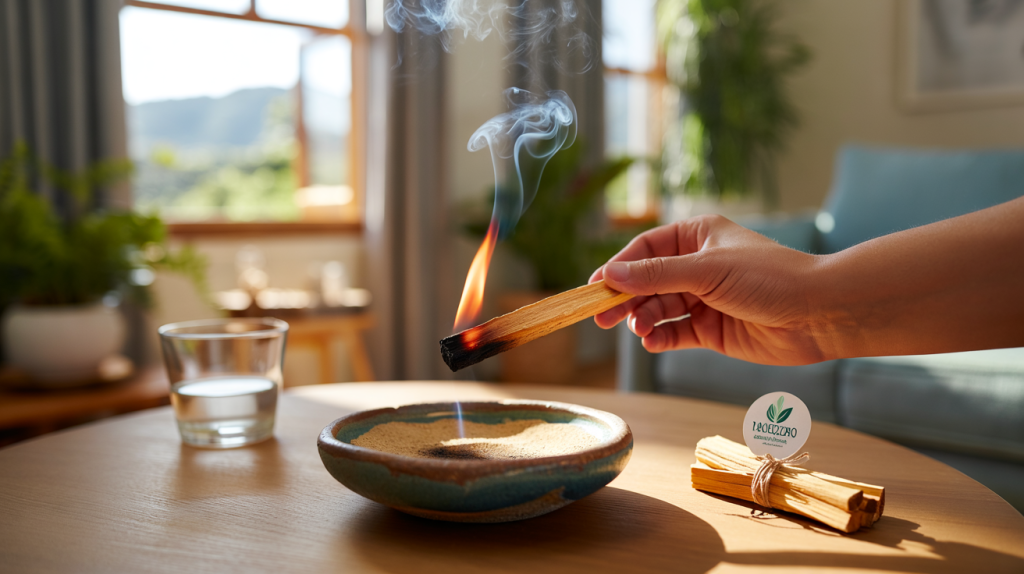
Looking for the right way to use palo santo without the fluff or the guilt. Open a window, hold the stick at a slight angle, light it for 20 to 30 seconds, blow out the flame, then let the aromatic smoke drift around the space or body for a minute or two. Park the stick on a fireproof dish, and end the ritual by pressing the ember into sand to fully extinguish. That is the simple, effective method people came for.
Context matters. Two different trees share the name “palo santo” : Bursera graveolens – the citrusy, resinous wood used in most smudge sticks from Ecuador and Peru – and Bulnesia sarmientoi from the Gran Chaco, which has been listed on CITES Appendix II since 2010 to regulate international trade (CITES 2010). Health also counts : smoke adds fine particles to indoor air, and the World Health Organization’s 2021 guideline sets the PM2.5 24‑hour average at 15 µg/m³, a level many homes exceed when anything smolders without ventilation (WHO 2021). So yes, the ritual can be mindful et clean when handled with care.
How to use palo santo : step by step, with intention and airflow
The aim is calm and clarity, not a room full of haze. A few simple moves turn a common mistake – too much smoke, no airflow – into a gentle, grounding practice. Short burn, slow movement, quick stop.
- Crack a window for cross‑ventilation. Place a ceramic or stone dish nearby.
- Hold the stick at 45 degrees. Light the tip for 20 to 30 seconds until it catches.
- Blow out the flame. You want a glowing ember, not fire.
- Set an intention in plain words. Then waft smoke around the room’s perimeter or around the body for 60 to 180 seconds.
- Rest the stick in the dish to smolder briefly, or tap the ember into sand to stop it.
- Never leave it unattended. Keep away from curtains, books, and anything dry.
Safety and health : ventilation first, open flame rules always
Incense, resins, candles – they all release fine particles. The WHO Global Air Quality Guidelines updated in 2021 recommend keeping daily PM2.5 exposure below 15 µg/m³ and the annual average below 5 µg/m³ (WHO 2021). That is why fresh air and short sessions matter. People with asthma, allergies, or migraines tend to react fast to smoke, so a non‑burn alternative often serves them better, like a diffuser or a room spray.
Fire risk is real in everyday settings. The National Fire Protection Association reports thousands of home fires tied to open flames from decorative use each year in the United States, with candle incidents alone leading to fatalities and property damage in recent datasets (NFPA). The fix is basic but effective : a stable, non‑flammable holder, a clear zone around the ember, and an adult in the room the entire time. Quick truth – a smudge should feel gentle, not dramatic.
Sourcing and sustainability : Bursera graveolens vs Bulnesia sarmientoi
The ethical question comes up fast : is palo santo endangered. Not all of it. The signature aromatic species for smudge sticks, Bursera graveolens, is assessed as “Least Concern” on the IUCN Red List as of 2019, though its dry forest habitat faces pressure from land conversion and grazing (IUCN 2019). Responsible producers in Ecuador and Peru typically work with naturally fallen branches and deadwood rather than cutting live trees, and that approach supports regeneration.
Confusion starts because another tree also carries the name “palo santo” in trade. Bulnesia sarmientoi from the Gran Chaco has been under CITES Appendix II since 2010, which means international trade requires permits to avoid over‑exploitation (CITES 2010). When buying, labels should name the species and the country of origin. If a seller cannot tell, that is a sign to pause. Certification or verified community projects add transparency, and local shops who know their supply can often trace how sticks were collected.
Respectful practice : alternatives, timing, and small rituals that work
Some days call for zero smoke. A few drops of palo santo essential oil in a diffuser changes the mood without combustion. Others swap to locally grown herbs, or use salt, sound, and a quick tidy to reset a room. The intention carries the ritual – the tool just supports it.
Timing helps. Short sessions before work, a reset after guests leave, or a mindful moment at dusk can shift the feel without overdoing it. People often expect a strong plume; in reality, less smoke means clearer air and a scent that lingers softly on textiles. Keep the stick dry between uses so it lights consistently, and do not relight over and over in one sitting. Spaces recieve calm when we stay practical about air and fire.
If the ritual is part of wellness, couple it with something measurable : two minutes of slow exhale breathing, one glass of water, a window cracked open until the room smells neutral again. That blend of tradition and simple health cues honors both the origin of the practice and the science that keeps homes safe.
Sources : CITES Appendices – Bulnesia sarmientoi listed in Appendix II since 2010. WHO Global Air Quality Guidelines 2021 – PM2.5 limits. IUCN Red List 2019 – Bursera graveolens status. NFPA reports on home fires involving open flame.