
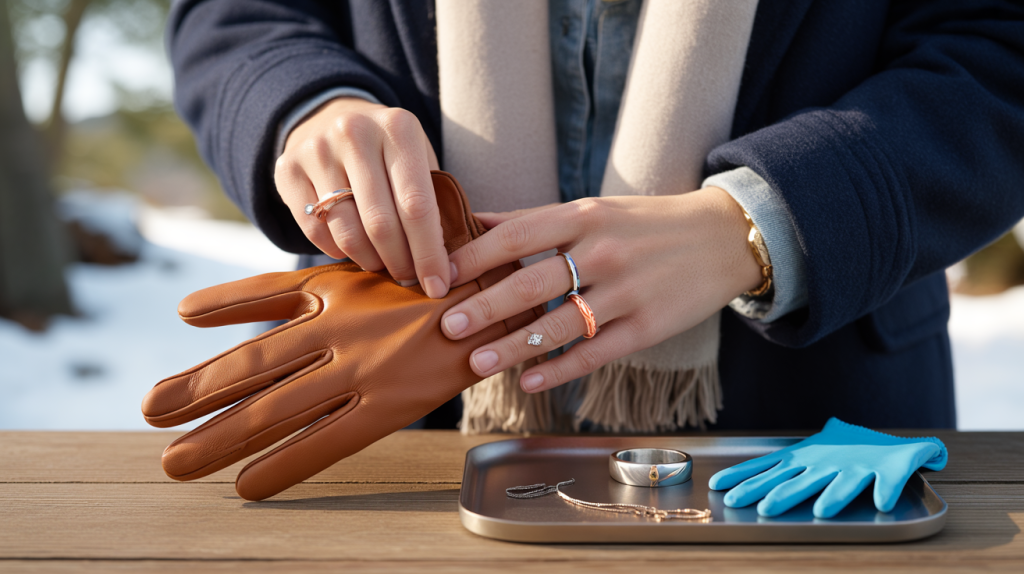
Cold morning, sleek gloves on, and that split-second doubt: can rings stay on without snags, stretched fingers, or scratched stones? Yes. The quick rule is simple : pick low-profile bands, avoid tall prongs, and pair the right ring with the right glove fabric. Do that, and both style and comfort make peace.
There is also a safety layer people skip. Thin knits forgive, latex and nitrile grip, and chunky settings scrape seams. For tight disposable gloves, experts advise removing metal rings or switching to a silicone band. That single choice protects the glove, your hands, and the ring. The rest comes down to fit, shape, and a smoother way to put gloves on and off.
Fit First : Wearing Rings with Gloves Without Snags
The main idea lands fast. Rings and gloves coexist when the ring sits low and smooth. Think flat wedding bands, rounded edges, bezel-set stones, and micro-pavé that does not protrude. Anything tall or clawed catches fabric. A taller setting also concentrates pressure at one point, which can stretch a glove finger and make it feel tight by the time the bus arrives.
Observation from everyday wear: leather and lined wool glide over polished bands, while ribbed knits and suede grab texture. If the glove fingertip looks strained once on, the ring is too bulky for that glove. Swap to a thinner band or size up the glove by one step for winter pairs. For disposable gloves, a metal ring under a tight fit often creates a weak spot that tears when you flex.
Problem that can be solved : wanting warmth, hygiene, and style at once. The quick workaround during commutes or in the office is a two-ring routine. Keep the statement piece on a chain under a coat, wear a slim band under gloves, and switch back when inside. Zero friction, no risk, same look once the gloves come off.
Materials That Play Nice : Metals, Stones, and Glove Fabrics
Here is where materials matter. Polished platinum, palladium, or tungsten with rounded edges glide best. Brushed finishes and micro-textures feel great to the touch but can fuzz a knit over time. Diamonds in a flush or bezel seat behave better than claw-set stones. Emeralds and opals are softer; they scratch if a zipper or leather seam presses hard in the cold.
Glove fabrics act differently. Cashmere blends and smooth leather move over rings with less friction. Ribbed wool, chenille, and suede cling. For touchscreen gloves, conductive threads near the index and thumb can tug on prongs. A bezel-set or low pavé avoids that. One small note for jewellry lovers in winter: condensation forms when going from cold to warm and back, so a snug band feels tighter at the café than on the street.
On the hygiene side, the World Health Organization’s 2009 “Guidelines on Hand Hygiene in Health Care” advise against rings under clinical gloves because rings harbor more microorganisms and stress the glove material. That logic scales to home cleaning or food prep too. When the task is wet or messy, switch to a smooth silicone band or remove the ring for the duration.
Techniques That Work : Put On, Take Off, and No-Snag Moves
Small changes in the sequence make a big difference. Dry hands. Align the ring so the smoothest edge faces the glove seam. Slide the glove on with a gentle twist instead of a straight push. When removing, pull from the cuff while keeping the ring finger straight, then pinch the fingertip to release fabric before the band drags.
For tight winter gloves, a thin silk or Merino liner reduces friction around a ring and adds warmth. With disposable gloves, a silicone ring or no ring at all beats a metal edge that could tear the material during a grip or twist. The American Society for Surgery of the Hand often cites ring avulsion injuries as rare but severe, widely recognized after Jimmy Fallon’s 2015 accident that required microsurgery. No style moment is worth that risk during high-force tasks.
If you want a checklist to keep things simple :
- Choose low-profile bands and bezel-set stones for glove days.
- Match fabric to finish : smooth leather with polished bands, avoid prongs with ribbed knits.
- Size winter gloves up once if the ring has any height.
- Use a silk or Merino liner to reduce friction and protect glove seams.
- Switch to a silicone ring for sports, cleaning, or disposable gloves.
- Store statement rings on a chain or in a zip pocket before tasks with force.
Safety and Hygiene Notes : CDC and WHO Guidance You Can Use
Latex allergies are not rare in some jobs. The CDC’s NIOSH notes that 8 to 12 percent of healthcare workers develop latex sensitivity. That is a strong reason to avoid latex gloves and to limit anything that stresses glove surfaces, like a metal ring ridge that can micro-tear material and expose skin. Source : CDC NIOSH, “Latex Allergy”, accessed 2023.
For disposable gloves of any material, healthcare guidance translates cleanly to daily life. WHO’s 2009 hand hygiene guidelines discourage rings under gloves because they increase bioburden on skin and raise the odds of glove damage during use. Source : WHO, “Guidelines on Hand Hygiene in Health Care”, 2009.
Logical wrap to make the routine complete : pair the day’s activity with the right ring. Desk and commute days welcome a flat band under leather gloves. Outdoor chores, gym, or food prep call for a silicone ring or no ring at all. Going out at night with a statement ring works smoothly if gloves are roomy, lined, and prong-free near fingertips. One calm choice per situation, and the look stays intact.