
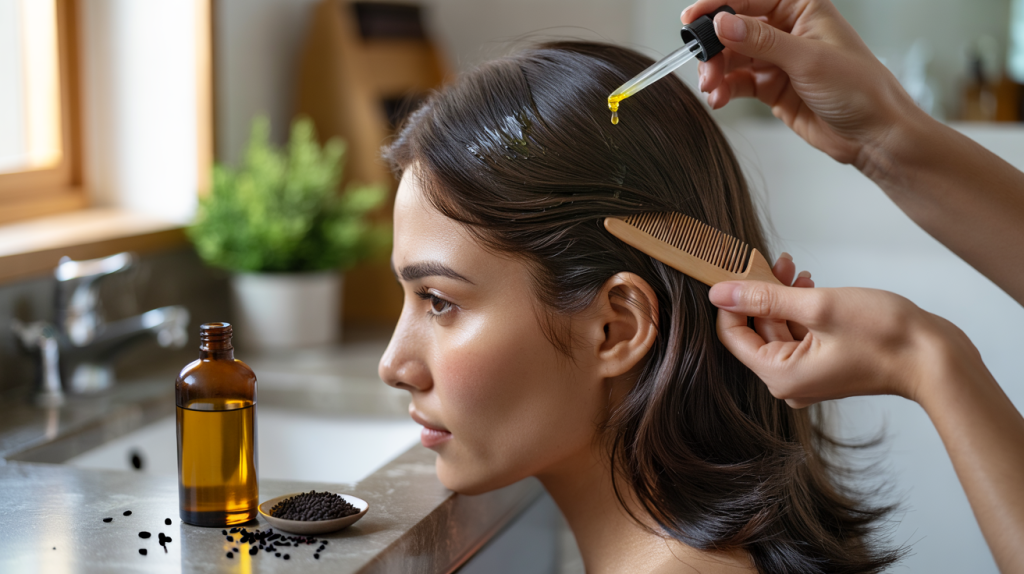
Curious about huile de cumin noir for hair? See real benefits, science-backed facts, and a simple routine to soothe the scalp et cut breakage fast.
Thinning edges, itchy flakes, dull lengths. When hair feels stressed, searches for “huile de cumin noir bienfaits cheveux” spike for a reason. Black seed oil, pressed from Nigella sativa, earns loyal fans because it helps calm the scalp, reduce breakage, and bring back slip and shine.
The core idea is simple. Rich in lightweight lipids et antioxidants, this oil supports the scalp barrier and coats the cuticle so hair breaks less during detangling. That is big when the American Academy of Dermatology Association reports we normally shed 50 to 100 hairs per day and hair grows only about 1.25 cm per month (AADA, 2022). Less breakage means strands look fuller even at the same growth rate. Expectations reset, stress down.
Huile de cumin noir benefits for hair growth et breakage: what changes first
First wins tend to be tactile. Less squeaky dryness after wash day. Combing feels smoother. Frizz softens without a heavy film. For many, scalp tightness and mild redness ease after a few massages because the oil helps seal in moisture on skin.
Growth claims get loud online, yet biology sets the tempo. With hair length increasing roughly half an inch per month (AADA, 2022), what black seed oil can realistically do is strenghten the strand, reduce mechanical loss, and create a calmer scalp environment for growth to stay on track. That is where it shines.
What science actually says: composition, scalp microbiome, antioxidants
Chemistry first. Black seed oil is dominated by essential fatty acids that the hair cuticle likes: linoleic acid around 50 to 60 %, oleic acid 20 to 25 %, and palmitic acid near 10 to 12 % (Journal of Ethnopharmacology, 2016). These lipids help improve slip and reduce friction – the small moments where breakage happens.
Scalp comfort matters because dandruff touches up to 50 % of adults at some point (Indian Journal of Dermatology, 2011), with Malassezia yeasts playing a role in flaking. Nigella sativa extracts show antimicrobial activity in vitro against several microbes including yeasts and bacteria (Frontiers in Microbiology, 2018; Saudi Journal of Biological Sciences, 2016). That does not make the oil an anti-dandruff drug, yet it helps explain why some users report a calmer scalp when they lock moisture in and reduce irritation triggers.
Then the antioxidant side. Thymoquinone, a key Nigella sativa constituent, has documented anti-inflammatory and antioxidant effects that modulate pathways like NF-kB (Frontiers in Pharmacology, 2017). Oxidative stress is linked to hair fiber weathering and scalp discomfort, so reinforcing that line of defense is relevant to daily care.
How to use huile de cumin noir on hair without grease: step-by-step
Light hands win. A little oil, applied right, beats a heavy coat every time.
- Do a patch test : apply a drop behind the ear for 24 to 48 hours to check reactivity.
- Scalp massage : 6 to 8 drops max on the scalp, 2 to 3 nights per week, massage 2 minutes to boost microcirculation.
- Lengths protection : warm 3 drops between palms, smooth over mid-lengths and ends before detangling.
- Blend smart : mix 1 part black seed oil with 1 part lighter oil like jojoba for a faster, non-greasy feel.
- Pre-shampoo mask : leave 20 to 30 minutes, then shampoo. Great for high-porosity curls.
- After-wash seal : on damp hair, one pump of leave-in, then 2 drops of oil to seal. Stop there.
- Quality check : look for cold-pressed, unrefined oil, stored in dark glass; keep it cool et capped.
Who should avoid it, what to pair with it, et when results show
Allergies come first. Anyone with a history of plant oil dermatitis should test carefully or consult a dermatologist. Skip use on broken or inflamed skin. During pregnancy or breastfeeding, topical cosmetic use is generally limited by sparse data – medical advice helps decide.
For those targeting density, keep perspective and build a simple stack. Combine black seed oil for scalp comfort with proven hair-care basics: a pH-balanced shampoo, a silicone-free conditioner for slip, and consistent detangling with tension control. For growth-focused routines, published evidence supports minoxidil as first-line. An RCT also found rosemary oil performed similarly to 2 % minoxidil at 6 months for androgenetic alopecia, with fewer reports of scalp itching (Panahi et al., Skinmed, 2015). That context helps place black seed oil as a supportive cosmetic, not a stand-alone regrowth therapy.
Timing matters. Changes most people notice first are easier detangling and less breakage within a few wash cycles. Scalp comfort often follows within 2 to 4 weeks of regular, light massages. Visible length gains respect the growth clock set by the AADA figures – give any routine at least 3 months before judging.