
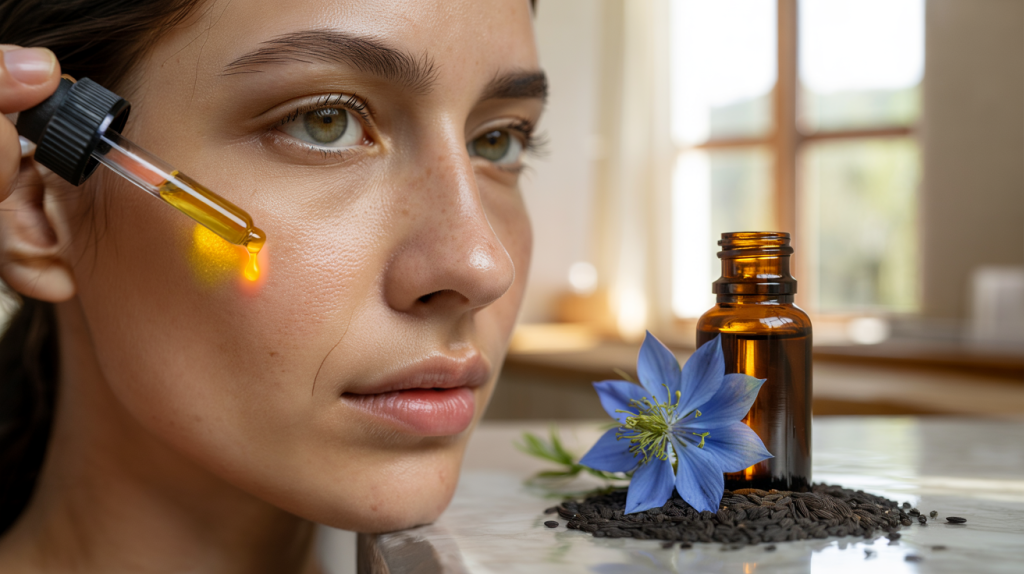
Black seed oil for face : fast facts that matter
Clicked for clear, calm skin with a natural oil. Good move. Huile de nigelle, also called black seed oil from Nigella sativa, brings antioxidant and soothing compounds that skincare fans keep raving about. Research has linked its star molecule thymoquinone to anti inflammatory and antimicrobial activity, two things skin with breakouts or redness really cares about.
Here is the useful context right away. The fixed oil is rich in fatty acids that support the skin barrier, while the volatile fraction holds thymoquinone. Food Chemistry reported in 2007 that black seed oil typically contains about 50 to 60 percent linoleic acid, 20 to 24 percent oleic acid, and around 12 to 14 percent palmitic acid (Cheikh‑Rouhou et al., 2007). A Phytotherapy Research review in 2003 noted that the volatile oil of Nigella sativa often ranges from 0.4 to 2.5 percent of the seed and that thymoquinone is a major component of that fraction (Ali and Blunden, 2003). That mix explains why faces prone to clogged pores, irritation, or a fragile barrier may respond well.
Huile de nigelle benefits for the face : what science actually supports
Main idea first. Linoleic acid helps replenish a compromised barrier, which can reduce transepidermal water loss and visible dryness. The high linoleic share reported in 2007 matches the needs of acne prone skin that often shows lower linoleic content in sebum compared with normal skin.
Now the practical question everyone asks. Does it help blemishes. Reviews have described antimicrobial activity of thymoquinone and Nigella sativa extracts against bacteria implicated in acne, alongside anti inflammatory effects that can calm red, tender spots. A 2003 Phytotherapy Research overview summarized these properties and highlighted thymoquinone as a key bioactive (Ali and Blunden, 2003). Dermatology reviews published since then have kept citing Nigella sativa among plant oils with potential benefits for irritated or acne prone skin.
Texture matters on the face. With roughly 50 to 60 percent linoleic acid and a lighter feel than many saturated oils, black seed oil tends to layer well under a moisturizer. Users often notice less tightness and a more even look after a few weeks, especially when routine and sun protection stay consistent. That everyday result is what creates the buzz.
How to use huile de nigelle on the face safely and without common mistakes
There is a simple problem to solve. Many start too fast with neat oil or mix it into actives on day one, then blame the ingredient if skin flares. A slow, patch tested approach reduces the risk of stinging or clogged pores.
Small but useful data points guide the routine. The 2007 fatty acid profile supports pairing black seed oil with a ceramide or glycerin moisturizer to lock in hydration. The 2003 review on thymoquinone backs its role in calming post breakout redness, especially when used after a gentle cleanser and before sunscreen during the day.
Try this streamlined method to get benefits without the fuss :
- Patch test on the jawline for 48 hours, then check for redness or bumps
- Start two or three nights a week with 1 to 2 drops on damp skin, after cleanser and before moisturizer
- Pair with niacinamide or panthenol on alternate nights, avoid layering directly with strong exfoliating acids
- Keep daytime use under sunscreen, as with any facial oil
- Stop and review if new cystic lesions appear or stinging persists beyond 20 minutes
Quality, risks, and who should skip it
Not all bottles deliver the same skin feel. Look for cold pressed, unrefined Nigella sativa seed oil with harvest year on the label and storage in dark glass. Oxidation changes scent and stability. Since the volatile fraction is small yet potent, sensitive skin can still react.
Safety notes help close the gaps. The Cosmetic Ingredient Review published a safety assessment of Nigella sativa derived cosmetic ingredients in 2021, concluding they are safe in current cosmetic uses when formulated to be non irritating. People with a history of fragrance allergies, active eczema flares, or broken skin should introduce slowly and consult a professional if symptoms occured.
There is one more piece to make the routine complete. Composition data from 2007 and the bioactive profile summarized in 2003 support a simple logic for the face : use huile de nigelle as a supporting player for barrier comfort and post blemish calm, not as a standalone cure. When combined with sunscreen and a gentle cleanser, the chances of a visible payoff rise steadily.
Sources : Ali B. H., Blunden G., Phytotherapy Research, 2003. Cheikh‑Rouhou S. et al., Food Chemistry, 2007. Cosmetic Ingredient Review, Safety Assessment of Nigella sativa derived Ingredients, 2021.