
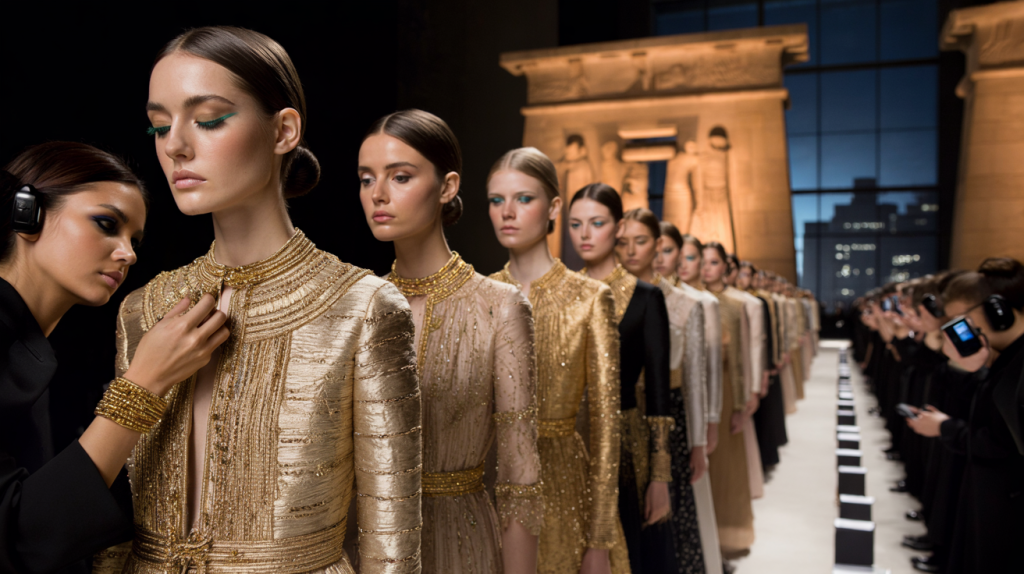
Step inside Chanel’s New York defilé: rare backstage access, timing, beauty moves, and why the Temple of Dendur show still shapes fashion’s playbook.
New York paused for Chanel at the Metropolitan Museum of Art, when the Métiers d’art 2018/19 collection unfolded beside the Temple of Dendur on 4 December 2018. Karl Lagerfeld orchestrated a glittering Egypt-meets-Manhattan moment, and yes, Pharrell Williams walked the runway in gold (Business of Fashion, 5 Dec 2018). For anyone typing “défilé Chanel New York coulisses”, the real story lives behind the curtains.
Backstage, the stakes were higher than a standard Fashion Week stop. The set occupied a gallery anchored by an ancient monument dated to 10 BCE, entrusted to the museum in 1967 and installed in 1978 (The Metropolitan Museum of Art). Vogue Runway’s report captured the energy on the floor that night, with Kaia Gerber among the cast and metallic textures catching every flash (Vogue Runway, 4 Dec 2018). What happened just out of frame is where the rhythm gets familar.
Inside Chanel backstage in New York : the pace, the craft, the space
The main idea is simple: a Chanel defilé breathes on precision. New York added another layer. Working next to the Temple of Dendur meant a choreography that respected the museum’s rules while keeping the show’s tempo alive. That tightrope walk defined the backstage: silent rushes, shoes lined like coordinates, garments zipped with a nod rather than a shout.
An observation heard often in the pit: models pivoted from fittings to final line-up in minutes, not hours, because Métiers d’art pieces carry exceptional embroidery and beading from specialist ateliers. Each look asked for careful handling before a single step met the runway. The museum’s climate and lighting also shaped hair and makeup choices, tuned to reflect stone, water and warm gold.
The solvable problem for viewers is clarity. Front-row photos flatten the magic. Backstage, stylists balanced weighty jewelry, seamstresses secured closures without crushing pleats, and coordinators timed exits to the second so the temple’s silhouette stayed clean for cameras. It reads calm on screen because the crew absorbed the storm.
Timelines, casting, beauty : what cameras miss at a Chanel show
Facts first. The venue was the Met’s Sackler Wing, home to the Temple of Dendur, a sandstone monument from the Roman period in Egypt, dating to 10 BCE (The Met). The museum logged a record 7.35 million visitors in fiscal year 2018, underscoring the cultural scale at play that season (The Met, 2018 attendance report). Chanel placed its Métiers d’art collection here for a reason: the house’s artisanship echoed the monument’s detail.
Casting blended icons and new faces. One headline moment came when Pharrell Williams stepped out in a gold mesh top and shorts – a look that ricocheted across social feeds within minutes (Business of Fashion). Vogue Runway’s coverage listed Kaia Gerber among runway names, with makeup keyed to luminous skin and kohl accents that nodded to the collection’s Egyptian thread (Vogue Runway).
For context, the brand’s muscle behind productions like this is documented. Chanel reported revenue of 11.12 billion dollars in 2018, up 10.5 percent at constant currency, reflecting the investment drive in shows and retail (Chanel Annual Results 2019). Those numbers explain the scale you do not see: lighting rigs engineered to protect art, dressers trained for high-jewelry closures, and security patterns that keep traffic flowing around priceless artifacts.
Missed details compound. Backstage teams often split looks into travel-safe components to accomodate tight turns near the water feature in the gallery, then reassemble at last call. Hair was secured to resist the gallery’s controlled humidity; makeup artists adjusted metallics so cameras read shine, not glare. The process looked effortless because hundreds of micro-decisions landed just right.
Want the backstage feel without a pass? Try this :
- Watch Chanel’s official Métiers d’art 2018/19 film on chanel.com, then replay with sound off to notice pacing and exits.
- Browse Vogue Runway’s New York gallery for close-ups that reveal stitching and beadwork direction.
- Scroll Sam McKnight and Lucia Pica’s archived posts from that week for hair and makeup callouts tied to the venue.
- Read Business of Fashion’s report for casting and industry context around the show’s strategy in New York.
- Open The Met’s Temple of Dendur page to map the set to the gallery’s layout and pool.
Why the New York defilé still matters in Chanel’s story
Here is the logic. Métiers d’art shows are designed to spotlight specialist ateliers, and New York’s Temple of Dendur amplified that point by setting intricate handwork against carved sandstone. When a modern collection stands alongside a monument dated to 10 BCE, every seam reads more clearly – a measured contrast that heightens craft without a word of explanation.
Since Karl Lagerfeld’s passing in February 2019 and Virginie Viard’s subsequent tenure, the brand has continued traveling collections to cities with strong cultural resonance. The New York chapter stays relevant because it perfected a formula: artisan detail, a venue with history, and casting that extends the conversation beyond fashion circles. That is why clips from this night resurface whenever runway staging enters the chat.
What is missing for many readers is a pathway to decode the quiet work behind the spectacle. Pair the official show video with museum notes and a credible runway gallery, then track how light, stone and water change each look’s read. That simple method turns any Chanel defilé – New York included – into a living masterclass in pace, proportion and place.