
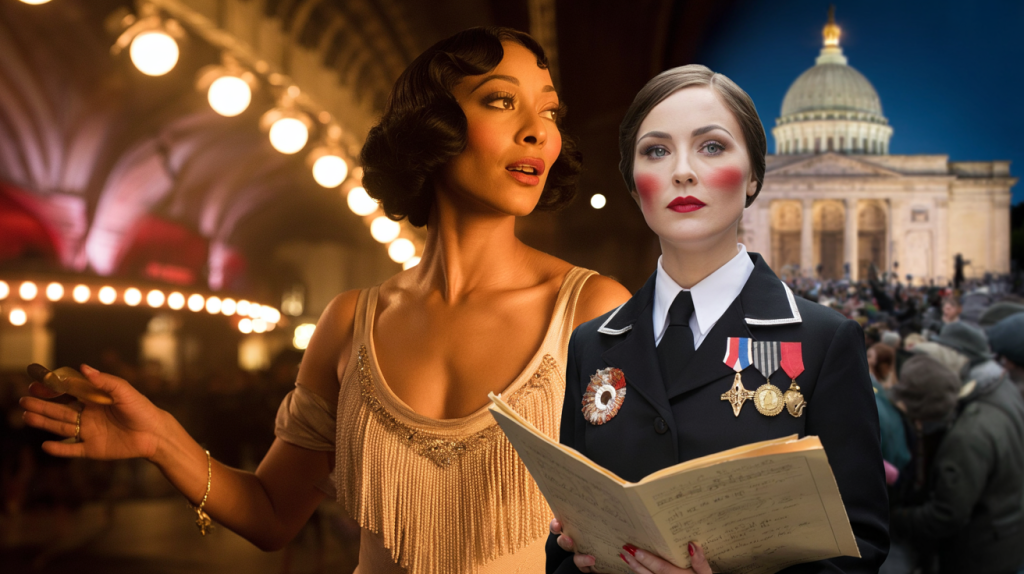
Few life stories beg for cinema like Joséphine Baker’s. Born in 1906 in St. Louis, crowned in Paris by 1925, war hero in the 1940s, voice at the March on Washington in 1963, and enshrined in France’s Panthéon in 2021, her journey fuses showbiz, espionage, and civil rights in one arc that still feels urgent.
That is why talk of a new Joséphine Baker biopic keeps bubbling up. The appetite is real : audiences want the thrill of the Folies Bergère, the coded wartime missions, and the woman who adopted 12 children to model a different world. The question hanging in the air is simple : how do you capture all that without flattening the truth.
Why a Joséphine Baker biopic is landing now
There is a clear pattern. The big screen keeps returning to complex icons, and Joséphine Baker sits at the crossroads of several timely beats : Black international stardom, migration, resistance, and allyship across borders. Her Panthéon induction on 30 November 2021, the first Black woman honored there, renewed global interest and gave producers a powerful final image.
Audiences already met a version of this story. HBO’s “The Josephine Baker Story” aired in 1991 and earned multiple Emmy Awards, introducing a generation to the artist behind the banana skirt. A modern biopic has new ground to cover, with access to archives about Resistance work and declassified anecdotes about how she smuggled notes in sheet music during World War II.
The core challenge is scope. Baker’s life stretches from segregated Missouri to Paris stages, from intelligence work to civil rights rallies. Compress too much, and the plot blurs. Focus too narrowly, and the legend turns familar but thin.
Joséphine Baker in facts : stage fire, wartime code, civil rights spine
The early rise is full of numbers and dates that anchor the myth. Baker arrived in Paris in 1925, exploded at the Folies Bergère with a high-energy Charleston, and became a sensation across Europe. Her silent film “Siren of the Tropics” premiered in 1927, proof that she was already crossing mediums.
Citizenship was not a footnote. After marrying Jean Lion in 1937, Baker became French, then risked everything for her adopted country during World War II. She gathered intelligence at embassy parties, ferried messages, and earned the Croix de guerre and the Medal of the Resistance with rosette. Charles de Gaulle awarded her the Légion d’honneur for that service.
The activist phase matters on screen. On 28 August 1963, wearing her Free French uniform, she addressed the crowd at the March on Washington, linking her European stature with the American fight for equality. Offstage, Baker adopted 12 children from around the world, a “Rainbow Tribe” that tested ideals inside a real home in the Dordogne.
Casting, music, and language : what the biopic must get right
Performance is the heartbeat here. Whoever steps into Baker’s spotlight needs controlled athleticism for the 1920s choreography, a jazz and music-hall ear for phrasing, and comic timing that can pivot into drama in a breath. That is the on-screen electricity audiences expect from the Folies sequences.
Language choices will steer credibility. Baker sang in French and English, and moved between both cultures. The film’s language mix should echo that reality, not erase it. And the accent journey matters : St. Louis roots, coupled with a later Parisian cadence, is a real arc.
Music rights can make or break authenticity. Her 1931 hit “J’ai deux amours” is not just a soundtrack cue, it is character. Use it at the right moment and the film explains the woman’s split identity without a wordy monologue.
Release questions : timeline, platforms, and what to watch next
Viewers search for three things first : release window, lead actor, and where to watch. Until an official announcement names a star and distributor, the smartest move is to track reliable markers : production listings, union filings, and music-rights clearances. Those usually surface before a trailer does.
Dates in Baker’s life offer a natural structure that a film can follow without distortion. The Paris breakthrough in 1925, the 1937 naturalization, wartime missions in the early 1940s, the 1963 speech in Washington, and the last comeback show in Paris in April 1975, days before her death at 68. The story already has turning points that play like cinema.
What often goes missing is the middle layer between triumphs. The quiet travel, the paperwork of war work, the domestic stresses of raising 12 children. A strong biopic will let those details breathe, then connect them to the public milestones. That is where the human being appears, and where modern audiences decide whether a legend still speaks to them.
Key checkpoints a Joséphine Baker biopic should cover :
- 1906 : birth in St. Louis and early touring years in segregated America
- 1925 : Paris debut and Folies Bergère breakthrough
- 1937 : French citizenship through marriage to Jean Lion
- 1940s : intelligence missions, Croix de guerre, Medal of the Resistance with rosette
- 1963 : speech at the March on Washington in Free French uniform
- 2021 : Panthéon induction in Paris, first Black woman honored there
So, what should readers expect next. If a project leans musical, watch for a choreographer attached early and a music supervisor with 1920s to 1960s credits. If it leans espionage, expect consultants from archives and on-screen text that uses precise dates and locations. Either way, the path to a release becomes visible long before the poster drops.